Artificial Intelligence & American Copyright Law: Analyzing the Copyright Office’s AI Report

Copyright Office’s AI Report: The Good, The Bad, and The Controversial

The Copyright Office just dropped Part 3 of its AI report, which aimed at addressing certain copyright law in regards to Artificial Intelligence. The thing that’s got everyone talking is the fact that the report was supposed to tackle infringement issues head on, but instead teased us by saying that answer will come up in “Part 4” that is expected to be released at a later date. Let’s dive into what was actually discussed.

Legal Theory: A Case by Case Basis

The report’s central thesis is a pretty straightforward legal theory. Basically, they recommend that there will be no blanket rule on whether training AI on copyrighted content constitutes infringement or fair use. Everything gets the case by case treatment, which is both realistic and frustrating depending on where you sit. That’s because most lawyers like clear bright line rules backed up by years of precedent, but when attempting to make legal frameworks regarding emerging technologies, the brightline approach is easier said than done.

The report acknowledges that scraping content for training data is different from generating outputs, and those are different from outputs that get used commercially. Each stage implicates different exclusive rights, and each deserves separate analysis. So in essence, what’s  actually useful here is the recognition that AI development involves multiple stages, each with its’ unique copyright implications.

This multi stage approach makes sense, but it also means more complexity for everyone involved. Tech companies can’t just assume that fair use covers everything they’re doing and content creators can’t assume it covers nothing. The devil is in the details.

Transformative Use Gets Complicated

The report reaffirms that various uses of copyrighted works in AI training are “likely to be transformative,” but then immediately complicates things by noting that transformative doesn’t automatically mean fair. The fairness analysis depends on what works were used, where they came from, what purpose they served, and what controls exist on outputs.

This nuanced approach is probably correct legally, but it’s also a nightmare for anyone trying to build AI systems at scale. You can’t just slap a “transformative use” label on everything and call it a day. The source of the material matters, and whether the content was pirated or legally obtained can factor into the analysis. So clearly purpose also matters since commercial use and research use will likely yield different results in the copyright realm. Control and mitigation matter in this context because developing the necessary guardrails is paramount to preventing direct copying or market substitution.

Nothing too revolutionary here, but the emphasis on these factors signals that the Copyright Office is taking a more sophisticated approach than some of the more simplistic takes we’ve seen from various opinions on this matter. This should be reassuring since a one size fits all approach at such an early stage of developing AI could stifle innovation. However if things are left to be too uncontrolled copyrighted works may face infringements to their copyright.

The Fourth Factor Controversy

Here’s where things get interesting and controversial. The report takes an expansive view of the fourth fair use factor: which is the effect on the potential market for the copyrighted work. That is because too many copyrighted works flooding the market brings fears of market dilution, lost licensing opportunities, and broader economic impacts.

The Office’s position is that the statute covers any “effect” on the potential market, which is broad interpretation. But that broad interpretation has a reason, they are worried about the “speed and scale” at which AI systems can generate content, creating what they see as a “serious risk of diluting markets” for similar works. Imagine an artist creates a new masterpiece only to get it copied by an AI model which makes the piece easily recreatble by anyone, diluting the value of the original masterpiece. These types of things are happening on the market today.

This gets particularly thorny when it comes to style. The report acknowledges that copyright doesn’t protect style per se, but then argues that AI models generating “material stylistically similar to works in their training data” could still cause market harm. That’s a fascinating tension, you can’t copyright a style but you might be able to claim market harm from AI systems that replicate it too effectively. It is going to be interesting to see how a court applies these rules in the coming future.

This interpretation could be a game-changer, and not necessarily in a good way for AI developers. If every stylistic similarity becomes a potential market harm argument, the fair use analysis becomes much more restrictive than many in the tech industry have been assuming.

The Guardrails

One of the more practical takeaways from the report is its emphasis on “guardrails” as a way to reduce infringement risk. The message is clear: if you’re building AI systems, you better have robust controls in place to prevent direct copying, attribution failures, and market substitution.

This is where the rubber meets the road for AI companies. Technical safeguards, content filtering, attribution systems, and output controls aren’t just up to the discretion of the engineers anymore they’re becoming essential elements of any defensible fair use argument.

The report doesn’t specify exactly what guardrails are sufficient, which leaves everyone guessing. But the implication is clear: the more you can show you’re taking steps to prevent harmful outputs, the stronger your fair use position becomes. So theoretically if a model has enough guardrails they may be able to mitigate their damages if the model happens to accidently output copyrighted works.

RAG Gets Attention

The report also dives into Retrieval Augmented Generation (RAG), which is significant because RAG systems work differently from traditional training approaches. Instead of baking copyrighted content into model weights, RAG systems retrieve and reference content dynamically.

This creates different copyright implications: potentially more like traditional quotation and citation than wholesale copying. But it also creates new challenges around attribution, licensing, and fair use analysis. The report doesn’t resolve these issues, but it signals that the Copyright Office is paying attention to the technical details that matter.

Licensing

The report endorses voluntary licensing and extended collective licensing as potential solutions, while rejecting compulsory licensing schemes or new legislation “for now.” This is probably the most politically palatable position, but it doesn’t solve the practical problems.

Voluntary licensing sounds great in theory, but the transaction costs are enormous when you’re dealing with millions of works from thousands of rights holders. Extended collective licensing might work for some use cases, but it requires coordination that doesn’t currently exist in most creative industries.

The “for now” qualifier is doing a lot of work here. It suggests that if voluntary solutions don’t emerge, more aggressive interventions might be on the table later.

The Real Stakes

What makes this report particularly significant isn’t just what it says, but what it signals about the broader policy direction. The Copyright Office is clearly trying to thread the needle between protecting creators and enabling innovation, but the emphasis on expansive market harm analysis tilts toward the protection side.

For AI companies, this report is a warning shot. The days of assuming that everything falls under fair use are over. The need for licensing, guardrails, and careful legal analysis is becoming unavoidable.

For content creators, it’s a mixed bag. The report takes their concerns seriously and provides some theoretical protection, but it doesn’t offer the clear-cut prohibitions that some have been seeking.

The real test will come in the courts, where these theoretical frameworks meet practical disputes. But this report will likely influence how those cases get decided, making it required reading for anyone in the AI space.

As we can see AI and copyright law is becoming only more and more complex. The simple answers that everyone wants don’t exist, and this report makes that abundantly clear. The question now is whether the industry can adapt to this new reality or whether we’re heading for a collision that nobody really wants.
An American Sovereign Wealth Fund: The Key to American Prosperity?

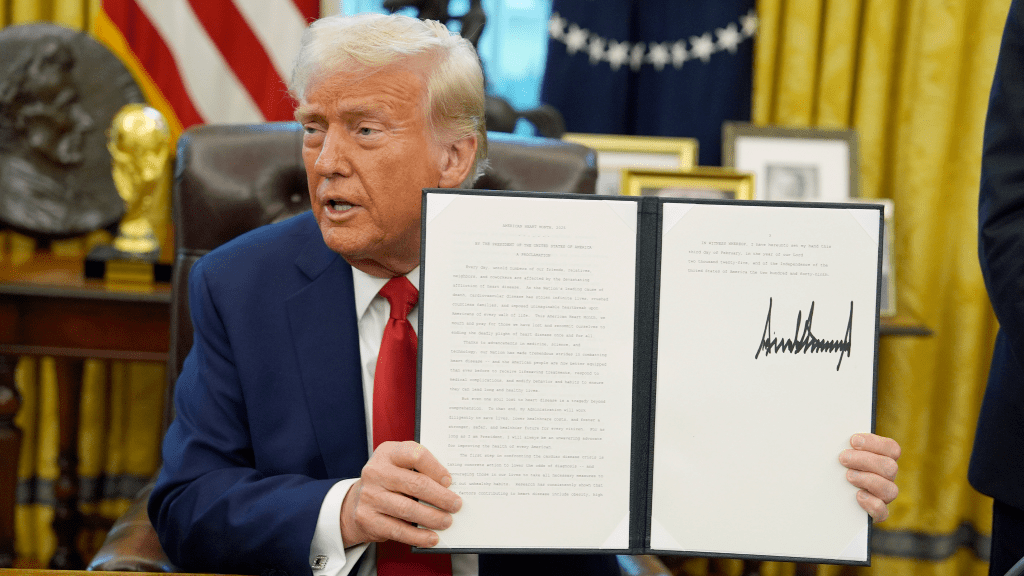
President Donald Trump has officially signed into law the creation of a U.S. sovereign wealth fund. This is one of the few of his controversial executive orders that have been signed that may have a bit of merit when it comes to addressing the affordability crisis the United States is facing.

A sovereign wealth fund is a government investment fund that pools and manages a nation’s revenues, often derived from natural resources, trade surpluses, or foreign exchange reserves, to generate long term wealth and stabilize the economy. Several economic powerhouses have a wealth fund: Norway,  Singapore, Saudi Arabia, and the United Arab Emirates (Dubai Fund) have used SWFs to diversify their economies, invest in global assets, and provide financial security for the youth. These funds have enabled these nations to achieve high levels of economic stability, global influence, & sustained growth, even during periods of global economic uncertainty, all while empowering their citizenry.

Trump signing the Executive Order 2/3/2023

The fund with the most long term exposure and demonstrated long term practical excellence is Singapore’s Central Provident Fund.

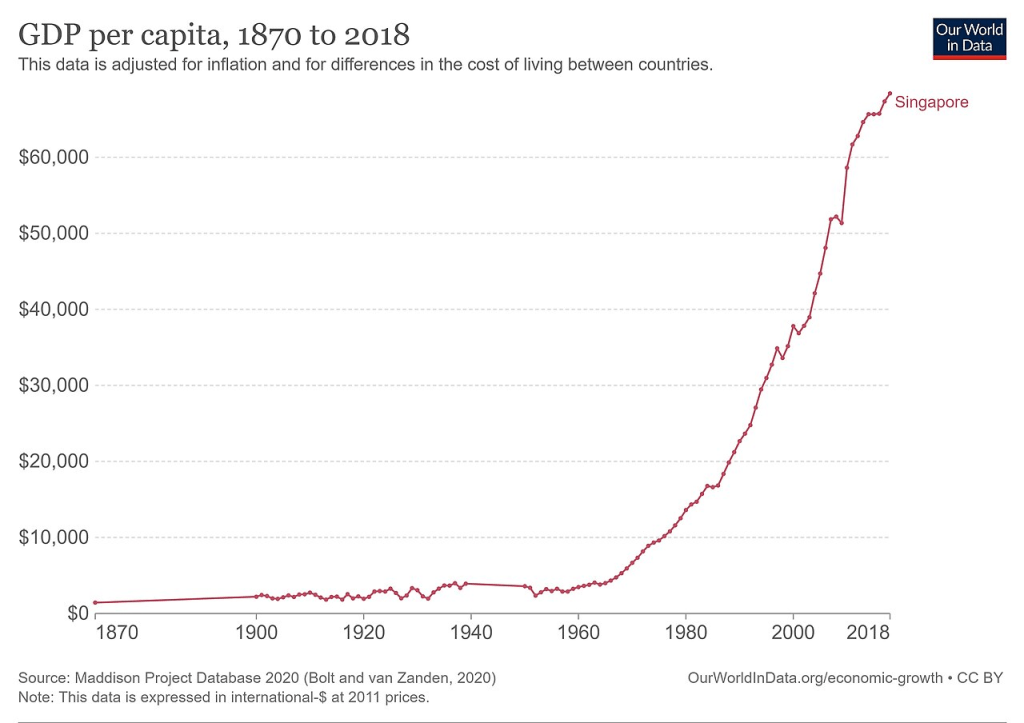
Singapore’s Central Provident Fund (CPF) offers a noteworthy model for the US. In the 1960s, Singapore faced significant economic challenges that necessitated comprehensive reforms. When Singapore became independent the nation faced significant economic challenges. Over 70% of households lived in overcrowded conditions, with a third residing in shanty towns on the city’s outskirts, and more than half of the population was illiterate. The situation was further exacerbated by a heavy influx of immigrants prior to Singapore’s expulsion from the Malaysian political union, leading to an unemployment rate of approximately 15-20%. (Asian Development Bank).

Fast forward 50 years, and Singapore’s transformation is remarkable. The literacy rate has soared to 97.65% as of 2021. The nation consistently ranks at the top globally in educational assessments for math, science, and reading. Unemployment has plummeted to around 2%, significantly lower than the global average of approximately 6%. Additionally, about 90.7% of Singaporeans are homeowners, a stark contrast to the United States, where the homeownership rate is at approximately 50%. This extraordinary progress can be largely attributed to the determination and hard work of Singapore’s populace,  as well as the Central Provident Fund. (Asian Development Bank).

The Central Provident Fund

Singapore’s exponential growth after establishment of CPF

Prime Minister Lee Kuan Yew recognized the potential of the existing Central Provident Fund (CPF), established in 1955 during British colonial rule, as a tool to address economic challenges. The Fund was originally designed as a compulsory savings scheme for retirement, the CPF required contributions from both employers and employees. Unlike traditional social security systems funded by taxes, the CPF allowed individuals to own and control their savings, providing flexibility in how funds were utilized. This structure enabled citizens to manage their accounts while also engaging with private banking institutions.

In 1968, the government expanded the CPF’s scope to include housing, permitting withdrawals for the purchase of government flats. This policy not only addressed housing shortages but also fostered social stability and economic growth. Over time, the CPF’s functions further extended to cover healthcare and education, ensuring that citizens’ basic needs were met and allowing them to focus on personal development and community engagement. These strategic expansions of the CPF were instrumental in transforming Singapore’s economy and enhancing the well-being of its population (Asian Development Bank, n.d.).

After the CPF expanded its focus to housing, enabling citizens to use their savings to purchase government built housing units the homeownership rate is now up to 90% in Singapore. For the U.S., a sovereign wealth fund could potentially support housing initiatives, allowing Americans to leverage tax advantaged savings for home purchases, thereby fostering ownership and equity building. (International Monetary Fund).

Beyond housing, the CPF encompasses healthcare and education, allowing citizens to allocate savings toward medical insurance and lifelong learning. This approach reduces financial burdens and enhances productivity by alleviating concerns over essential services. A U.S. sovereign wealth fund could adopt similar strategies, offering dedicated accounts for healthcare and education expenses, possibly with employer matched contributions to accelerate wealth accumulation. (International Monetary Fund).

Implementing such a system in the U.S. presents significant challenges and hurdles . Political resistance to state managed savings programs and the complexities of federalism could impede adoption. Additionally, effective management is crucial to prevent issues like corruption or market volatility. Nevertheless, the potential benefits such as; reduced wealth inequality, increased productivity, and a buffer against economic downturns- are alluring. (PricewaterhouseCoopers).

While the executive order establishing a U.S. sovereign wealth fund is still in its early stages, Singapore’s CPF demonstrates that integrating state oversight with individual agency can transform citizens into stakeholders. For modern Americans burdened by housing costs, medical debt, and student loans, a similar fund could offer substantial relief and innovate on America’s financial institutions in a positive way.

Richard E. Carroll explores the potential for sovereign wealth funds at both the state and federal levels in the United States as a solution to financial challenges. At the state level, 20 U.S. states have established SWFs to manage natural resource revenues and benefit their citizens. For example the Alaska Permanent Fund, established in 1976, is the most well known, currently valued at over $5 billion. Many Alaskans get dividends from this fund, giving them expendable income for education or subsistence needs. New Mexico has done something similar, reducing the tax burden of the average citizen by about $1,000. I for one am a firm advocate for a SWF.

The Fund could be used to invest in infrastructure projects, such as roads, bridges, renewable energy, and broadband, creating jobs and stimulating economic growth. However, generally Americans are skeptical of government run programs, particularly those involving personal savings and investments. Therefore, building public trust would be essential for the fund’s success, perhaps including an opt out for citizens would be beneficial, but after their decision to opt out they should not be eligible to receive any benefits from the program- which is within their right. However, if the fund is managed properly, a steady stream of income from the SWF, the federal government could reduce income, corporate, or sales taxes, which could in theory put money back into the pockets of citizens and businesses. In essence America would be paying you for contributing positively to the American economy.

Having outlined all of that, the key question is whether the U.S. can adapt this model at the Federal level complicated by its diverse landscape. Time will tell.

Sources:

______________________________________________

  • International Monetary Fund. (2020). Sovereign wealth funds and public savings: Lessons from global models.  

Why’s America Sleeping? A Discussion Regarding The United Healthcare CEO’s Assassination.

“It takes violent shocks to change an entire nations psychology.”

– John F. Kennedy

This quote written in John F. Kennedy’s Magnum Opus ‘Why England Slept’ encapsulates the current collective psychology of the United States after the tragic assassination of Brian Thompson. Some people celebrated the CEO’s death, a symbol of the frustration many Americans have been feeling regarding the nation’s healthcare system. Critiques of the healthcare system are definitely warranted, and Luigi Manginoni’s tragic act has once again put the nations healthcare debate at the forefront a public discourse.  

President Kennedy’s quote is correct, often violent acts can change an entire nations collective psychology, there are plenty of examples in history that agree with that proposition. However, people are wrong assuming that the assassination will trigger meaningful change due to the fear healthcare insurance executives may feel after the assassination of Brian Thompson. People’s idealism can cloud the reality on how institutions operate in the real world. History has proven powerful players rarely relinquish control freely. The healthcare industry could hypothetically double down and refuse to budge, further entrenching an “us vs. them” mentality that pervades many contemporary national debates. Though, admittedly, the act could hypothetically result in meaningful change in the healthcare industry- but not in the way people celebrating the death would imagine. A good case study as to why that is the case would be the Ludlow Massacre.

On April 20, 1914, in Ludlow, Colorado, striking coal miners demanded better pay, safer working conditions, and the right to unionize ( more info on Ludlow here). The strikers were attacked by the Colorado National Guard and company-hired guards, killing the protestors and some of their family members. The Ludlow Massacre lead to the Colorado Coalfield War, where workers formed a militia and started attacking Colorado National Guardsmen and private law enforcement . The workers successfully attacked many of their oppositions positions and had a lower casualty count but when the dust settled the strikers’ demands were not met, the union did not obtain recognition and many striking workers were replaced. Further 408 strikers were arrested, 332 of them were indicted for murder. The institution decided to double down on the crackdowns resulting in none of the strikers work demands being met.

Though the workers themselves did not reach their goals, the tragedy of Ludlow spurred a greater national debate on workers rights in the United States. Slowly the grievances raised by the Ludlow massacre lead to the enactment of federal labor laws that we still use today. American society should turn this tragedy into a positive and reinvigorate the discussion and action that will lead to fundamental changes in the healthcare industry. The Ludlow Massacre forced the nation to confront workers’ rights, and similarly the tragic assassination of Brian Thompson could prompt similar discussions about the systemic failures in healthcare. However, history shows that institutional change is slow and often requires sustained public pressure. Hopefully, this time around the change will come sooner, if not there are indications that matters may get worse rather than better.  Analyzing the economic incentives causing this turmoil will illuminate the problem areas in the sector and hopefully lead to some practical solutions.

Economic Moral Hazards

The problem with the healthcare sector is that it produces bad economic incentives. 1 Often healthy economic incentives encourage behavior that benefits both individuals and society, they are aimed at promoting positive economic action while discouraging negative consequence such as waste or harm. For example good economic incentives would be efficiency standards for cars, they incentivize manufacturers to produce efficient automobiles by offering various government benefits. For example, car companies may get tax breaks,  recognition for meeting higher energy efficiency standards, or might get access to lucrative government contracts. This makes energy utilization effective, lowers bills for consumers, and helps reduce environmental impacts by using wasteful technology.

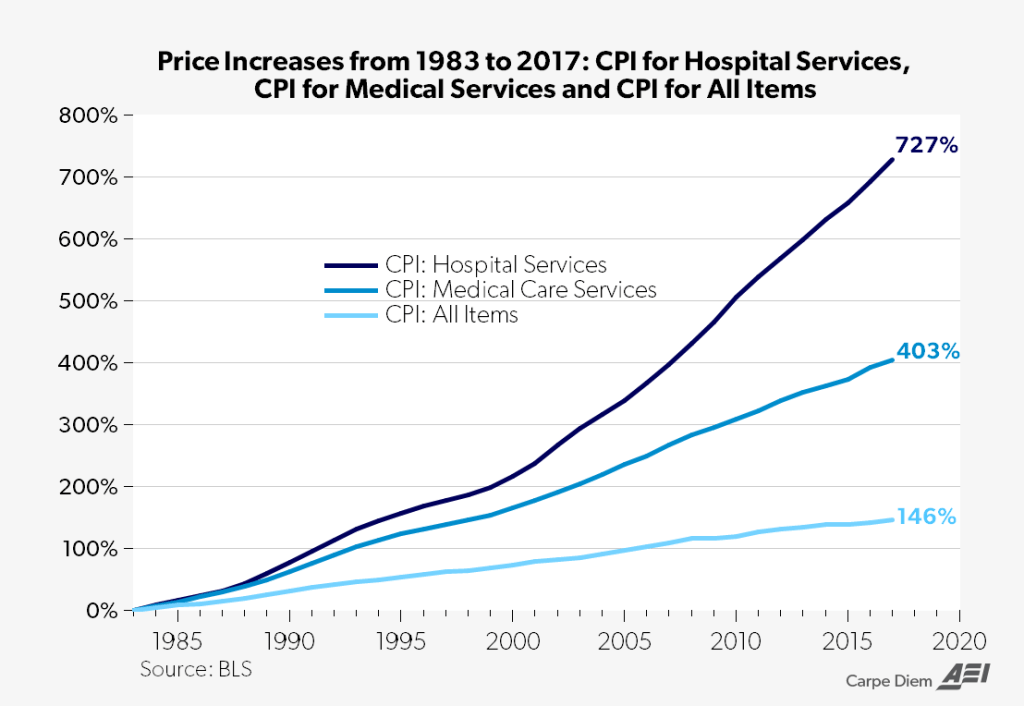
The healthcare industry seems to be running in the opposite direction regarding incentives. Large hospitals commonly increase prices for services and lab technology, knowing that insurers and government programs will foot the bill one way or the other. 2  A big reason hospitals can do this is due to lack of competition within the sector. 3 On average Americans have access to only a few healthcare providers, which incentives monopolistic practices such as price gouging. 4  These practices shift the financial burden onto patients, insurers, and taxpayers, exacerbating the system’s inefficiencies.  Insurance companies also contribute to producing bad economic incentives but in a different way.

Source: American Enterprise Institute

Health care Insurers also contribute to overall inflated healthcare prices. That’s because insurance companies have few incentives to negotiate for better rates or challenge the high prices set by hospitals.  They are well aware that they can pass those costs onto consumers in the form of higher premiums or deductibles in order to fulfill their fiduciary duty to their shareholders. 5 By passing those costs on to their consumers they ensure their shareholders are maximizing profits effectively fulfilling their duty. This leads to a disconnect between the price of healthcare and the actual cost to consumers leading to the  inflated cost of healthcare of the healthcare system.

Additionally, some companies during economic downturns might only focus on the volume of services provided, rather than the quality or necessity of those services. This may encourage doctors to prescribe unnecessary treatments overuse of healthcare and can result in unnecessary tests or procedures, which drive up the overall healthcare costs. If you are fully covered getting extensive tests is beneficial for your health but unnecessary care drives up the price for people who do not have adequate coverage. That is because higher utilization of healthcare services- necessary or not artificially inflates demand, which providers often use to justify price increases. Most insurance companies operate within fee-for-service payment systems, where providers are reimbursed based on the volume of services delivered rather than the value or outcomes. This further incentivizes unnecessary treatments, tests, and procedures, as healthcare providers have a financial interest in maximizing billable services

Further, the administrative complexity of health insurance also adds significant costs to the healthcare system. Insurers maintain vast bureaucracies to process claims, determine coverage, and manage provider networks, which requires substantial resources. Anecdotally, after spending some time in the insurance sector, a lot of the administrative tasks incentivize an incredible amount of waste.  These costs are ultimately passed on to consumers. For example, administrative expenses in the U.S. healthcare system account for nearly 8% of total spending, compared to 2-3% in countries with simpler, more centralized systems. 6

Action is Necessary

The tragic events surrounding Brian Thompson’s assassination have understandably stirred intense emotions and reignited a national conversation about the flaws in our healthcare system. While these tragedies can bring the issue to the forefront, history shows us that meaningful change doesn’t come from fleeting moments of outrage. The shockwaves from Thompson’s death can grab attention temporarily, but true change only happens when we confront the deeper economic incentives that drive the inefficiencies and inequalities in healthcare.

Reform, as we’ve seen in the past, is rarely quick or easy. It faces resistance from entrenched interests that benefit from the status quo. But the time to act is now. The monopolistic pricing, the disconnect between what healthcare actually costs and what patients pay, and the lack of meaningful negotiation from insurers- all of these must be tackled with urgency. It’s time to rethink the economic incentives behind the healthcare system and shift the focus toward transparency, competition, and patient-centered care. The current model is unsustainable, and the responsibility for change lies with all of us; policymakers, healthcare providers, insurers, and the public.

Let us use this tragedy not as a fleeting moment of anger but as a rallying point to demand systemic reform. By ensuring that economic incentives align with the well-being of patients and the long-term sustainability of the system, we can move toward a healthcare system that serves the needs of every American, not just the powerful few. Now is the time for thoughtful, deliberate action to reform the healthcare system in a way that reflects the values of justice, fairness, and efficiency for all.

“The time to repair the roof is when the sun is shining.”

-John F. Kennedy

Right now, I’m sad to say, it seems like we’re attempting to repair a roof in the middle of a tornado. Urgent action is needed.


Sources

  1. According to the Journal of the American Medical Association (JAMA), the U.S. healthcare system is plagued by administrative inefficiencies, price inflation, and overuse of medical services, which are driven by poorly aligned incentives among providers, insurers, and payers.

    Source: JAMA. “Waste in the US Health Care System: Estimated Costs and Potential for Savings.” (2019). ↩︎
  2. Research from the RAND Corporation indicates that hospitals charge private insurers an average of 247% of Medicare rates for the same services. This price disparity exists because private insurers lack the bargaining power to negotiate rates effectively, and hospitals rely on these inflated payments to subsidize their operations.

    Source: RAND Corporation. “Prices Paid to Hospitals by Private Health Plans Are High Relative to Medicare and Vary Widely.” (2020).. ↩︎
  3. Research shows that hospital consolidation reduces competition and leads to higher prices. A study by the National Bureau of Economic Research (NBER) found that hospital mergers result in price increases of 6% to 18%, depending on the level of market concentration.

    Source: NBER. “The Price Effects of Cross-Market Hospital Mergers.” (2018).
     The Health Care Cost Institute (HCCI) reports that the average price for hospital services is significantly higher in concentrated markets than in competitive ones.

    Source: HCCI. “Healthy Marketplace Index.” (2020). ↩︎
  4. The American Medical Association (AMA) found that in 2019, 90% of metropolitan areas in the U.S. were highly concentrated for hospital markets, meaning patients had limited choices among providers. This is also the case in more rural areas as well.

    Source: AMA. “Competition in Health Insurance: A Comprehensive Study of U.S. Markets.” (2019). ↩︎
  5. Premiums and deductibles for employer-sponsored health insurance have been steadily rising, with average family premiums increasing by 55% over the past decade. Insurers often attribute this to rising healthcare costs from hospitals and providers.

    Source: KFF. “2022 Employer Health Benefits Survey.” ↩︎
  6. The Study highlights the disproportionately high administrative costs in the U.S. healthcare system compared to other high-income nations with centralized systems, where administrative spending ranges between 2-3% of total healthcare expenditures             

       Source: Woolhandler, S., & Himmelstein, D. U. “Administrative Work Consumes One-Quarter of U.S. Physicians’ Working Hours and Lowers Their Career Satisfaction.” Health Affairs, 2014. ↩︎

Arbitration: A Key Piece To Africa’s Future Economic Success

This article is an excerpt of a larger working paper aimed at policy makers, economists, and investors. This article was aimed to be shorter and less technical than the larger paper.

International commercial arbitration has been touted by many members of the business community and legal profession as a suitable means of settling trade disputes outside of a formal court room. The reasons a person would want to choose to arbitrate a commercial dispute could range from the rapidness of arbitral proceedings in comparison to domestic courts to the ability to keep proceedings confidential. But the benefits of commercial arbitration are not strictly limited to the parties involved in the arbitrational proceedings. There have been numerous studies outlining how commercial arbitration also facilitates economic growth and social well being within nations. The United Nations has acknowledged the many benefits of commercial arbitration fact and has incentivized the use of arbitral institutions. No other continent can benefit more from arbitration than Africa.

The UN has facilitated arbitration by incentivizing a multilateral treaty regime for international commercial transactions. One of the main treaties that attempted to incentivize arbitral proceedings is formally known as United Nations Convention on the Recognition and Enforcement of Foreign Arbitral Awards (also known as the  ‘New York Convention’).  Every signatory to the New York Convention makes two fundamental promises. The first promise is to honor written agreements that call for parties to arbitrate matters that are capable of settlement by the arbitration agreement. And the second fundamental promise is that nations who are signatories to the New York Convention agree that their national domestic courts will recognize and enforce arbitral awards. (New York Convetion).  Out of 193 nations, 162 nations are signatories to the New York Convention. The 162 nations include some of the worlds trading powerhouses most notably China and the United States.

Africa is the continent with the least signatories to the New York Convention.  Further, in comparison to other continents, Africa is the least economically developed. (per the Global Policy Forum).  This is not a correlation that should be overlooked. International commercial arbitration attracts investment and can play a vital role in developing a nation’s overall political economy. At a surface level commercial arbitration facilities trade between nations increasing trade input and output, improving economic activity. However, there is subtle message being sent when a nation has a robust institutional system of commercial arbitration and has domestic courts willing to enforce arbitral awards. That message is simple, “we want to incentivize international trade in a fair and equitable manner”. When a nation does this business are more likely to invest and contract with people/entities within that nation, because they have the confidence that domestic courts will enforce arbitral awards. Continents which are considered to be ‘highly developed’, namely Europe and North America, have robust systems that facilitate international commercial arbitration. (Latham & Watkins).

During the 20th century Africa as a continent relied heavily on aid from other wealthier nations to develop. And foreign aid to this day still plays a major role in Africa, and has it’s benefits. However, research done by Mai Abdulaziz Alghamdi suggests that foreign aid may be doing more harm than good. (Alghamdi). He argues that burdensome amounts of foreign aid can have deleterious effects on aid-recipient countries. (Alghamdi). That is because Africa is the largest recipient of foreign aid. The effect of foreign aid on economic growth is positive however the net benefit of foreign aid is small, suggesting that foreign aid does not result in drastic increases in economic growth.( Alghamdi). Countries need aid to develop but there are negative consequences if a nation heavily relies on aid to fund its government and develop its economy. For example, Bazoumana Ouattara analyzed the effect of aid flow in Senegal. He found that that a large portion of aid flow (around 41%) is used to finance Senegal’s debt and 20% of the government’s resources are devoted to debt servicing. (Ouattara). Secondly, he found that the impact of aid flows on domestic expenditures is statistically insignificant, and that debt servicing has a significant negative effect on domestic expenditure. (Ouattara). In essence, the aid given to Senegal is used to finance the government and not neccesarily used to directly develop the economy as a whole. Several African nations seem to have recognized that in order to sustain meaningful economic development then they must not rely so much on foreign aid. Many nations have attempted to stimulate business activity within their jurisdiction via various economic initiatives. But Africa’s economic powerhouses seem to have one thing in common when it comes to economic/ legal development in the 21st century. They all are utilizing the tools of international commercial arbitration to stimulate economic growth.  One significant nation

Four years after Kenyan independence, that Kenya would enact its first sovereign arbitration legislation, The Arbitration Act of 1968. It was largely influenced by the Arbitration Ordinance of 1914 which was legislation used in colonial Kenya. However, for some unexplained reason, the act adopted outdated arbitral protocol when instead they ideally should have used the New York Convention as a model for Kenya’s arbitral legislation. So, in essence what occurred is that Kenya kept Britain’s colonial arbitral law intact. Unfortunately, the act allowed the court to retain their oversight over all arbitral proceedings in Kenya, meaning that parties could manipulate the court system to frustrate and delay the arbitral process. (Mbithi). In contrast to Kenya’s pre-colonial arbitral past. For example, in East African Power & Lightning Co. Ltd v Kilimanjaro Construction ltd, the Court of Appeals, declined to stay proceedings in favor of arbitration in spite of the fact of the existence of an arbitration agreement.

However a  comprehensive piece of arbitral legislation would come in to effect in 1995. After Kenya aggressively pursued policies that successfully attracted foreign direct investment, it quickly became apparent that the Arbitration Act of 1968 needed reform in order to keep foreign investment within Kenya high. (Mbithi). Kenya had some of its worst economic performances between the years of 1991-92. Growth stagnated. Inflation reached a historic level. Further the government’s budget deficit was over 10% of GDP. In effect, due to treaty requirements, bilateral and multilateral donors suspended their aid programs in Kenya in 1991, resulting in economic uncertainty. One of the ways Kenyan legislature attempted to remedy the dire economic situation was by repealing the old arbitration act and creating a new framework. (Mbithi).  The legislature enacted the Arbitration Act, No. 4 of 1995. The new piece of legislation adopted the UNCITRAL model law, a more modern framework arbitral framework. It also was expanded to include both domestic and international arbitration. (Mbithi).  But despite these major improvements, there was a profound change to the new piece legislation.  Section X of the Arbitration Act stipulated “except as provided in this Act, no court shall intervene in matters governed by this Act”. This not only had ramifications in international commercial arbitration, but it also was a check on the judiciary by the legislature, prior to this act the courts had absolute oversight over all adjudicative functions in the country.

In 2006, Kenya’s government drafted a new developmental program that would make sure that by 2030 Kenya is “newly industrialized, middle income country that provides a high quality of life to all it’s citizens”. (Vision 2030).  The plan is called Kenya Vision 2030.  As of 2020, the initiative has proven fruitful. (World Bank). Kenya far at performs its neighbors economically, mainly due to the influx of foreign investment and their well developed social and physical infrastructure. (World Bank). Further, in 2020 Kenya ranked number 56 in the Ease of Doing Business Index. This is a significant jump in rankings when compared to Kenya’s position in 2010 which was 95. This improvement can be partly explained by changes made within Kenya’s Constitution. In order to facilitate the Kenya Vision 2030 plan, the constitution was changed to include this provision: “alternative forms of dispute resolution including reconciliation, mediation, arbitration and traditional dispute resolution mechanisms shall be promoted, subject to clause”. (Muigua). Arbitration was now backed via statute and Kenya’s constitution. This signaled to foreign investors and businesses that commercial arbitration is being incentivized within the nation. After the constitution was changed, Kenya made exponential improvements economically, and their rankings in the Ease of Doing business index would continue to rise. (Muigua) Kenya will likely fulfill the goals set out in the Kenya Vision 2030 plan.

A Snapshot of Environmental Law: The Differences Between The Equal Footing Doctrine & Public Trust Doctrine

By Hamza Karoumia & Erica Peralta

Broadly speaking the equal footing doctrine stipulates that all states admitted to the Union under the Constitution in 1789 enter on “equal footing” with the 13 states already in the Union. This doctrine has implications for natural resources law, specifically, state’s title interests in their public lands. Under the Equal Footing Doctrine States’ have title to land that was navigable at the time the State entered the Union. This established equality between the states regarding their political power and state sovereignty. Several landmark cases illustrate this point.

In Pollard v. Hagan, the Supreme Court held that the shores of and land beneath navigable waters were reserved for that state. The proper test to determine navigability for Equal Footing purposes is the Daniel Ball test. The test necessitates making a factual determination about whether a source of water was navigable at the time of a state’s unionization. For example, in Ball the issue was whether a federal law mandating a permit to transport merchandise or passengers extended to wholly state activity. The court determined that it was navigable because the water way’s capacity was customarily used as a “highway for commerce” and “travel”, implicating the commerce clause. 

Hagan outlined the limitations on Federal power on state lands. This case was decided during a period of growth for state rights advocacy which may have had a slight influence on the outcome of the case. The issue was whether Alabama had title to the submerged lands between the shores of navigable waters within their border. The court held that Alabama had title to the lands since the land underneath navigable waters was vested to the states under the Equal Footing Doctrine. Even dried lands that are intrastate and are modestly used for commerce are subject to the Equal Footing Doctrine (see Utah v US). The implications of that are that states hold title via the Equal Footing Doctrine but are limited in use by the Public Trust Doctrine.

In contrast, the Public Trust Doctrine comes from state law and controls what the states can and cannot do with lands underneath navigable and tidal waters that were acquired under the Equal Footing Doctrine. However, this discretion is limited by the federal government. States cannot abdicate this trust duty in the same way they cannot give up their police power (Defenders of Wildlife v. Hull (2001)). States may also not discriminate between residents and non-residents in granting access to these areas that fall under the Public Trust Doctrine (Neptune City v. Avon-By-The-Sea (1972)).  

Despite these federal limits, the scope of the public trust is quite expansive and includes non-navigable tributaries (National Audubon Society v. Superior Court (1983)), as well as lands influenced by the tides, whether or not they are navigable (Philips Petroleum Co v. Mississippi (1988)). 

The purpose of the public trust is to provide for navigation, commerce, fishing, and preservation (Illinois Central Railroad Co v. Illinois (1892)). The navigability “for title” test is further broken down into navigable in fact and tidal. Whether the state, using the Public Trust Doctrine, has discretion depends on whether the waters were navigable at the time the state entered the union, which falls under the Equal Footing Doctrine.       

While the Public Trust Doctrine provides a method for separating public waters from private waters based on the federal Daniel Ball test, this distinction is further complicated by recreation. This led to the development of the navigability “for use” test. States vary in their application of this test. Some states like Colorado hold there is no right to recreational use over private property containing non-navigable waters (People v. Emmert (1979)) whereas other states like Montana hold that there is (Montana Coalition for Stream Access, Inc. V. Hildreth (1984)). 

In conclusion there are similarities between the two doctrines, but they operate differently. The Equal Footing Doctrine allows states equal title for lands underneath navigable waters. While the states are limited by this federal doctrine, the Public Trust Doctrine allows for discretion by the states through the use of the other navigability tests.

How The Supreme Court Justified Eugenics: The Curious Case Of ‘Buck V Bell’

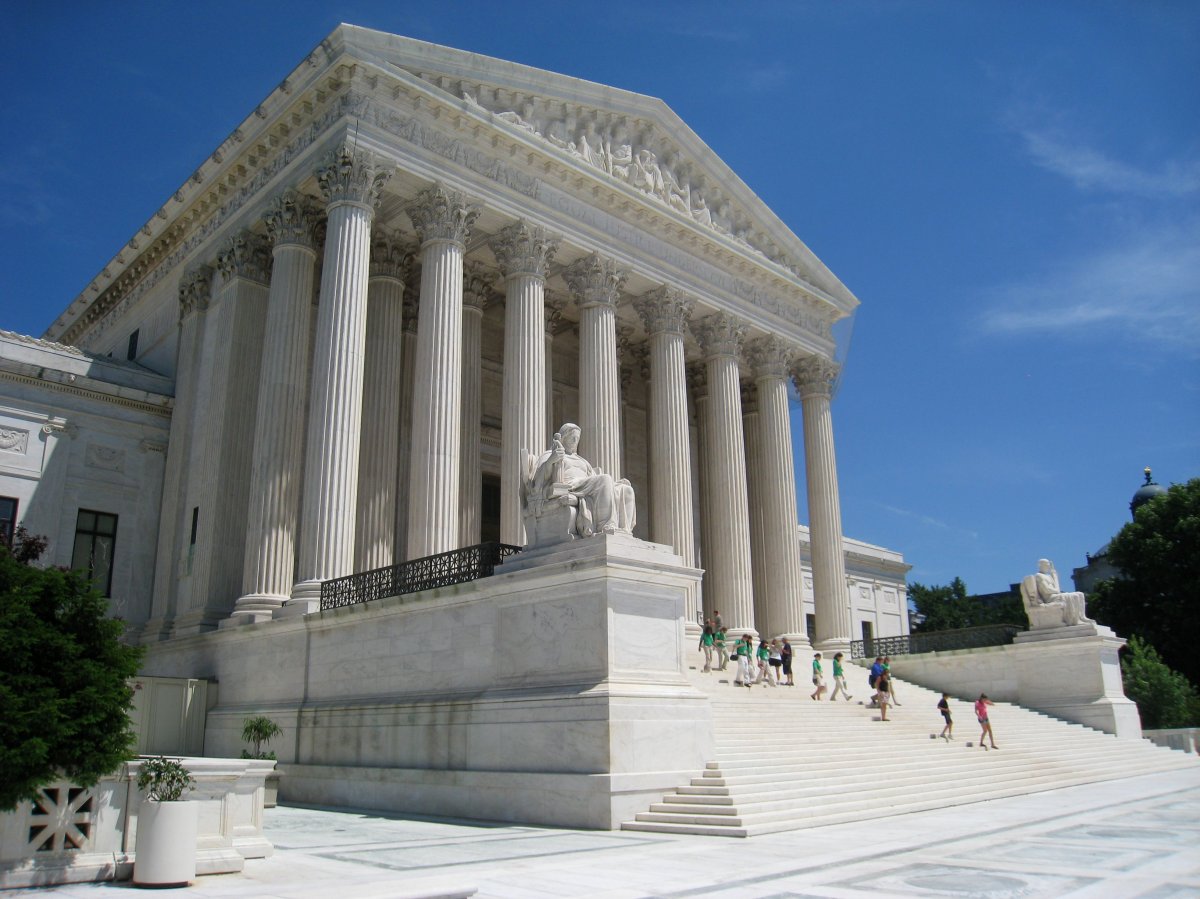
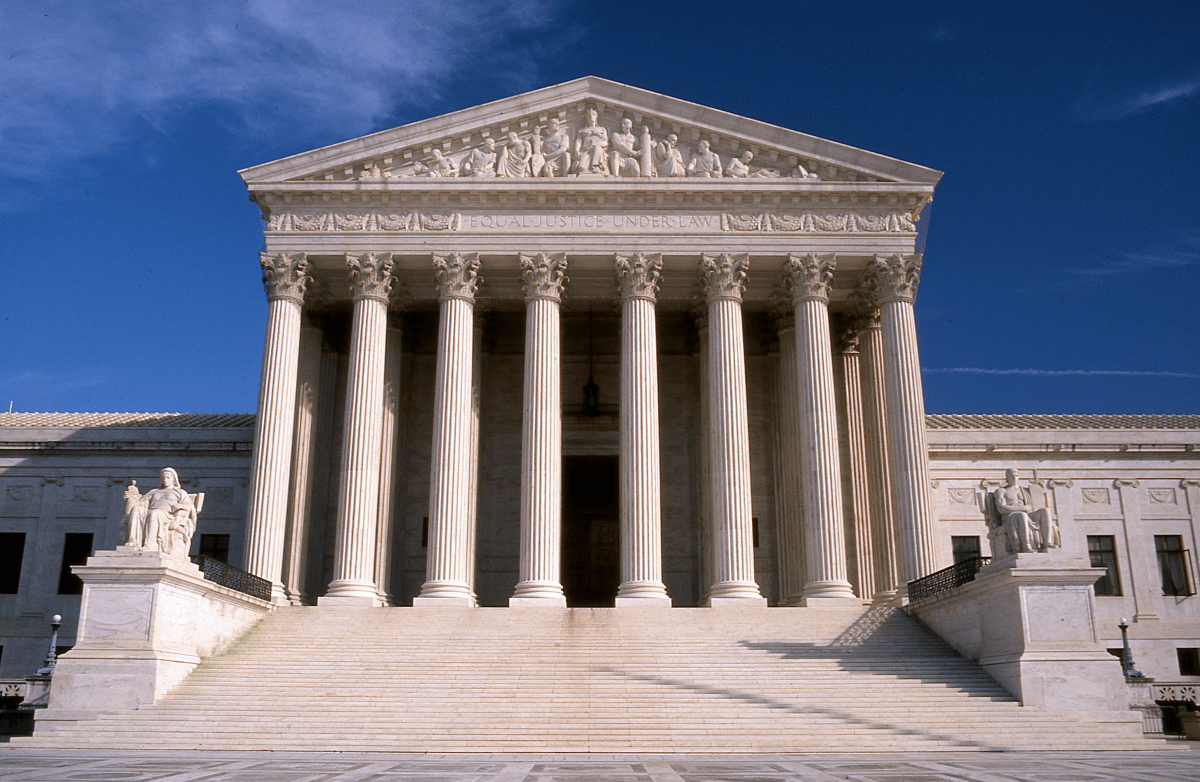
It’s no secret that the U.S. Supreme Court has a tumultuous past with certain rulings. A few examples being the infamous Dred Scott case which erroneously reasoned that certain set of humans were deemed property, Hammer v Dager which justified child labor, or Plessy v Ferguson the case that set the precedent for Jim Crow. People who’ve taken an American History course will more or less be familiar with the aforementioned cases. However, there’s an ambiguous case titled ‘Buck v Bell’ that deals with the controversial topic of eugenics. If you aren’t familiar with eugenics it’s basically a method of social engineering used to create the “best” race of humans. The method being notoriously implemented by Nazi Germany. Interestingly enough, it wasn’t just Nazis trying to make these plans come to fruition. The U.S. legal system had to deal with the topic of eugenics. Here’s how they addressed it.

Historical Context

In order to get a full understanding of the case some historical context on eugenics is necessary.  The theory of eugenics begins in the late 19th century, sometime after Charles Darwin publishes his magnum opus On the Origin of Species. During that time people rush to apply the theory of natural selection to human society. This movement gains traction throughout the western world. Peaking around the 1920’s. Universities in the USA begin to offer courses on eugenics. Increasing its popularity among academics. Despite the popularity of eugenics, academics begin to debate which humans were the superior ones. Some said the Anglos were & others argued that the Germans, Italians, Frenchs etc, were. Obviously in hindsight advancements in biology & genetics debunk all those aforementioned statements. But for the time this was the scientific truth. That lead the politicians of that era to make it their “moral” duty to prevent the degeneration of their race. This is similar to when the American Psychiatric Association classified homosexuality as a mental disorder in DSM III (published 1980), which falsely influenced societies perception on homosexuality. The same happened to eugenics in America. False research was given, debate ensued, and  legislation was implemented which leads us to the curious case of ‘Buck v Bell’.

The Case

The case begins with Carrie Buck. A resident of The State Colony for Epileptics and Feeble Minded at Lynchburg, Virginia which is headed by Albert Priddy. Carrie Buck finds herself at this institution after a series of unfortunate events in 1924.  Buck, a victim of rape, became pregnant and her adopted family had her committed to the SCEFM due to the “immorality” of having a child out of wedlock ( turns out they falsified she was raped). While at the institution they discover she has the “mental age of a 9 year old”, Priddy is a staunch supporter of eugenical sterilization, and suggests sterilization of Ms Buck due to her “moral delinquency”. Reasoning that it was probably passed down from her mother who was also known to be promiscuous and “feeble minded”.

Priddy was warned by a court in 1918 of his personal liability in sterilization operations and stopped for some time. However, realizing an opportunity to legally validate his operations, he takes the Buck case to the board of SCEFM. At the hearing Priddy argued his case to the board and it’s approved. It is then taken to local circuit court where evidence provided by an “expert”  detailed Buck’s “clear” lineage of moral delinquency. It also helped that Bucks consul (Irving Whitehead a founder of SCEFM) brought forth no arguments against Bell . The reason being was Whitehead sought the same end as Priddy; legal eugenical sterilization. The case would end up at the Supreme Court.


During the appeals process Mr. Priddy dies and the case is taken up by John H Bell. Who argues to the Court that due process was given to Buck and state police powers allowed them to protect and decide for persons such as Buck. Whitehead argued that institutions such as SCEFM could easily become havens where

” (The) worst forms of tyranny practiced…inaugurated in the name of science.” Furthermore, Bucks legal guardian argued that her right to procreate infringed on the due process clause of the constitution. Buck would lose the case 8-1. Supreme Court Justice Holmes writing for the court rejected Bucks arguments. The equal protection argument was shot down by Holmes because the policy applied to all within the institution. Furthermore, he adds that if the nation can call upon its “best citizens” in times of war, a lesser sacrifice can be made by those “lesser” that “sap the strength of society”.

The prevention of procreation is justified because “(t)hree generations of imbeciles are enough”. Strong words, iffy ruling.

Conclusion

After all was said and done Carrie Buck was sterilized in the name of eugenics. That ruling set the precedent for other states to enact similar laws. On the bright side after the Nazi’s were defeated and advancements in science, eugenics laws slowly began to fade. Despite this ‘Buck v Bell’ stands as the law of the land. The case has yet to be overturned.


Sources: The Oxford Guide to United States Supreme Court Decisions

Sapiens A Brief History of Human Kind by Yuval Noah Harari

Gerrymandering & Redistricting; A Supreme Court Affair

Gerrymandering, a technique that has helped fuel various political machines, is a topic of great debate within the Untied States. Gerrymandering on the surface is undemocratic. Allowing a political party that’s in power to redraw voting lines will naturally lead them to misuse their power. Partly because parties have used the technique to maintain political power by redrawing districts in their favor by diluting voting power. As was the case in 2011 in Wisconsin, where Republicans received a majority of house seats (60%) with only 49% of the state wide vote. How is this possible? Simple; Gerrymandering. It’s this overt case of the corrupt technique that has brought the debate to the Supreme Court. The Court plans to issue it’s ruling on Gill v. Whitford (The Wisconsin casein June 2018. Whatever side the court rules on, one thing is for sure: it will set a monumental precedent in terms of governing in the USA. (I’ve included a video explaining gerrymandering further down below.)

However, gerrymandering has two sides. Interestingly enough it’s been used to empower disenfranchised voices that have been diluted (usually by gerrymandering). Though the Court didn’t directly state it, racial redistricting was deemed somewhat constitutional. Here’s how they justified it.

The case involved in the debate was called United Jewish Organization of Williamsburg v Carey. In short, Kings County administrators followed the District Attorneys of New York’s plan of redistricting (In conjunction with the Civil Rights Act). Part of the provision called for certain districts to reach a nonwhite majority of 65 percent. Coincidentally, a Hasidic Jewish community was located in one of these districts. The effect of the provision was that the community was split in half, and was reassigned to an adjoining district. The Jewish community would then bring a suit for injunctive and declaratory relief, alleging that the 1974 plan violated their rights under the Fourteenth and Fifteenth Amendments, arguing that the plan diluted their franchise. The case would soon make it’s self up the ladder to the eyes of the Supreme Court.

The Court tip toed on it reasoning of the case. For the sake of simplicity and to save you time on the legal jargon here are the main points of the Courts justification of  New York’s redistricting plan:


  1. The Court mentions that racial discriminatory redistricting is unconstitutional.
  2.  Since the redistricting follows the provisions in the Civil Rights Act it isn’t discriminatory but rather hopes to reverse discrimination.
  3. So the use of racial criteria in drawing district lines may be required per Civil Rights Act (Specifically Voting Act)
  4. Additionally, the use of racial criteria is not limited to remedies of explicit prior discrimination.
  5. The use of numerical racial quotas in establishing certain black majority districts does not automatically violate the Fourteenth and Fifteenth Amendments
  6. The Court also says the constitution doesn’t recognize the Jewish Communities right to reapportionment as a separate entity.

Clearly the court relied heavily on the Civil Rights Act legislation and rightly so, in terms of the specific justification for enfranchisement of persecuted communities. But also seems to undermine the Jewish community. American history shows that those people haven’t necessarily been treated fairly either. Furthermore, gerrymandering is totally ignored in the Courts argument. Perhaps trying to devout their attention to the pressing societal challenges plaguing the era at the time. Racial tensions were high and The Court justified the means to combat racial injustice. However, in that pursuit the Court  may have indirectly set a precedent for justifying gerrymandering.

In all, gerrymandering is a complicated and nuanced subject; making it justified in multiple idiosyncratic realms. But the core of the issue is undemocratic. It gives room for manipulation by people seeking to fulfill their own sinister interests. If those sinister acts are possible then shouldn’t it be abolished? We’ll see what the Supreme Court has to say when confronted with the core issue in June.


LINK


Sources: http://caselaw.findlaw.com/us-supreme-court/430/144.html


Catalonia: Spain’s Savage Hypocrisy

Catalonia, a region in Northeastern Spain with a unique culture, language, and identity. A culture and history you can argue that is distinctly not “Spanish”.

Catalonia has seemed to have it’s identity trapped within the walls of Spain throughout it’s history. Before the kingdoms of Castille and Aragon combined their lands in the 15th century (this would later become modern day Spain), Catalonia was largely independent. It wasn’t until later centuries of Spanish conquest that Catalonia found itself on the losing side of a series of wars, which led to it’s absorption into Spain. But despite this, the Catalan culture and economy remained vibrant and vehemently independent.

EP603
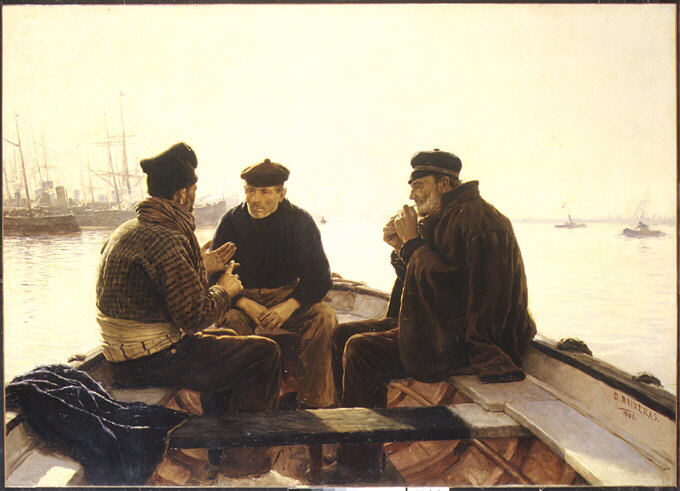
“The Boatman Of Barcelona” by Dionisio Baixeras y Verdaguer (Spanish, Barcelona 1862–1943 Barcelona)

Fast forward to the 1930’s in Catalonia. Nationalism is running high and the Spanish Civil War is in full effect in the region. The Catalans recognized the void and decided to fight for their independence.However, despite their efforts the separatist would lose. That resulted in a win for Francisco Franco, a dictator backed by Nazi Germany. He went on to suppress civil liberties by banning the Catalan language, books, and other cultural events. He imprisoned and killed many Catalan leaders and activists in the process. This suppression would last until 1975 when Franco died.

Now the argument for the separation of Spanish and Catalan culture in it’s essence could be chalked up as subjective. People perhaps might say that they are different yet synonymous, along the lines of a symbiotic relationship. But one thing that isn’t subjective (or symbiotic) is Catalonia’s huge economic contributions to Spain’s overall GDP (Catalonia’s nominal GDP in 2014 was €200 billion the highest in Spain). Which is excellent for Spain’s tax revenue, but undermines a majority of Catalans who feel as if they’re being ‘robbed’ by the central government in Madrid. Because often, the way the tax revenue is used neglects Catalonia’s regional interests. Giving way for feelings of neglect and exploitation. Symbiotic relationships require two parties to benefit, but by definition when only one party benefits it becomes a PARASITIC relationship. It’s these idiosyncratic differences (both cultural and economic) that have put the region at odds with the Spain’s central government throughout history, and even more so in our modern political sphere.

The modern Catalan sentiment is that the region does more for Spain in terms of the economy than what it gets in return from Spain. That frustration, mixed with the Catalan historical identity has been fuel for recent separatist movements. Recently the regional Catalan parliament passed a law on Sept. 6th 2017 to hold a referendum on independence, Spain’s national government said it was illegal and filed a complaint to the National Constitutional Court. Spain ruled that the referendum was unconstitutional. Nevertheless the Catalans went on with referendum process. Spain responded by shutting down the referendums website, sending the police to stop any polls that had been set up for the referendum, and they confiscated about 10 million ballot papers/ millions of advertising posters. Successfully suppressing the democratic process. Additionally, around 700 of Catalonia’s about 900 mayors are being held under investigation for their role for preparing the referendum. Many of them could possibly face bans on holding democratically elected public office. Despite this many of them will continue to represent their constituents in Catalonia.

At the moment it’s unclear what’s going to happen in Spain amidst this democratic and political crisis. Things seem to be a bit rocky in terms of institutional implementation. Regardless, the world is watching.


Sources: AP

https://www.britannica.com/place/Catalonia

My Junior Year Research Paper

and Wikipedia for dates


A Case For Free Speech: Abrams v United States

Background

On August 23rd 1918, four political anarchist were arrested in New York City for handing out ‘anti war leaflets’ in the streets. Among the people arrested for passing out the leaflets were Jacob Abrams, a Russian immigrant and anarchist, along with his other ‘comrades’; Molly Steitmer, Samuel Lipman, and Hyman Lachowsky. The leaflets were written/printed in two languages, one version was written in Yiddish and another in English. They were distributed throughout the city, and condemned Woodrow Wilson’s involvement in World War I (The Yiddish leaflet called for a general strike to protest against government intervention). The group of protesters were indicted under the Sedition Act of 16 May 1918 which made it a crime to “willfully utter, print, write,or publish any disloyal, profane, scurrilous, or abusive language” about the United States government, additionally it was against the law to  “willfully urge, incite or advocate any curtailment of production” of things “necessary or essential to the prosecution of the war… with intent by such curtailment to cripple or hinder the United States in the prosecution of the war.”. The group of protesters were found guilty before federal district court judge Henry DeLamar Clayton, Jr., they were sentenced to serve between 15- 20 years in federal prison. The defendants appealed their conviction on the grounds of free speech and it went all the way up to the Supreme Court. Their case arguments began on the 21st of October 1919 and a final decision was made in November of that same year.

Majority opinion (with a vote of 7 to 2 Written by Justice John Hessien Clarke) 

In the middle of the appeals process the Supreme Court upheld the convictions of antiwar socialist under the Espionage Act of 1917 (Schneck v United States) and under the Sedition Act of 1918 (Debs v United States). Both cases would be influential in the reasoning behind the Abram’s case. Additionally, both decisions were unanimous and were written by Justice Oliver Wendell Holmes who reasoned in the Schneck case that “[t]he question in every case is whether the words used are used in such a circumstance and are of such a nature as to create a clear and present danger that they will bring substantive evils that congress has a right to prevent”. A similar line of reasoning would be used in the Abrams case by the majority opinion written by Justice Clarke. The leaflets were indeed a ‘clear and present danger’, Clarke rationalized that because they had been handed out “at the supreme crisis of the war” and could be simplified as “an attempt to defeat the war plans of the Government”. Any form of speech that impeded (or could impeded) the American war effort was now deemed the law of the land.


Dissenting Opinion (Written by  Justice Oliver Wendell Holmes )


Ironically, the dissenting opinion would come from the man who had written the opinions which set the precedent for the reasoning behind the argument for Abrams conviction. His dissent went against his previous definition of ” clear and present danger”. Justice Holmes had drastically modified his point of view by the time he’d have to see the Abrams case. Having been personally disturbed by the oppression resulting from the anti radical hysteria of the time, and being influenced by lawyers with libertarian interpretation of the law, Holmes began to lean towards a more libertarian point of view on the “clear and present” danger precedent.

Holmes now reasoned, “(congress) constitutionally may punish speech that produces or is intended to produce a clear and imminent danger that will bring about forthwith certain substantive evils that the United States constitutionally may seek to prevent” Furthermore, Holmes denied that ” the surreptitious publishing of a silly leaflet by an unknown man” created an imminent threat to the government. For Holmes the First Amendment protected the expression of all opinions ” unless they imminently threaten immediate interference with the lawful and pressing purposes of the law that an immediate check is required to save the country”.

The Supreme Courts would continue to battle with the definition of “clear and imminent” danger when it came to free speech, and the Abrams case is an important case for this fight for free speech. What stands out the most in this case is the eloquent and well articulated dissent of Justice Holmes. He opens up the discussion for future generations of the connection between freedom of speech, the search for the truth, and the importance of worldly experimentation:holmes-and-supreme-court

” But when men have realized that time has upset many fighting faiths, they may come to believe even more than they believe the very foundations of their own conduct that the ultimate good desired is better reached by free trade in ideas — that the best test of truth is the power of the thought to get itself accepted in the competition of the market, and that truth is the only ground upon which their wishes safely can be carried out. That at any rate is the theory of our Constitution. It is an experiment, as all life is an experiment”


Wise words from a decent man.


Sources: https://scholar.google.com/scholar_case?case=14321466231676186426&hl=en&as_sdt=6&as_vis=1&oi=scholarr