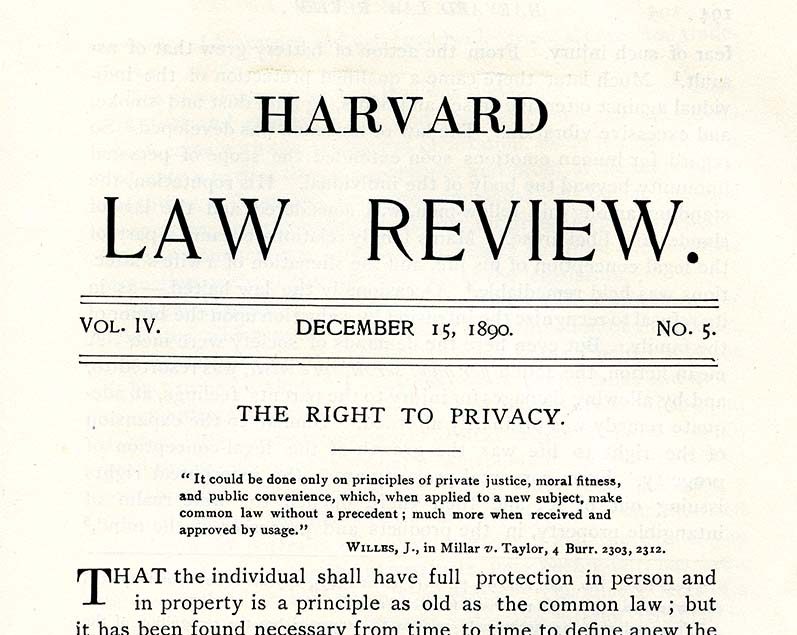
“The Right to Privacy”: The Foundation for Modern Privacy Law

Louis Brandeis, along with his law partner Samuel Warren, penned “The Right to Privacy” in 1890, marking a pivotal moment in the discourse on privacy rights. The article articulated a valid argument for the recognition of a fundamental right to privacy in American jurisprudence, which still influences the debates we have had today about the intersection of privacy law and emerging technology such as AI, surveillance, and the internet.

Defining Privacy Rights

In “The Right to Privacy”, Brandeis and Warren framed privacy as the right to be left alone, a notion plenty of people can relate to especially if you are living in the social media age. Essentially being left alone meant shielding individuals from unwarranted intrusion into their personal lives, thoughts, and affairs. They identified two types of privacy invasions: the use of one’s likeness or personal information for commercial purposes without consent, and the publication of private information that could cause emotional distress or harm to one’s reputation.

Brandeis and Warren highlighted the detrimental effects of sensationalist journalism and emerging technologies such as photography on individual privacy. They argued that advances in technology had outpaced legal protections, leaving individuals vulnerable to intrusive media practices and public exposure without a proper remedy to collect on. In hind sight they essentially predicted the world we live in now, one full of Tik Toks, selfies, streamers, and retweets.

Individual Autonomy and Dignity

The core focus of the article was advocacy for privacy rights which reflected broader philosophical principles of individual autonomy, dignity, and the right to control one’s personal information and identity. The article emphasized the importance of privacy in preserving personal autonomy, fostering intimate relationships, and cultivating individuality free from external scrutiny and interference.

Brandeis’ philosophical stance resonated with Enlightenment ideals of personal liberty and dignity that were popular with thinkers at the time, challenging the notion that individuals should be subject to public scrutiny or commodification without their consent. His advocacy for privacy rights aligned with a broader movement towards recognizing and protecting individual rights against encroachment by powerful societal forces, whether governmental, corporate, or media related.

Influence on American Jurisprudence

“The Right to Privacy” had a profound impact on American jurisprudence, laying the groundwork for the development of privacy law in the United States. Though not immediately codified into statutory law, Brandeis’ and Warren’s ideas influenced judicial interpretations and legislative efforts to protect privacy rights in various contexts.

The article set forth a conceptual framework for recognizing privacy as an inherent and fundamental right implicit in the U.S. Constitution, particularly in the Fourth Amendment’s protections against unreasonable searches and seizures. Brandeis’ arguments resonated in subsequent Supreme Court decisions, including Olmstead v. United States (1928) and Griswold v. Connecticut (1965), which recognized privacy rights in the context of wiretapping and contraception.

Brandeis’ philosophical and legal legacy continues to inform contemporary debates on privacy rights in the digital age, as technology continues to reshape how personal information is collected, stored, and disseminated. His advocacy for privacy as a bulwark against invasive technologies and media practices remains relevant as society grapples with issues of data privacy, cybersecurity, and surveillance in the 21st century. So though the article was written in the 19th century, it would be able to tackle the core privacy issues new technology such as the internet would pose.

Early Foundations of Cyber Law

The early development of cyber law in the United States was influenced by a series of legislative initiatives aimed at addressing the challenges posed by digital communication, electronic commerce, and data privacy. This further entrenched the idea Brandeis and Warren had one hundred years prior, privacy must be safeguarded. One of the earliest legislative efforts was the Electronic Communications Privacy Act (ECPA) of 1986, which established protections against unauthorized interception of electronic communications and access to stored electronic communications. The ECPA safeguarded digital privacy rights, setting the stage for subsequent legislative and judicial developments. It was clear Warren and Brandeis’ message had reached the law makers tackling the privacy issues this new technology was posing.

Another pivotal piece of legislation was the Computer Fraud and Abuse Act (CFAA) of 1986, which criminalized unauthorized access to computer systems and provided civil remedies for victims of computer related crimes. The CFAA was instrumental in addressing cybersecurity threats and unauthorized access to sensitive information, establishing a legal framework for prosecuting cybercrime and protecting the integrity of a user’s private digital systems(computers, phones, usb etc).

Privacy Law in Healthcare

The most commonly cited piece of privacy legislation is HIPPA, ( The Health Insurance Portability and Accountability Act) which introduced comprehensive standards for protecting personal health information and electronic health records. HIPAA’s Privacy Rule and Security Rule established guidelines for healthcare providers, insurers, and business associates to ensure the confidentiality, integrity, and availability of Protected Health Information (PHI). The enactment of HIPAA represented a significant advancement in healthcare privacy law. As well as emphasizing the importance of protecting sensitive medical information, further expanding on the notions of private sensitive information that the Brandeis article discussed.

HIPAA truly transformed the US standard on handling medical information. It serves as a robust shield protecting personal health details from unauthorized access and ensuring stringent confidentiality standards. Before HIPAA, the landscape was less regulated, regular people had valid concerns over who could access medical records and their security. HIPAA’s impact extends beyond privacy it fortifies defenses against cyber threats, ensuring medical data remains secure.

Privacy in the Digital Age: Challenges and Regulatory Responses

However, though there have been strides in privacy regulation, there have still been issues that have not been adequately addressed. For example, the proliferation of digital communication, social media platforms, and online commerce has raised new challenges for privacy law, prompting regulatory responses to address issues such as data breaches, online tracking, and consumer profiling. The Federal Trade Commission (FTC) has played a central role in enforcing consumer privacy protections under its authority to prevent unfair and deceptive practices in commerce. The FTC’s enforcement actions have targeted companies that fail to secure consumer data, engage in deceptive data collection practices, or violate consumers’ privacy preferences.

However, critics have argued that the FTC alone cannot enforce every possible violation at the federal level, and that some state intervention is also needed. In recent years, concerns about online privacy have been amplified by high profile data breaches and scandals involving major technology companies. The Cambridge Analytica scandal, in which Facebook users’ personal data was harvested for political purposes without their consent, underscored the vulnerability of personal information in the digital age and sparked public debate about the need for stronger privacy protections. And now some state’s have responded with their own protections.

State Level Regulation

Illinois’s Biometric Information Privacy Act (BIPA)

The Biometric Information Privacy Act (BIPA) was passed in 2008 by Illinois’s legislature and is one of the most stringent biometric privacy laws in the United States. The act is aimed at regulating the collection, storage, use, and dissemination of biometric identifiers and biometric information. Biometric identifiers covered under BIPA include fingerprints, retina or iris scans, voiceprints, and facial geometry scans.

BIPA mandates that private entities obtain informed consent from individuals before collecting their biometric identifiers or information. Entities must disclose the specific purpose and duration for which biometric data is being collected, stored, and used.

Additionally it imposes strict guidelines on the retention and destruction of biometric data. Entities must establish a written policy outlining the retention schedule and guidelines for permanently destroying biometric information once the purpose for its collection has been fulfilled or after a certain period expires.

BIPA prohibits private entities from selling, leasing, trading, or otherwise profiting from an individual’s biometric identifiers or information. Entities are also prohibited from disclosing biometric data without obtaining the individual’s consent or as required by law.

One of the most notable aspects of BIPA is its provision allowing individuals to sue private entities for violations of the statute. Individuals can seek damages ranging from $1,000 for negligent violations to $5,000 for intentional or reckless violations, as well as attorney’s fees and costs.

The private right of action under BIPA has led to a significant number of class action lawsuits against companies alleged to have violated the statute’s provisions. These lawsuits have underscored the importance of compliance with BIPA’s requirements and the potential financial liabilities for noncompliance.

In the case of Patel v. Facebook, filed in Illinois in 2015, users accused Facebook of unlawfully collecting and storing biometric data through its “Tag Suggestions” feature. This feature automatically recognized and suggested tags for people in photos uploaded to Facebook based on facial recognition technology, without explicit consent from users. Plaintiffs argued that Facebook’s practices violated BIPA by failing to inform users about the collection and use of their biometric data and obtain their written consent.

The lawsuit proceeded as a class action, representing millions of Illinois Facebook users affected by the alleged violations of BIPA. Over the course of litigation, Facebook contested the lawsuit’s class certification and challenged the interpretation of BIPA’s requirements.

Ultimately, in 2020, Facebook agreed to settle the Patel lawsuit for $650 million, one of the largest settlements in history for a privacy related lawsuit. The settlement underscored the substantial financial risks companies face for non compliance with biometric privacy laws like BIPA and reinforced the importance of obtaining informed consent and implementing robust data protection measures in biometric technology.

The California Consumer Privacy Act

The California Consumer Privacy Act (CCPA) of 2018 grants consumers rights to access, delete, and opt out of the sale of their personal information, reflecting a state level effort to strengthen privacy rights and regulate data driven business practices. This law was heavily influenced by European Union legislation that broadly protects data privacy for all EU member countries.

Global Influence: GDPR and Setting Privacy Standards

One of the gold standards for data specific privacy regulation is The European Union’s General Data Protection Regulation (GDPR), implemented in 2018. It has had a transformative impact on global privacy standards by establishing comprehensive requirements for data protection, user consent, and individual rights over personal data. The GDPR’s principles of transparency, accountability, and data minimization have set a global benchmark for privacy regulation, influencing regulatory frameworks and corporate practices worldwide.

Any policymaker knows that drafting and passing a statute is half the battle, proper enforcement is what actually influences law. The GDPR incentivizes proper enforcement. Its enforcement is effective because the statute combines substantial financial penalties, strong regulatory authority, and enumerates clearly defined individual rights. The possibility of significant fines creates a real economic incentive for companies to comply, while regulators can investigate violations and require corrective action. This combination makes privacy obligations enforceable rather than merely aspirational, encouraging organizations to build data protection into their everyday operations and corporate decision making.

Emerging Technologies and Privacy Challenges: AI, Biometrics, and Surveillance

The rapid advancement of emerging technologies such as artificial intelligence (AI), biometric data collection, and facial recognition has raised complex legal and ethical questions about privacy rights and surveillance in the digital age. AI algorithms capable of processing vast amounts of personal data for predictive analytics and decision making purposes have prompted calls for consumer regulatory oversight to ensure that AI systems respect privacy rights, avoid bias, and uphold transparency.

The use of biometric identifiers such as fingerprints, iris scans, and facial images for authentication and identification purposes has introduced new challenges for privacy law, as biometric data is inherently sensitive and permanent.

Surveillance technologies, including local police and corporate surveillance programs, pose additional challenges to privacy rights and civil liberties. The debate over mass surveillance, warrantless wiretapping, and the collection of metadata has prompted legal challenges and legislative efforts to strike a balance between national security interests and individual privacy rights. This is evident in the recent discourse in various American states surrounding Flock cameras and how the technology can be misused by local police departments.

The Future of Cyber Law and Privacy: Adapting to Technological Change

Looking ahead, the evolution of cyber law and privacy in the United States will continue to be shaped by rapid technological advancement but it is imperative to balance innovation with robust regulatory oversight. Policymakers, legal scholars, and industry stakeholders must collaborate to develop adaptive legal frameworks that protect privacy rights, promote technological innovation, national security, and maintain public trust in digital technologies.

Efforts to establish ethical guidelines and regulatory frameworks for emerging technologies like AI, blockchain, and the internet as a whole will be essential in addressing privacy challenges and ensuring that technological innovations benefit society while respecting individual rights. Principles of accountability, transparency, and fairness will guide regulatory efforts to mitigate risks associated with data privacy, cybersecurity threats, and the ethical implications of AI and machine learning.

It is clear that Louis Brandeis’ article “The Right to Privacy” remains a foundational text in the evolution of privacy law and ethics, articulating enduring principles of individual autonomy and the right to be free from unwarranted intrusion. These philosophical insights helped outline the arguments on the importance of privacy rights which continue to guide legal frameworks and policy debates, shaping how societies balance technological innovation with the protection of fundamental human rights.

As the United States and other nations navigate the complexities of the digital age, the commitment to upholding privacy rights must remain focused, grounded in Brandeis’ vision of a society where individuals can assert control over their personal information and maintain autonomy in an increasingly interconnected world.

Sources

-Brandeis, Louis D., and Samuel D. Warren. “The Right to Privacy.”

-California Consumer Privacy Act of 2018. Cal. Civ. Code §§ 1798.100–1798.199.

-Computer Fraud and Abuse Act of 1986. 18 U.S.C. § 1030.

-Electronic Communications Privacy Act of 1986. 18 U.S.C. §§ 2510–2523, 2701–2713, 3121–3127.

-European Parliament and Council of the European Union. “Regulation (EU) 2016/679 (General Data Protection Regulation).” Official Journal of the European Union, 2016.

-Health Insurance Portability and Accountability Act of 1996. Pub. L. No. 104-191, 110 Stat. 1936.

-Illinois Biometric Information Privacy Act. 740 Ill. Comp. Stat. 14/1–14/99.

–Olmstead v. United States. 277 U.S. 438. Supreme Court of the United States, 1928.

–Patel v. Facebook, Inc. 932 F.3d 1264. United States Court of Appeals for the Ninth Circuit, 2019.

–Griswold v. Connecticut. 381 U.S. 479. Supreme Court of the United States, 1965.
Artificial Intelligence & American Copyright Law: Analyzing the Copyright Office’s AI Report

Copyright Office’s AI Report: The Good, The Bad, and The Controversial

The Copyright Office just dropped Part 3 of its AI report, which aimed at addressing certain copyright law in regards to Artificial Intelligence. The thing that’s got everyone talking is the fact that the report was supposed to tackle infringement issues head on, but instead teased us by saying that answer will come up in “Part 4” that is expected to be released at a later date. Let’s dive into what was actually discussed.

Legal Theory: A Case by Case Basis

The report’s central thesis is a pretty straightforward legal theory. Basically, they recommend that there will be no blanket rule on whether training AI on copyrighted content constitutes infringement or fair use. Everything gets the case by case treatment, which is both realistic and frustrating depending on where you sit. That’s because most lawyers like clear bright line rules backed up by years of precedent, but when attempting to make legal frameworks regarding emerging technologies, the brightline approach is easier said than done.

The report acknowledges that scraping content for training data is different from generating outputs, and those are different from outputs that get used commercially. Each stage implicates different exclusive rights, and each deserves separate analysis. So in essence, what’s  actually useful here is the recognition that AI development involves multiple stages, each with its’ unique copyright implications.

This multi stage approach makes sense, but it also means more complexity for everyone involved. Tech companies can’t just assume that fair use covers everything they’re doing and content creators can’t assume it covers nothing. The devil is in the details.

Transformative Use Gets Complicated

The report reaffirms that various uses of copyrighted works in AI training are “likely to be transformative,” but then immediately complicates things by noting that transformative doesn’t automatically mean fair. The fairness analysis depends on what works were used, where they came from, what purpose they served, and what controls exist on outputs.

This nuanced approach is probably correct legally, but it’s also a nightmare for anyone trying to build AI systems at scale. You can’t just slap a “transformative use” label on everything and call it a day. The source of the material matters, and whether the content was pirated or legally obtained can factor into the analysis. So clearly purpose also matters since commercial use and research use will likely yield different results in the copyright realm. Control and mitigation matter in this context because developing the necessary guardrails is paramount to preventing direct copying or market substitution.

Nothing too revolutionary here, but the emphasis on these factors signals that the Copyright Office is taking a more sophisticated approach than some of the more simplistic takes we’ve seen from various opinions on this matter. This should be reassuring since a one size fits all approach at such an early stage of developing AI could stifle innovation. However if things are left to be too uncontrolled copyrighted works may face infringements to their copyright.

The Fourth Factor Controversy

Here’s where things get interesting and controversial. The report takes an expansive view of the fourth fair use factor: which is the effect on the potential market for the copyrighted work. That is because too many copyrighted works flooding the market brings fears of market dilution, lost licensing opportunities, and broader economic impacts.

The Office’s position is that the statute covers any “effect” on the potential market, which is broad interpretation. But that broad interpretation has a reason, they are worried about the “speed and scale” at which AI systems can generate content, creating what they see as a “serious risk of diluting markets” for similar works. Imagine an artist creates a new masterpiece only to get it copied by an AI model which makes the piece easily recreatble by anyone, diluting the value of the original masterpiece. These types of things are happening on the market today.

This gets particularly thorny when it comes to style. The report acknowledges that copyright doesn’t protect style per se, but then argues that AI models generating “material stylistically similar to works in their training data” could still cause market harm. That’s a fascinating tension, you can’t copyright a style but you might be able to claim market harm from AI systems that replicate it too effectively. It is going to be interesting to see how a court applies these rules in the coming future.

This interpretation could be a game-changer, and not necessarily in a good way for AI developers. If every stylistic similarity becomes a potential market harm argument, the fair use analysis becomes much more restrictive than many in the tech industry have been assuming.

The Guardrails

One of the more practical takeaways from the report is its emphasis on “guardrails” as a way to reduce infringement risk. The message is clear: if you’re building AI systems, you better have robust controls in place to prevent direct copying, attribution failures, and market substitution.

This is where the rubber meets the road for AI companies. Technical safeguards, content filtering, attribution systems, and output controls aren’t just up to the discretion of the engineers anymore they’re becoming essential elements of any defensible fair use argument.

The report doesn’t specify exactly what guardrails are sufficient, which leaves everyone guessing. But the implication is clear: the more you can show you’re taking steps to prevent harmful outputs, the stronger your fair use position becomes. So theoretically if a model has enough guardrails they may be able to mitigate their damages if the model happens to accidently output copyrighted works.

RAG Gets Attention

The report also dives into Retrieval Augmented Generation (RAG), which is significant because RAG systems work differently from traditional training approaches. Instead of baking copyrighted content into model weights, RAG systems retrieve and reference content dynamically.

This creates different copyright implications: potentially more like traditional quotation and citation than wholesale copying. But it also creates new challenges around attribution, licensing, and fair use analysis. The report doesn’t resolve these issues, but it signals that the Copyright Office is paying attention to the technical details that matter.

Licensing

The report endorses voluntary licensing and extended collective licensing as potential solutions, while rejecting compulsory licensing schemes or new legislation “for now.” This is probably the most politically palatable position, but it doesn’t solve the practical problems.

Voluntary licensing sounds great in theory, but the transaction costs are enormous when you’re dealing with millions of works from thousands of rights holders. Extended collective licensing might work for some use cases, but it requires coordination that doesn’t currently exist in most creative industries.

The “for now” qualifier is doing a lot of work here. It suggests that if voluntary solutions don’t emerge, more aggressive interventions might be on the table later.

The Real Stakes

What makes this report particularly significant isn’t just what it says, but what it signals about the broader policy direction. The Copyright Office is clearly trying to thread the needle between protecting creators and enabling innovation, but the emphasis on expansive market harm analysis tilts toward the protection side.

For AI companies, this report is a warning shot. The days of assuming that everything falls under fair use are over. The need for licensing, guardrails, and careful legal analysis is becoming unavoidable.

For content creators, it’s a mixed bag. The report takes their concerns seriously and provides some theoretical protection, but it doesn’t offer the clear-cut prohibitions that some have been seeking.

The real test will come in the courts, where these theoretical frameworks meet practical disputes. But this report will likely influence how those cases get decided, making it required reading for anyone in the AI space.

As we can see AI and copyright law is becoming only more and more complex. The simple answers that everyone wants don’t exist, and this report makes that abundantly clear. The question now is whether the industry can adapt to this new reality or whether we’re heading for a collision that nobody really wants.

Why’s America Sleeping? A Discussion Regarding The United Healthcare CEO’s Assassination.

“It takes violent shocks to change an entire nations psychology.”

– John F. Kennedy

This quote written in John F. Kennedy’s Magnum Opus ‘Why England Slept’ encapsulates the current collective psychology of the United States after the tragic assassination of Brian Thompson. Some people celebrated the CEO’s death, a symbol of the frustration many Americans have been feeling regarding the nation’s healthcare system. Critiques of the healthcare system are definitely warranted, and Luigi Manginoni’s tragic act has once again put the nations healthcare debate at the forefront a public discourse.  

President Kennedy’s quote is correct, often violent acts can change an entire nations collective psychology, there are plenty of examples in history that agree with that proposition. However, people are wrong assuming that the assassination will trigger meaningful change due to the fear healthcare insurance executives may feel after the assassination of Brian Thompson. People’s idealism can cloud the reality on how institutions operate in the real world. History has proven powerful players rarely relinquish control freely. The healthcare industry could hypothetically double down and refuse to budge, further entrenching an “us vs. them” mentality that pervades many contemporary national debates. Though, admittedly, the act could hypothetically result in meaningful change in the healthcare industry- but not in the way people celebrating the death would imagine. A good case study as to why that is the case would be the Ludlow Massacre.

On April 20, 1914, in Ludlow, Colorado, striking coal miners demanded better pay, safer working conditions, and the right to unionize ( more info on Ludlow here). The strikers were attacked by the Colorado National Guard and company-hired guards, killing the protestors and some of their family members. The Ludlow Massacre lead to the Colorado Coalfield War, where workers formed a militia and started attacking Colorado National Guardsmen and private law enforcement . The workers successfully attacked many of their oppositions positions and had a lower casualty count but when the dust settled the strikers’ demands were not met, the union did not obtain recognition and many striking workers were replaced. Further 408 strikers were arrested, 332 of them were indicted for murder. The institution decided to double down on the crackdowns resulting in none of the strikers work demands being met.

Though the workers themselves did not reach their goals, the tragedy of Ludlow spurred a greater national debate on workers rights in the United States. Slowly the grievances raised by the Ludlow massacre lead to the enactment of federal labor laws that we still use today. American society should turn this tragedy into a positive and reinvigorate the discussion and action that will lead to fundamental changes in the healthcare industry. The Ludlow Massacre forced the nation to confront workers’ rights, and similarly the tragic assassination of Brian Thompson could prompt similar discussions about the systemic failures in healthcare. However, history shows that institutional change is slow and often requires sustained public pressure. Hopefully, this time around the change will come sooner, if not there are indications that matters may get worse rather than better.  Analyzing the economic incentives causing this turmoil will illuminate the problem areas in the sector and hopefully lead to some practical solutions.

Economic Moral Hazards

The problem with the healthcare sector is that it produces bad economic incentives. 1 Often healthy economic incentives encourage behavior that benefits both individuals and society, they are aimed at promoting positive economic action while discouraging negative consequence such as waste or harm. For example good economic incentives would be efficiency standards for cars, they incentivize manufacturers to produce efficient automobiles by offering various government benefits. For example, car companies may get tax breaks,  recognition for meeting higher energy efficiency standards, or might get access to lucrative government contracts. This makes energy utilization effective, lowers bills for consumers, and helps reduce environmental impacts by using wasteful technology.

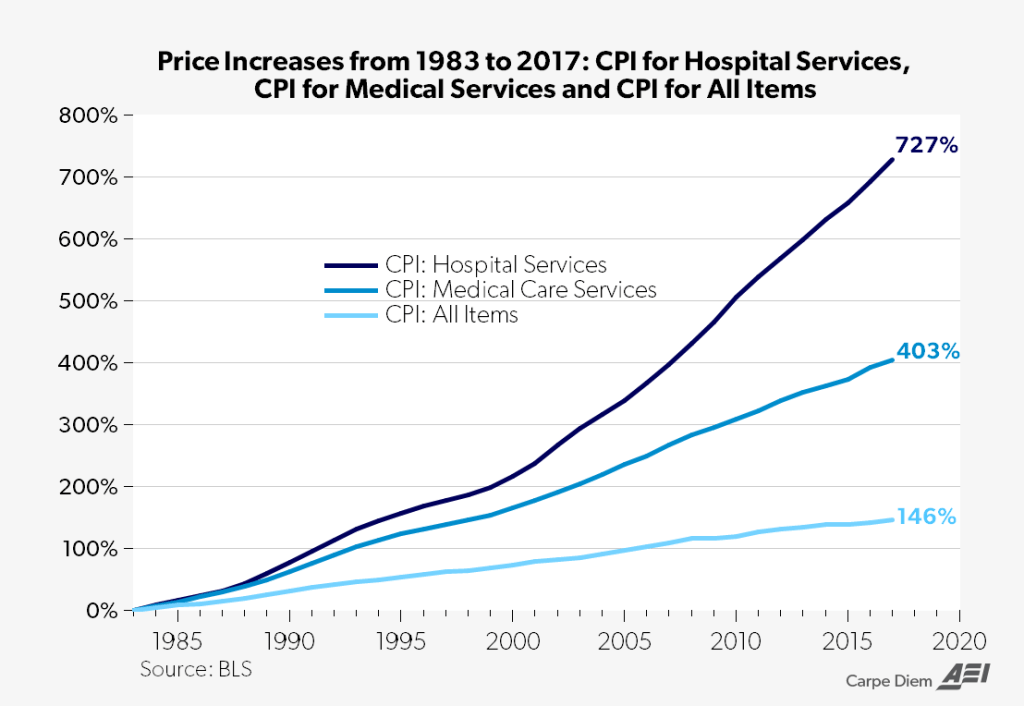
The healthcare industry seems to be running in the opposite direction regarding incentives. Large hospitals commonly increase prices for services and lab technology, knowing that insurers and government programs will foot the bill one way or the other. 2  A big reason hospitals can do this is due to lack of competition within the sector. 3 On average Americans have access to only a few healthcare providers, which incentives monopolistic practices such as price gouging. 4  These practices shift the financial burden onto patients, insurers, and taxpayers, exacerbating the system’s inefficiencies.  Insurance companies also contribute to producing bad economic incentives but in a different way.

Source: American Enterprise Institute

Health care Insurers also contribute to overall inflated healthcare prices. That’s because insurance companies have few incentives to negotiate for better rates or challenge the high prices set by hospitals.  They are well aware that they can pass those costs onto consumers in the form of higher premiums or deductibles in order to fulfill their fiduciary duty to their shareholders. 5 By passing those costs on to their consumers they ensure their shareholders are maximizing profits effectively fulfilling their duty. This leads to a disconnect between the price of healthcare and the actual cost to consumers leading to the  inflated cost of healthcare of the healthcare system.

Additionally, some companies during economic downturns might only focus on the volume of services provided, rather than the quality or necessity of those services. This may encourage doctors to prescribe unnecessary treatments overuse of healthcare and can result in unnecessary tests or procedures, which drive up the overall healthcare costs. If you are fully covered getting extensive tests is beneficial for your health but unnecessary care drives up the price for people who do not have adequate coverage. That is because higher utilization of healthcare services- necessary or not artificially inflates demand, which providers often use to justify price increases. Most insurance companies operate within fee-for-service payment systems, where providers are reimbursed based on the volume of services delivered rather than the value or outcomes. This further incentivizes unnecessary treatments, tests, and procedures, as healthcare providers have a financial interest in maximizing billable services

Further, the administrative complexity of health insurance also adds significant costs to the healthcare system. Insurers maintain vast bureaucracies to process claims, determine coverage, and manage provider networks, which requires substantial resources. Anecdotally, after spending some time in the insurance sector, a lot of the administrative tasks incentivize an incredible amount of waste.  These costs are ultimately passed on to consumers. For example, administrative expenses in the U.S. healthcare system account for nearly 8% of total spending, compared to 2-3% in countries with simpler, more centralized systems. 6

Action is Necessary

The tragic events surrounding Brian Thompson’s assassination have understandably stirred intense emotions and reignited a national conversation about the flaws in our healthcare system. While these tragedies can bring the issue to the forefront, history shows us that meaningful change doesn’t come from fleeting moments of outrage. The shockwaves from Thompson’s death can grab attention temporarily, but true change only happens when we confront the deeper economic incentives that drive the inefficiencies and inequalities in healthcare.

Reform, as we’ve seen in the past, is rarely quick or easy. It faces resistance from entrenched interests that benefit from the status quo. But the time to act is now. The monopolistic pricing, the disconnect between what healthcare actually costs and what patients pay, and the lack of meaningful negotiation from insurers- all of these must be tackled with urgency. It’s time to rethink the economic incentives behind the healthcare system and shift the focus toward transparency, competition, and patient-centered care. The current model is unsustainable, and the responsibility for change lies with all of us; policymakers, healthcare providers, insurers, and the public.

Let us use this tragedy not as a fleeting moment of anger but as a rallying point to demand systemic reform. By ensuring that economic incentives align with the well-being of patients and the long-term sustainability of the system, we can move toward a healthcare system that serves the needs of every American, not just the powerful few. Now is the time for thoughtful, deliberate action to reform the healthcare system in a way that reflects the values of justice, fairness, and efficiency for all.

“The time to repair the roof is when the sun is shining.”

-John F. Kennedy

Right now, I’m sad to say, it seems like we’re attempting to repair a roof in the middle of a tornado. Urgent action is needed.


Sources

  1. According to the Journal of the American Medical Association (JAMA), the U.S. healthcare system is plagued by administrative inefficiencies, price inflation, and overuse of medical services, which are driven by poorly aligned incentives among providers, insurers, and payers.

    Source: JAMA. “Waste in the US Health Care System: Estimated Costs and Potential for Savings.” (2019). ↩︎
  2. Research from the RAND Corporation indicates that hospitals charge private insurers an average of 247% of Medicare rates for the same services. This price disparity exists because private insurers lack the bargaining power to negotiate rates effectively, and hospitals rely on these inflated payments to subsidize their operations.

    Source: RAND Corporation. “Prices Paid to Hospitals by Private Health Plans Are High Relative to Medicare and Vary Widely.” (2020).. ↩︎
  3. Research shows that hospital consolidation reduces competition and leads to higher prices. A study by the National Bureau of Economic Research (NBER) found that hospital mergers result in price increases of 6% to 18%, depending on the level of market concentration.

    Source: NBER. “The Price Effects of Cross-Market Hospital Mergers.” (2018).
     The Health Care Cost Institute (HCCI) reports that the average price for hospital services is significantly higher in concentrated markets than in competitive ones.

    Source: HCCI. “Healthy Marketplace Index.” (2020). ↩︎
  4. The American Medical Association (AMA) found that in 2019, 90% of metropolitan areas in the U.S. were highly concentrated for hospital markets, meaning patients had limited choices among providers. This is also the case in more rural areas as well.

    Source: AMA. “Competition in Health Insurance: A Comprehensive Study of U.S. Markets.” (2019). ↩︎
  5. Premiums and deductibles for employer-sponsored health insurance have been steadily rising, with average family premiums increasing by 55% over the past decade. Insurers often attribute this to rising healthcare costs from hospitals and providers.

    Source: KFF. “2022 Employer Health Benefits Survey.” ↩︎
  6. The Study highlights the disproportionately high administrative costs in the U.S. healthcare system compared to other high-income nations with centralized systems, where administrative spending ranges between 2-3% of total healthcare expenditures             

       Source: Woolhandler, S., & Himmelstein, D. U. “Administrative Work Consumes One-Quarter of U.S. Physicians’ Working Hours and Lowers Their Career Satisfaction.” Health Affairs, 2014. ↩︎