Artificial Intelligence & American Copyright Law: Analyzing the Copyright Office’s AI Report

Copyright Office’s AI Report: The Good, The Bad, and The Controversial

The Copyright Office just dropped Part 3 of its AI report, which aimed at addressing certain copyright law in regards to Artificial Intelligence. The thing that’s got everyone talking is the fact that the report was supposed to tackle infringement issues head on, but instead teased us by saying that answer will come up in “Part 4” that is expected to be released at a later date. Let’s dive into what was actually discussed.

Legal Theory: A Case by Case Basis

The report’s central thesis is a pretty straightforward legal theory. Basically, they recommend that there will be no blanket rule on whether training AI on copyrighted content constitutes infringement or fair use. Everything gets the case by case treatment, which is both realistic and frustrating depending on where you sit. That’s because most lawyers like clear bright line rules backed up by years of precedent, but when attempting to make legal frameworks regarding emerging technologies, the brightline approach is easier said than done.

The report acknowledges that scraping content for training data is different from generating outputs, and those are different from outputs that get used commercially. Each stage implicates different exclusive rights, and each deserves separate analysis. So in essence, what’s  actually useful here is the recognition that AI development involves multiple stages, each with its’ unique copyright implications.

This multi stage approach makes sense, but it also means more complexity for everyone involved. Tech companies can’t just assume that fair use covers everything they’re doing and content creators can’t assume it covers nothing. The devil is in the details.

Transformative Use Gets Complicated

The report reaffirms that various uses of copyrighted works in AI training are “likely to be transformative,” but then immediately complicates things by noting that transformative doesn’t automatically mean fair. The fairness analysis depends on what works were used, where they came from, what purpose they served, and what controls exist on outputs.

This nuanced approach is probably correct legally, but it’s also a nightmare for anyone trying to build AI systems at scale. You can’t just slap a “transformative use” label on everything and call it a day. The source of the material matters, and whether the content was pirated or legally obtained can factor into the analysis. So clearly purpose also matters since commercial use and research use will likely yield different results in the copyright realm. Control and mitigation matter in this context because developing the necessary guardrails is paramount to preventing direct copying or market substitution.

Nothing too revolutionary here, but the emphasis on these factors signals that the Copyright Office is taking a more sophisticated approach than some of the more simplistic takes we’ve seen from various opinions on this matter. This should be reassuring since a one size fits all approach at such an early stage of developing AI could stifle innovation. However if things are left to be too uncontrolled copyrighted works may face infringements to their copyright.

The Fourth Factor Controversy

Here’s where things get interesting and controversial. The report takes an expansive view of the fourth fair use factor: which is the effect on the potential market for the copyrighted work. That is because too many copyrighted works flooding the market brings fears of market dilution, lost licensing opportunities, and broader economic impacts.

The Office’s position is that the statute covers any “effect” on the potential market, which is broad interpretation. But that broad interpretation has a reason, they are worried about the “speed and scale” at which AI systems can generate content, creating what they see as a “serious risk of diluting markets” for similar works. Imagine an artist creates a new masterpiece only to get it copied by an AI model which makes the piece easily recreatble by anyone, diluting the value of the original masterpiece. These types of things are happening on the market today.

This gets particularly thorny when it comes to style. The report acknowledges that copyright doesn’t protect style per se, but then argues that AI models generating “material stylistically similar to works in their training data” could still cause market harm. That’s a fascinating tension, you can’t copyright a style but you might be able to claim market harm from AI systems that replicate it too effectively. It is going to be interesting to see how a court applies these rules in the coming future.

This interpretation could be a game-changer, and not necessarily in a good way for AI developers. If every stylistic similarity becomes a potential market harm argument, the fair use analysis becomes much more restrictive than many in the tech industry have been assuming.

The Guardrails

One of the more practical takeaways from the report is its emphasis on “guardrails” as a way to reduce infringement risk. The message is clear: if you’re building AI systems, you better have robust controls in place to prevent direct copying, attribution failures, and market substitution.

This is where the rubber meets the road for AI companies. Technical safeguards, content filtering, attribution systems, and output controls aren’t just up to the discretion of the engineers anymore they’re becoming essential elements of any defensible fair use argument.

The report doesn’t specify exactly what guardrails are sufficient, which leaves everyone guessing. But the implication is clear: the more you can show you’re taking steps to prevent harmful outputs, the stronger your fair use position becomes. So theoretically if a model has enough guardrails they may be able to mitigate their damages if the model happens to accidently output copyrighted works.

RAG Gets Attention

The report also dives into Retrieval Augmented Generation (RAG), which is significant because RAG systems work differently from traditional training approaches. Instead of baking copyrighted content into model weights, RAG systems retrieve and reference content dynamically.

This creates different copyright implications: potentially more like traditional quotation and citation than wholesale copying. But it also creates new challenges around attribution, licensing, and fair use analysis. The report doesn’t resolve these issues, but it signals that the Copyright Office is paying attention to the technical details that matter.

Licensing

The report endorses voluntary licensing and extended collective licensing as potential solutions, while rejecting compulsory licensing schemes or new legislation “for now.” This is probably the most politically palatable position, but it doesn’t solve the practical problems.

Voluntary licensing sounds great in theory, but the transaction costs are enormous when you’re dealing with millions of works from thousands of rights holders. Extended collective licensing might work for some use cases, but it requires coordination that doesn’t currently exist in most creative industries.

The “for now” qualifier is doing a lot of work here. It suggests that if voluntary solutions don’t emerge, more aggressive interventions might be on the table later.

The Real Stakes

What makes this report particularly significant isn’t just what it says, but what it signals about the broader policy direction. The Copyright Office is clearly trying to thread the needle between protecting creators and enabling innovation, but the emphasis on expansive market harm analysis tilts toward the protection side.

For AI companies, this report is a warning shot. The days of assuming that everything falls under fair use are over. The need for licensing, guardrails, and careful legal analysis is becoming unavoidable.

For content creators, it’s a mixed bag. The report takes their concerns seriously and provides some theoretical protection, but it doesn’t offer the clear-cut prohibitions that some have been seeking.

The real test will come in the courts, where these theoretical frameworks meet practical disputes. But this report will likely influence how those cases get decided, making it required reading for anyone in the AI space.

As we can see AI and copyright law is becoming only more and more complex. The simple answers that everyone wants don’t exist, and this report makes that abundantly clear. The question now is whether the industry can adapt to this new reality or whether we’re heading for a collision that nobody really wants.
Why’s America Sleeping? A Discussion Regarding The United Healthcare CEO’s Assassination.

“It takes violent shocks to change an entire nations psychology.”

– John F. Kennedy

This quote written in John F. Kennedy’s Magnum Opus ‘Why England Slept’ encapsulates the current collective psychology of the United States after the tragic assassination of Brian Thompson. Some people celebrated the CEO’s death, a symbol of the frustration many Americans have been feeling regarding the nation’s healthcare system. Critiques of the healthcare system are definitely warranted, and Luigi Manginoni’s tragic act has once again put the nations healthcare debate at the forefront a public discourse.  

President Kennedy’s quote is correct, often violent acts can change an entire nations collective psychology, there are plenty of examples in history that agree with that proposition. However, people are wrong assuming that the assassination will trigger meaningful change due to the fear healthcare insurance executives may feel after the assassination of Brian Thompson. People’s idealism can cloud the reality on how institutions operate in the real world. History has proven powerful players rarely relinquish control freely. The healthcare industry could hypothetically double down and refuse to budge, further entrenching an “us vs. them” mentality that pervades many contemporary national debates. Though, admittedly, the act could hypothetically result in meaningful change in the healthcare industry- but not in the way people celebrating the death would imagine. A good case study as to why that is the case would be the Ludlow Massacre.

On April 20, 1914, in Ludlow, Colorado, striking coal miners demanded better pay, safer working conditions, and the right to unionize ( more info on Ludlow here). The strikers were attacked by the Colorado National Guard and company-hired guards, killing the protestors and some of their family members. The Ludlow Massacre lead to the Colorado Coalfield War, where workers formed a militia and started attacking Colorado National Guardsmen and private law enforcement . The workers successfully attacked many of their oppositions positions and had a lower casualty count but when the dust settled the strikers’ demands were not met, the union did not obtain recognition and many striking workers were replaced. Further 408 strikers were arrested, 332 of them were indicted for murder. The institution decided to double down on the crackdowns resulting in none of the strikers work demands being met.

Though the workers themselves did not reach their goals, the tragedy of Ludlow spurred a greater national debate on workers rights in the United States. Slowly the grievances raised by the Ludlow massacre lead to the enactment of federal labor laws that we still use today. American society should turn this tragedy into a positive and reinvigorate the discussion and action that will lead to fundamental changes in the healthcare industry. The Ludlow Massacre forced the nation to confront workers’ rights, and similarly the tragic assassination of Brian Thompson could prompt similar discussions about the systemic failures in healthcare. However, history shows that institutional change is slow and often requires sustained public pressure. Hopefully, this time around the change will come sooner, if not there are indications that matters may get worse rather than better.  Analyzing the economic incentives causing this turmoil will illuminate the problem areas in the sector and hopefully lead to some practical solutions.

Economic Moral Hazards

The problem with the healthcare sector is that it produces bad economic incentives. 1 Often healthy economic incentives encourage behavior that benefits both individuals and society, they are aimed at promoting positive economic action while discouraging negative consequence such as waste or harm. For example good economic incentives would be efficiency standards for cars, they incentivize manufacturers to produce efficient automobiles by offering various government benefits. For example, car companies may get tax breaks,  recognition for meeting higher energy efficiency standards, or might get access to lucrative government contracts. This makes energy utilization effective, lowers bills for consumers, and helps reduce environmental impacts by using wasteful technology.

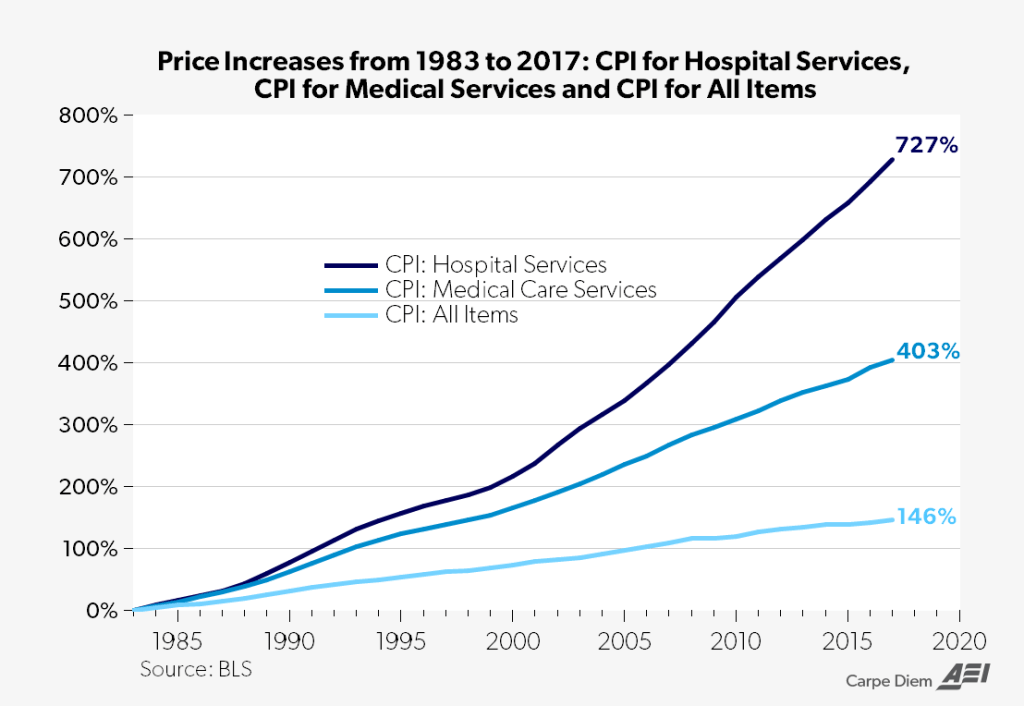
The healthcare industry seems to be running in the opposite direction regarding incentives. Large hospitals commonly increase prices for services and lab technology, knowing that insurers and government programs will foot the bill one way or the other. 2  A big reason hospitals can do this is due to lack of competition within the sector. 3 On average Americans have access to only a few healthcare providers, which incentives monopolistic practices such as price gouging. 4  These practices shift the financial burden onto patients, insurers, and taxpayers, exacerbating the system’s inefficiencies.  Insurance companies also contribute to producing bad economic incentives but in a different way.

Source: American Enterprise Institute

Health care Insurers also contribute to overall inflated healthcare prices. That’s because insurance companies have few incentives to negotiate for better rates or challenge the high prices set by hospitals.  They are well aware that they can pass those costs onto consumers in the form of higher premiums or deductibles in order to fulfill their fiduciary duty to their shareholders. 5 By passing those costs on to their consumers they ensure their shareholders are maximizing profits effectively fulfilling their duty. This leads to a disconnect between the price of healthcare and the actual cost to consumers leading to the  inflated cost of healthcare of the healthcare system.

Additionally, some companies during economic downturns might only focus on the volume of services provided, rather than the quality or necessity of those services. This may encourage doctors to prescribe unnecessary treatments overuse of healthcare and can result in unnecessary tests or procedures, which drive up the overall healthcare costs. If you are fully covered getting extensive tests is beneficial for your health but unnecessary care drives up the price for people who do not have adequate coverage. That is because higher utilization of healthcare services- necessary or not artificially inflates demand, which providers often use to justify price increases. Most insurance companies operate within fee-for-service payment systems, where providers are reimbursed based on the volume of services delivered rather than the value or outcomes. This further incentivizes unnecessary treatments, tests, and procedures, as healthcare providers have a financial interest in maximizing billable services

Further, the administrative complexity of health insurance also adds significant costs to the healthcare system. Insurers maintain vast bureaucracies to process claims, determine coverage, and manage provider networks, which requires substantial resources. Anecdotally, after spending some time in the insurance sector, a lot of the administrative tasks incentivize an incredible amount of waste.  These costs are ultimately passed on to consumers. For example, administrative expenses in the U.S. healthcare system account for nearly 8% of total spending, compared to 2-3% in countries with simpler, more centralized systems. 6

Action is Necessary

The tragic events surrounding Brian Thompson’s assassination have understandably stirred intense emotions and reignited a national conversation about the flaws in our healthcare system. While these tragedies can bring the issue to the forefront, history shows us that meaningful change doesn’t come from fleeting moments of outrage. The shockwaves from Thompson’s death can grab attention temporarily, but true change only happens when we confront the deeper economic incentives that drive the inefficiencies and inequalities in healthcare.

Reform, as we’ve seen in the past, is rarely quick or easy. It faces resistance from entrenched interests that benefit from the status quo. But the time to act is now. The monopolistic pricing, the disconnect between what healthcare actually costs and what patients pay, and the lack of meaningful negotiation from insurers- all of these must be tackled with urgency. It’s time to rethink the economic incentives behind the healthcare system and shift the focus toward transparency, competition, and patient-centered care. The current model is unsustainable, and the responsibility for change lies with all of us; policymakers, healthcare providers, insurers, and the public.

Let us use this tragedy not as a fleeting moment of anger but as a rallying point to demand systemic reform. By ensuring that economic incentives align with the well-being of patients and the long-term sustainability of the system, we can move toward a healthcare system that serves the needs of every American, not just the powerful few. Now is the time for thoughtful, deliberate action to reform the healthcare system in a way that reflects the values of justice, fairness, and efficiency for all.

“The time to repair the roof is when the sun is shining.”

-John F. Kennedy

Right now, I’m sad to say, it seems like we’re attempting to repair a roof in the middle of a tornado. Urgent action is needed.


Sources

  1. According to the Journal of the American Medical Association (JAMA), the U.S. healthcare system is plagued by administrative inefficiencies, price inflation, and overuse of medical services, which are driven by poorly aligned incentives among providers, insurers, and payers.

    Source: JAMA. “Waste in the US Health Care System: Estimated Costs and Potential for Savings.” (2019). ↩︎
  2. Research from the RAND Corporation indicates that hospitals charge private insurers an average of 247% of Medicare rates for the same services. This price disparity exists because private insurers lack the bargaining power to negotiate rates effectively, and hospitals rely on these inflated payments to subsidize their operations.

    Source: RAND Corporation. “Prices Paid to Hospitals by Private Health Plans Are High Relative to Medicare and Vary Widely.” (2020).. ↩︎
  3. Research shows that hospital consolidation reduces competition and leads to higher prices. A study by the National Bureau of Economic Research (NBER) found that hospital mergers result in price increases of 6% to 18%, depending on the level of market concentration.

    Source: NBER. “The Price Effects of Cross-Market Hospital Mergers.” (2018).
     The Health Care Cost Institute (HCCI) reports that the average price for hospital services is significantly higher in concentrated markets than in competitive ones.

    Source: HCCI. “Healthy Marketplace Index.” (2020). ↩︎
  4. The American Medical Association (AMA) found that in 2019, 90% of metropolitan areas in the U.S. were highly concentrated for hospital markets, meaning patients had limited choices among providers. This is also the case in more rural areas as well.

    Source: AMA. “Competition in Health Insurance: A Comprehensive Study of U.S. Markets.” (2019). ↩︎
  5. Premiums and deductibles for employer-sponsored health insurance have been steadily rising, with average family premiums increasing by 55% over the past decade. Insurers often attribute this to rising healthcare costs from hospitals and providers.

    Source: KFF. “2022 Employer Health Benefits Survey.” ↩︎
  6. The Study highlights the disproportionately high administrative costs in the U.S. healthcare system compared to other high-income nations with centralized systems, where administrative spending ranges between 2-3% of total healthcare expenditures             

       Source: Woolhandler, S., & Himmelstein, D. U. “Administrative Work Consumes One-Quarter of U.S. Physicians’ Working Hours and Lowers Their Career Satisfaction.” Health Affairs, 2014. ↩︎

Robert Moses: The Unelected Master Planner

Robert Moses is a figure that’s relatively obscure to the general public. However his influence has had a lasting impact throughout the United States. He would be paramount in engineering how cities in the States were structured, effectively influencing how and where Americans would spend their money.

Who was Robert Moses? Well, to start, he was unelected public official who held about 12 positions in the Greater New York city area. His stints in public office span from 1924-66. The positions he held had tremendous influence over urban planning. Urban planners aren’t often thought of as being political behemoths but Robert Moses’s tenure in these positions forces us to reconsider the influence unelected politicians may have over society.

Mr. Moses was a relentless, effective, and a calculated worker. His ability to start and finish public projects is arguably unmatched within the scope of American history. Furthermore, his ability to manipulate power goes far beyond the scope of anything Machiavelli could have imagined within a democratic republic. Robert Moses wasn’t fully understood or recognized outside of New York until the publication of Rob Caro’s Pulitzer winning book The Power Broker. The book gives us a grandiose look into the Moses. Robert Caro spent years researching for his book which spans roughly 1,300 pages. His scholarship, alongside with years of historical developments since the initial publication, are what guide my analysis on Robert Moses. Through our investigation of Robert Moses we will come to understand how a lot of cities in the United States mirror each other in terms of structure and societal development. And, albeit indirectly, an analysis of Moses forces us to consider a few philosophical questions when it comes to ideal local governance in the United States. But before we attempt to get understand why these two inquires are relevant , we have to investigate the rise of Robert Moses.

 Robert Moses assent spanned various societal backgrounds. His tenure in public office spans three major historical events in the United States. Moses held positions during the economic boom of the 1920s, a crippling Depression in the 1930’s, World War II, and the subsequent post war economic boom.

The 1920’s: The Rise to Power

After finishing up his PhD at Columbia University, Moses decides to enter New York politics as a political idealist motivated to make change. A story familiar to many young professionals who aim to change the “old guard” within political systems. Moses had plenty of issues he wanted to grapple over. The society he was living in was corrupt, had little to no consumer protection, and certain industries were dominated by monopolies. He briefly worked for the Bureau of Municipal Research and with the U.S. Food Commission. But soon he realized that philosophical theories and logic, no matter how beneficial, wouldn’t take you far when it came to political advancement. His initial propositions were brushed under the rug by the seasoned veterans of government. Though his theoretical understanding of politics would come in handy from time to time, his practical education of political power would be where he was able to hone the craft of political power.

After a series of fortunate events  Moses found himself appointed as the chief of staff to a woman named Belle Moskowitz. She was the leader of a commission tasked with organizing New Yorks administrative structure. A responsibility which came with significant power. It’s worthy to note Belle Moskowitz wasn’t elected by anyone. Rather, Moskowitz was appointed by Alfred Smith the Governor of New York. Smith was of course elected. I include these details not to be redundantly informative but rather to highlight the opaque nature of local government when it comes to transparency. People who you may assume are in control are passing that responsibility to an “advisor”, meaning there are various puppeteers pulling the strings. Moses’s time with Moskowitz is where he would learn the “tricks of the trade” in terms local governance. After managing to impress Alfred Smith through the early 1920’s, Moses found himself appointed to his first positions of power. The appointments would lead him to a notorious political squabble with an eventual US president, Mr. Franklin Delano Roosevelt.

The Appointed One & The Fight with Roosevelt.

In 1924 Moses was appointed as the leader of both the Long Island State Park Commission and State Council of Parks. Moses actually drafted the legislation that created the power of these commission earlier in his career. Personally, when I read the names of these positions I didn’t immediately think POWER.  But let’s remember that Moses was calculated.  He strategically used the power that he did have to gain even more power. Being head of these political bodies allowed him unprecedented control over land-use and highway construction. Behind the scenes he usurped control over certain political entities from elected officials. Moses would lobby constituents, politicians, and special interest groups into allowing him to have independent control over land-use and highway development commissions. Overtime he began to resemble a mini dictator. However, his power wouldn’t go unchallenged.

LC645-600Border
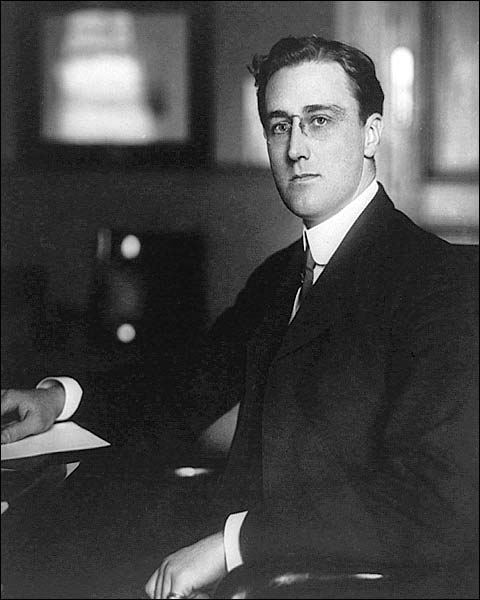
Young Roosevelt.

Franklin Roosevelt, at the time leader of the Taconic State Parkway Commission, had a political spat with Moses. It all started when Roosevelt had a plan to build a parkway through a region of New York City called the Hudson Valley. Moses had different plans. He managed to funnel all the funds from Roosevelt’s project to his own project. Moses was able to keep the funding to Roosevelt’s project so low that it could barely even maintain operations. Roosevelt complained to the governor that Moses was “skinning” Smith’s administration alive. But nothing happened. Eventually, Roosevelt became governor and eventually his parkway project was completed. Roosevelt had another goal in mind, and that was to remove Moses from power. But the removal of Moses was almost impossible by the time Roosevelt became governor. Robert Moses had set up a powerful base of political independence by using legislation, public funding, the press, and young political reformers to support his positions. He would later spearhead a commission which aimed to consolidate 187 separate agencies into eighteen departments. In just 10 year’s Moses was able to absorb power from potential opponents and build a powerful network to get his projects done. But this was just the start there was much more to come from Robert Moses.

The Depression & Beyond

During the 1930’s the United States suffered an economic depression. During this economic catastrophe Robert Moses would blossom. Ironically, his former rival actually enabled this via New Deal legislation lead by President Roosevelt. Moses was granted even more executive and monetary incentive to solidify his power by the Federal Government. Roosevelt, not forgetting his political tenure in New York, attempted to get Moses ousted by making federal funds available only if Moses was removed from office. Moses wasn’t threatened. He told the press of Roosevelts demands. Subsequently, the Federal Government had to stop after increasing public pressure. But as World War II was being waged, Robert Moses’s influence on New York City began to take shape.  The Master Builder started to work on his vision. One unnamed federal official commented on Moses during this era saying:

“Because Robert Moses was so far ahead of anyone else in the country, he had greater influence on urban renewal in the United States – on how the program developed and on how it was received by the public – than any other single person.”

That quote gives us an insight on the magnitude of power Moses had. He was responsible for many projects ranging from the United Nations Headquarters, Shea Stadium, and the Pratt Institute. But he also led initiatives to spur more highway developments, suburban housing developments, strip malls, and other public amenities. Moses got even better at getting projects done. A common strategy involved starting projects knowing that financially they couldn’t be accomplished , but he would leverage political clout in order to manipulate political officials to complete his projects anyway. While in the depression his projects employed a largely jobless populous during the Great Depression. During this era, he held numerous public positions at the same time. None of the positions required him to be publicly elected.

WWII & The New America

The world dramatically changed after World War II. The United States emerged as an economic and political powerhouse within the International community.  Moses understood this and he wanted to further influence the new world around him. His goal for NYC was one that attempted to integrate an urban center to suburban areas which would all be interconnected via parkways. The bureaucrat’s vision would influence America for the years to come.

After World War II America’s social community began to change. Women entered the work force in droves, the nation was in better economic shape than a lot of nations in the world, and the ideal of “Americanness” began to solidify. What do I mean by Americanness? I mean white picket fences, increased home & automobile ownership, and the development of mass consumerism. After WWII plenty of soldiers came home to start anew. They were incentivized to start “nuclear” families, to buy homes, develop their market skills, and most importantly to spend money in order to expand the American economy. Robert Moses was fully aware of this societal shift. He saw the traditional layout of American cities as archaic and counter intuitive to the world’s economic demands. Small retail owners were dismissed in favor of shopping behemoths

download (1)
Robert Moses and NYC Mayor Jimmy Walker.

such as Macy’s, Sears, and the advent of the shopping mall. Local restaurants were forgotten as Dairy Queen and McDonalds slowly became staples in the American diet. Automobiles slowly eliminated the reliance on public transport, allowing people to buy suburban properties further away from NYC.  Moses preferred a sprawl model over concentrated urban communities. And he developed plenty of projects to incentivize the sprawl model. New Yorkers, such as Robert Caro, criticize Moses for destroying New York neighborhoods in favor of vast highways that connected the suburbs to the City. When developing these projects Moses displaced hundreds of thousands of people, destroyed economic centers, and arguably community identity. This led critics to surmise that Moses perhaps preferred automobiles and shopping centers over people. Furthermore, Moses played a part in depleting New York’s resources to develop his projects.  But despite that, the Moses model was in demand in post war America. Plenty of public officials from around the country demanded Robert Moses’s expertise in developing their city plans. This may explain why many American cities, especially in the Midwest, mirror each other in a plethora of ways.

In hindsight Moses’s city planning was a perfect model for a globalized economy. It was predictable; generally people would work a similar hourly schedule, consistently consume products from publicly traded corporations, and, by driving, consumers would

download
Robert Moses

support the gas, oil, and automobile industry. This model has its merits. It’s predicable, safe, and allows people to consume their preferred products. However, a community too reliant on the Moses model is more susceptible to global economic crises. This isn’t just a theoretical proposition, practical examples are evident when we look at Detroit and Las Vegas during the 2008 financial crisis. But it’d be remiss to not mention how many new and innovative developments Moses was responsible for. He was able to engineer and execute massive urban plans that did help a considerable amount of people. But at the expense of displacing many people out of their communities. But one of the most disturbing things about Robert Moses is his ability to become an immensely influential political figure without having to get elected into political office.

Moses’s story forces us to think about the type of local (& perhaps national) governments people would prefer. Do we prefer governments that can be taken over by “Mosesesque” figures in order to get long term, and perhaps beneficial, projects done? Or do we want a system that is a bit more decentralized which doesn’t allow any one sole “political will” to dominate? Whatever you prefer, each has its positive and negative implication.

Which begs a peripheral question: How much do YOU know about the unelected officials in your local government? A question to consider.

Sources:

Power Broker by Robert Caro

ROBERT MOSES AND THE RISE OF NEW YORK THE POWER BROKER IN PERSPECTIVE by KENNETH T. JACKSON

A Consumer’s Republic: The Politics of Mass Consumption in Postwar America by Lizabeth Cohen

https://www.pbs.org/wnet/need-to-know/environment/the-legacy-of-robert-moses/16018/

http://fordhampoliticalreview.org/the-legacy-of-robert-moses/

America’s Forgotten Civil War: Colorado’s Coalfield War

     The first article of the new five part Forgotten American History series! The Forgotten American History series aims to introduce readers to the less commonly known aspects of American history. The first edition takes us to Colorado! Hope you enjoy. 


Colorado’s Coalfield War is one of the most violent yet obscure events in American history. Which is a bit puzzling since The Coalfield War has all the allure of the quintessential American story. It has divisiveness, the quest for the American dream, violence, and an underdog. The Coalfield War took place after a rapid economic boom in the United States. The early 20th century saw the development of notable business magnates. Some you are most likely familiar with such as Andrew Carnegie, John D. Rockefeller, and Henry Ford. During their time they were commonly referred to as ‘industrialist”. That’s mainly due to the economic supremacy they had on industries such as fossil fuel, manufacturing, and transportation. The business strategies commonly used by these magnates were monopolistic. Common techniques used to monopolize included unilateral corporate acquisitions, price controls, and wage suppression. However, a new social development would attempt to countervail the monopolistic tendencies of these business tycoons.  The development being worker’s unions.

Laborers in the early 20th century worked in abhorrent conditions. An unnamed worker who grew up in one of Pennsylvania’s mining communities provides an account on what life was like for a miner:

Our daily life is not a pleasant one. When we put on our oil soaked suit in the morning we can’t guess all the dangers which threaten our lives. We walk sometimes miles to the place- to the man way or traveling way, or to the mouth of the shaft on top of the slope. Add then we enter the darkened chambers of the mines. On our right and on our left we see the logs that keep up the top and support the sides which may crush us into shapeless masses, as they have done to many of our comrades. We get old quickly. Powder, smoke, after-damp, bad air- all combine to bring furrows to our faces and asthma to our lungs.”

Wages were often not paid in US dollars. Rather, workers were paid with metallic strips which were redeemable in company stores. A stark contrast to how modern wage payment is facilitated. Furthermore, workers often lived at their work sites. Worker’s would often build their own dwellings which ranged from tents to shacks. This led to the development of work specific settlements.  In addition, workers often lacked representation in terms of corporate boardrooms. However, workers unions began to spring up providing an opportunity for representation. Exploited laborers could finally voice their frustration en masse.

Colorado’s Coalfield War gives us a perfect opportunity to examine the early relationship between industrialists and workers unions. The stereotypical relationship is often framed idealistically. The cliché often goes like this; workers are in discontent due to their impoverished work situation.  They then begin to band together and organize. Managers are often against organizing but after some convincing they slowly join the workers’ cause. And in one harmonious swoop the workers walk over to administrative offices and demand that the industrialist improve conditions. The industrialist, understanding the gravity of the situation, then succumbs to their demands. And after both parties reach an agreement. But realistically it was never that straightforward.  Colorado’s Coalfield War will give us a realistic glimpse of how a lot of early labor disputes panned out in the United States.

The story of Colorado’s Coalfield War begins in the coal mines of southern Colorado during the 1910’s. Colorado’s coal industry at the time was booming. So much so that roughly 10 percent of the state’s population was employed by the coal sector. At the time coal was highly profitable due to the demand of America’s expanding railroad system which needed coal to fuel their engines. One of the nation’s richest people were involved

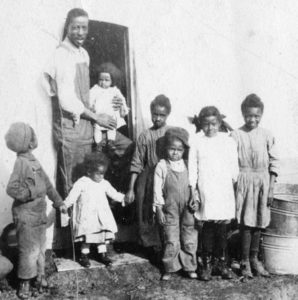
Apr20family-298x300
One of Colorado’s mining families that was living in a tent community

in the coal industry. For example, John D. Rockefeller Jr (heir to John D. Rockefeller) recognized an opportunity to capitalize and acquired ownership of the Colorado Fuel and Iron company (CFI).

Coal mining for the CFI was physically arduous and hazardous work. CFI’s coal miners were under a considerable amount of fatal risk compared to other American coal miners. Statistically, miners in Colorado were twice as likely to die on the job compared to their peers in other states. That’s not to say that the other states were a pleasant place work. But Colorado’s coal mines were considerably risky. The fear of explosion, suffocation and collapsing mines was the reality for many coal miners . Ironically, Colorado had some of the best mining laws in the country. But Colorado’s mining laws were rarely enforced. The United States House Committee on Mines once declared:

Colorado has good mining laws and such that ought to afford protection to the miners as to safety in the mine if they were enforced, yet in this State the percentage of fatalities is larger than any other, showing there is undoubtedly something wrong in reference to the management of its coal mines

Furthermore, mining labor in Colorado was egregiously exploited. Worker’s were paid for the tonnage of coal produced. However, their “dead work” (maintenance, supply runs, and infrastructure repairs) were unpaid.

By 1913, 10,000 of Colorado’s miners had enough with their work environment and decided to strike. The strikers attempted to unionize via the United Mine Workers of America. They demanded improved work conditions, better wages, strict enforcement of Colorado’s mining laws, and union recognition. The CFI responded by rejecting all of the union’s demands.


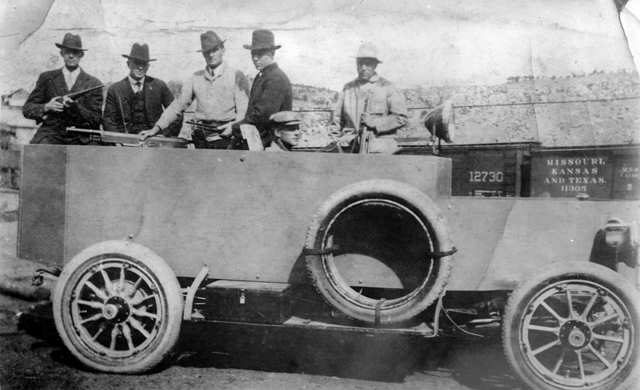
Ludlow_Death_Car
Baldwin- Felts employees with an armored car.

There were considerable measures taken to countervail unionization. The CFI employed strikebreakers to keep the company running. The company evicted strikers from their company homes forcing the striker to build tents for their families nearby. Under Rockefellers orders, the CFI hired Baldwin- Felts Detective Agency (a private detective agency) to harass the strikers.  The agency would shine spotlight on tents, fire live ammunition at strikers’ tents, and patrolled the tent communities with an armored vehicle that had a machine gun mounted unto it. Clearly these were terror tactics. The strikers were unphased. Strikers responded to the terror tactics by taking up arms and defending their tents. Eventually, the skirmishes were acknowledged by the governor of Colorado and he responded by sending the National Guard to the tent community in Ludlow. The strikers were under the impression that the National Guard was there to protect them. But several hundred strikers were arrested by them and often beat the strikers. The National Guard would add more fuel to the fire when they discovered that a strikebreaker had been murdered. The National Guard had been financed by the CFI to cover the expenses of deployment, so they had an implicit obligation to make sure the CFI’s interests were met. One day while the tent dwellers were at funerals commemorating two infants, the National Guard began to dismantle the tent community. However, the community members rebuilt the tents and they continued the strike, persevering through the winter. However, things would come to a boiling point on April of 1914.

The Ludlow Massacre

On April 20th 1914, two national guard posts were deployed on top of a hill, encircling the Ludlow tent community. They deployed an armed post with a machine gun overlooking the strikers. No one is exactly sure what instigated the violence. Some historical records suggest that the National Guard was demanding the release of a

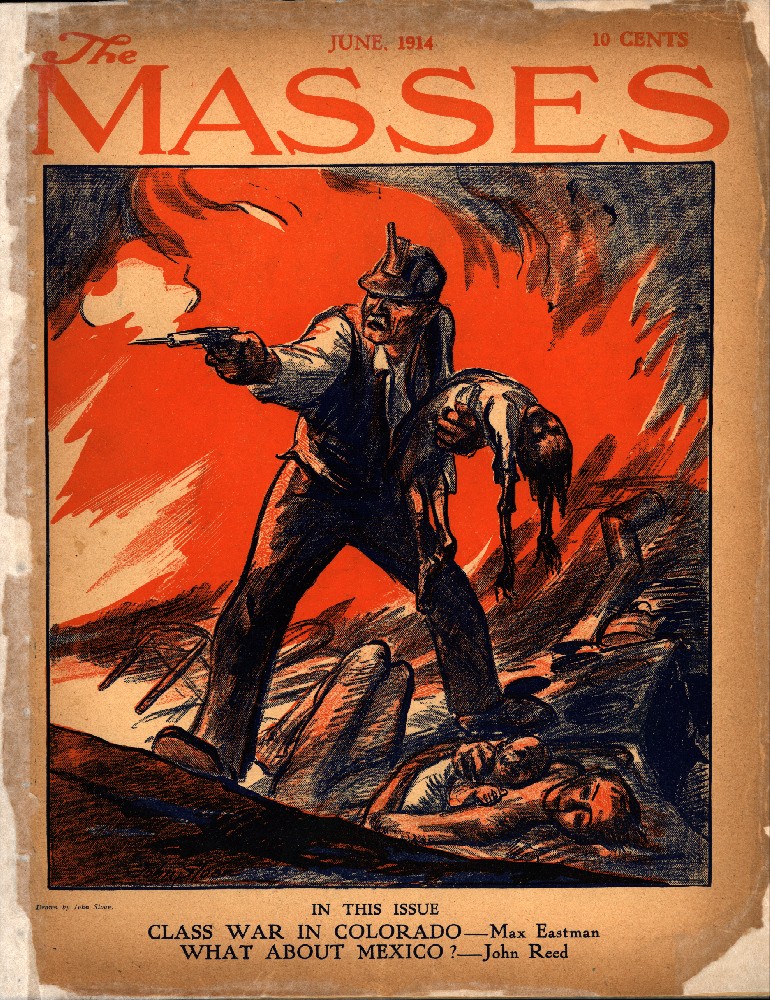
Masses_1914_John_Sloan
The Masses cover art depicting the Ludlow Massacre

hostage, but the strikers refused to give the hostage up. One of the sides then opened fire (it’s unclear who fired the first shot). Nevertheless, a battle would ensue which lasted the whole day. The casualties included high ranking union members such as Louis Tikas. Innocent bystanders (mainly women and children) hid in their tents to avoid the gunfire. The strikers retreated. The National guard then went to the tents, doused them with kerosene, and set them on fire. One of the tents that were set on fire housed 11 children and 2 women. The women and children all died, they were either burned or suffocated to death. These casualties were deemed a massacre by several periodicals in Colorado. The news of the National Guard’s atrocities would then spread across the nation like wild fire.

   Height of The Coalfield War

In Denver, the United Mine Workers declared “A Call to Arms”. They suggested that all union members should gather all “arms and ammunition legally available.” . Subsequently an insurgency would take place in Colorado. Three hundred armed strikers marched from all over Colorado to the Ludlow area. When they made it, the insurgents cut telephone and telegraph wires. And they prepared for battle. The New York Times described the event as such:

“With the deadliest weapons of civilization in the hands of savage-mined men, there can be no telling to what lengths the war in Colorado will go unless it is quelled by force … The President should turn his attention from Mexico long enough to take stern measures in Colorado

Furthermore, in an act of solidarity railroad workers refused to transport National Guard soldiers from Trinidad to Ludlow via railway. Up north in Colorado Springs, union

CC-X-60543
Colorado National Guardsman at an Outpost in Southern Colorado.

miners walked off their jobs and set off to Trinidad. They carried revolvers, rifles, and shotguns. Support was even shown on the East Coast. In New York City, picketers marched in front of the Rockefeller office located on 26 Broadway, New York City. However, these demonstrations were quickly quashed by local law enforcement.

When all the miners met in southern Colorado violence naturally ensued. They attacked antiunion town officials, supervisors/guards, and strikebreakers. Sporadic violence was rampant in southern Colorado as the miners carried out targeted killings, the statistical figures on fatalities vary considerably. So, a precise number can’t be drawn on how many people died. The insurgents also damaged a considerable amount of mining infrastructure.  The Associated Press estimated the financial losses at $18 million (which is about $450,239,203 in 2019).  The CFI alone lost $1.6 million. They were also able to strategically take control of an area that was roughly 50 miles long and 5 miles wide. However, this control didn’t last long. President Woodrow Wilson dispatched federal troops to Colorado, and the miners subsequently surrendered.

         Aftermath

After the Coalfield Wars, Congress held hearings with John D. Rockefeller Jr, union leaders, and several high-ranking members of the National Guard. Though atrocities were recognized by both sides during the hearing, no one was ever formally indicted for their crimes. Unfortunately, a lot of the tangible benefits the strikers were fighting didn’t materialize.  But all wasn’t lost. Rockefeller, feeling political pressure, lead an initiative so workers could have internal representation in the CFI. A measure akin to modern internal corporate arbitration. He also created an internal company union. And encouraged internal social services such as creating a YMCA for the Mining department. During this era, the YMCA played a substantial role in influencing morality and promoting athletic activity within American communities. But it’s important to remember these measures are a far cry from what the original demands the UMWA fought for. It can be argued that these measures were a bit of strategic marketing from Rockefeller. Think about internal company unions will always have corporate interest in mind. So full workers representation isn’t fulfilled. But there is a silver lining, the UMWA gained 4,000 new  members.

In all the Coalfield War gives us an interesting look into the dynamic relationship between industrialists, the government, and workers. Namely, that when disenfranchised workers sought better work conditions that undermined corporate interests, considerable measures were taken to curtail workers goals. Measures which would disgusts modern American sentiments.  Hiring private companies to terrorize workers, bringing in government officials to suppress workers, and massacring innocent bystanders would likely surprise many American households in the 21st century. We also get a key insight on what happens when “the people” get pushed too far in terms of getting their grievances acknowledged. Violent civil disobedience.


I’ll leave readers with song lyrics about the Ludlow massacre by Woody Guthrie:

It was early springtime when the strike was on,

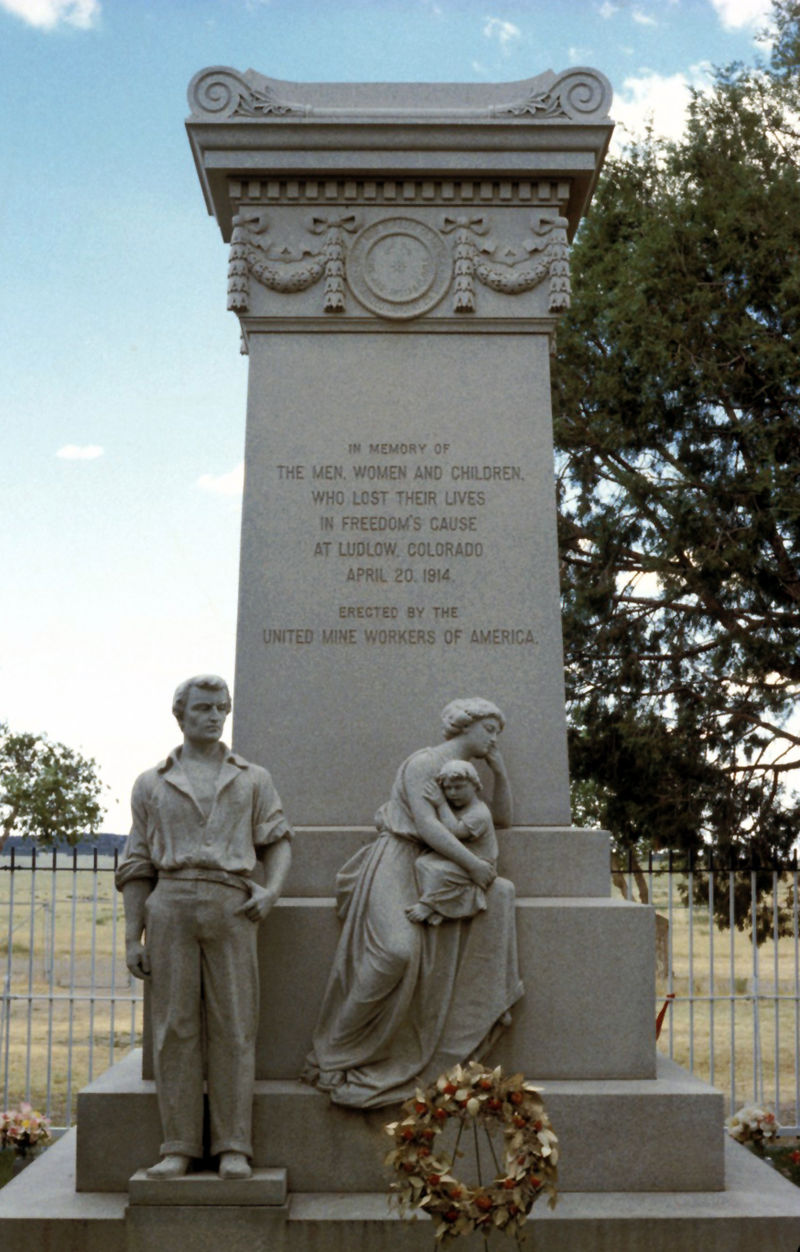
800px-Ludlow_Monument_Cropped
Ludlow Memorial

They drove us miners out of doors,

Out from the houses that the Company owned,

We moved into tents up at old Ludlow.


I was worried bad about my children,

Soldiers guarding the railroad bridge,

Every once in a while a bullet would fly,

Kick up gravel under my feet.


We were so afraid you would kill our children,

We dug us a cave that was seven foot deep,

Carried our young ones and pregnant women

Down inside the cave to sleep.


That very night your soldiers waited,

Until all us miners were asleep,

You snuck around our little tent town,

Soaked our tents with your kerosene


Works Cited:

https://coloradoencyclopedia.org/article/ludlow-massacre

https://www.zinnedproject.org/news/tdih/ludlow-massacre/

https://www.pbs.org/wgbh/americanexperience/features/rockefellers-ludlow/

https://upcolorado.com/university-press-of-colorado/item/download/301_0c3ef02f967b1fa4d978737d608bc159

The Ludlow Massacre: Class, Warfare, and Historical Memory in Southern Colorado by Mark Walker (Historical Archaeology Vol. 37, No. 3, Remembering Landscapes of Conflict (2003), pp. 66-80)

A Miner’s Story The Independent, LIV (June 12, 1902), 1407-10. (http://www.digitalhistory.uh.edu/voices/social_history/14miner.cfm)

Thales & Heraclitus: What Russell Got Wrong.

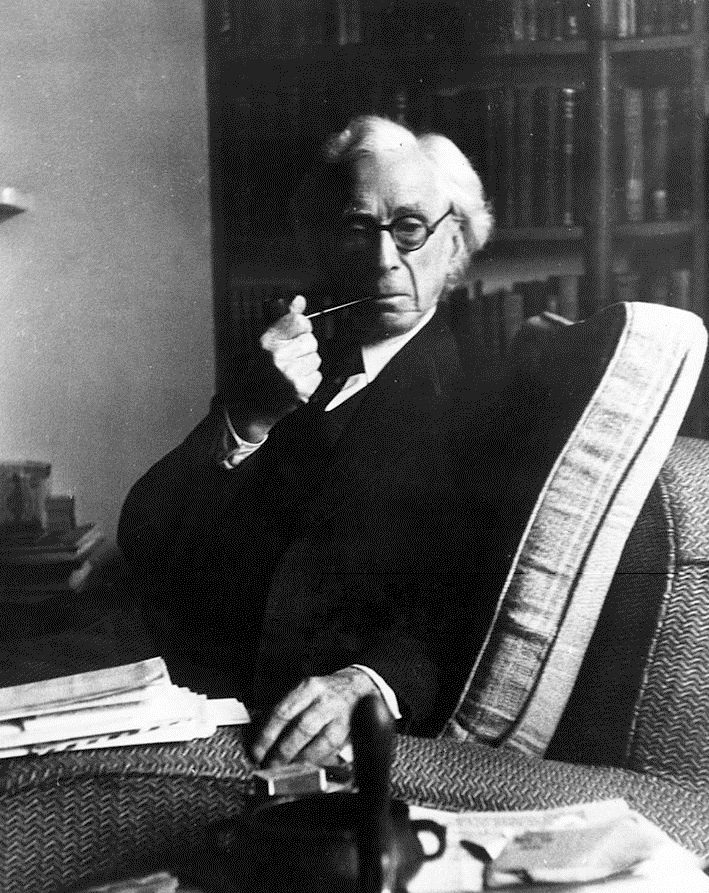
Bertrand Russell Chiefing A Pipe.

    Often Bertrand Russell is revered in the mainstream philosophical community. And rightly so, the work he’s done in the fields of logic, linguistics, and mathematics have had a profound impact on the world. His influence has led him to be credited as the founder of analytic philosophy. But people often forget that Russell was also interested in history, so much so that he penned a lengthy history of Western Philosophy, which he called A History of Western Philosophy. This article will discuss Bertrand Russell’s account of Heraclitus and Thales. Two philosophers who came before Plato and Aristotle. The reason such a discussion is necessary is due to the fact that Russell may not be giving an accurate portrayal of either philosopher in his book. The reason being is that Russel relies on problematic sources to back his claims. This piece will attempt to outline the thoughts Russell had on these thinkers, and then we will criticize certain elements of his arguments. But in order to conduct a proper analysis we must understand the overal goal of Russel book.

    In the History of Western Philosophy  Bertrand Russell attempts to provide a coherent timeline for western philosophical thought. He claims that in order to successfully attempt such a project a specific method of analysis must be used. A method which is “philosophical”. By “philosophical” Russell means that he’ll attempt to synthesize the historical development of two different styles of inquiry, those being scientific and theological traditions (Russell Xiii). Both have different functions, but yet throughout history they’ve reinforced one another in various ways. For Russel, theology is useful because it allows us to make “speculation on matters as to which definite knowledge has, so far, been unascertainable.”(Russell Xiii). In other words, theology allows human reason to explore the unknowable. Now on the other hand, science allows human reason to explore the knowable (Russell Xiv). According to Russell, both have limitations; theology induces dogmatic belief (which he disapproves of), while science tells us what we can in fact know but “what we can know is little” (Russell xiv). Having acknowledged their flaws, Russell proceeds to argue that the development of human intellectual history has been shaped by those two methods of inquiry interacting with one another over time. Theology picks up the methodological flaw inherent in science, and vice versa. It’s this symmetric relationship which allows Russell to put various thinkers in dialogue with one another. Giving readers a coherent narrative to follow in terms of the development of western philosophical thought. But Russell’s methods have drawn scrutiny amongst critics. Frederick Copleston, a contemporary of Russel, acknowledged that “[Russell] treatment of a number of important philosophers is both inadequate and misleading.”. The inadequacy and misleading nature of Russell’s work is evident in his description of two philosophers who came before Socrates, Thales and Heraclitus.  


Bertrand’s Thales

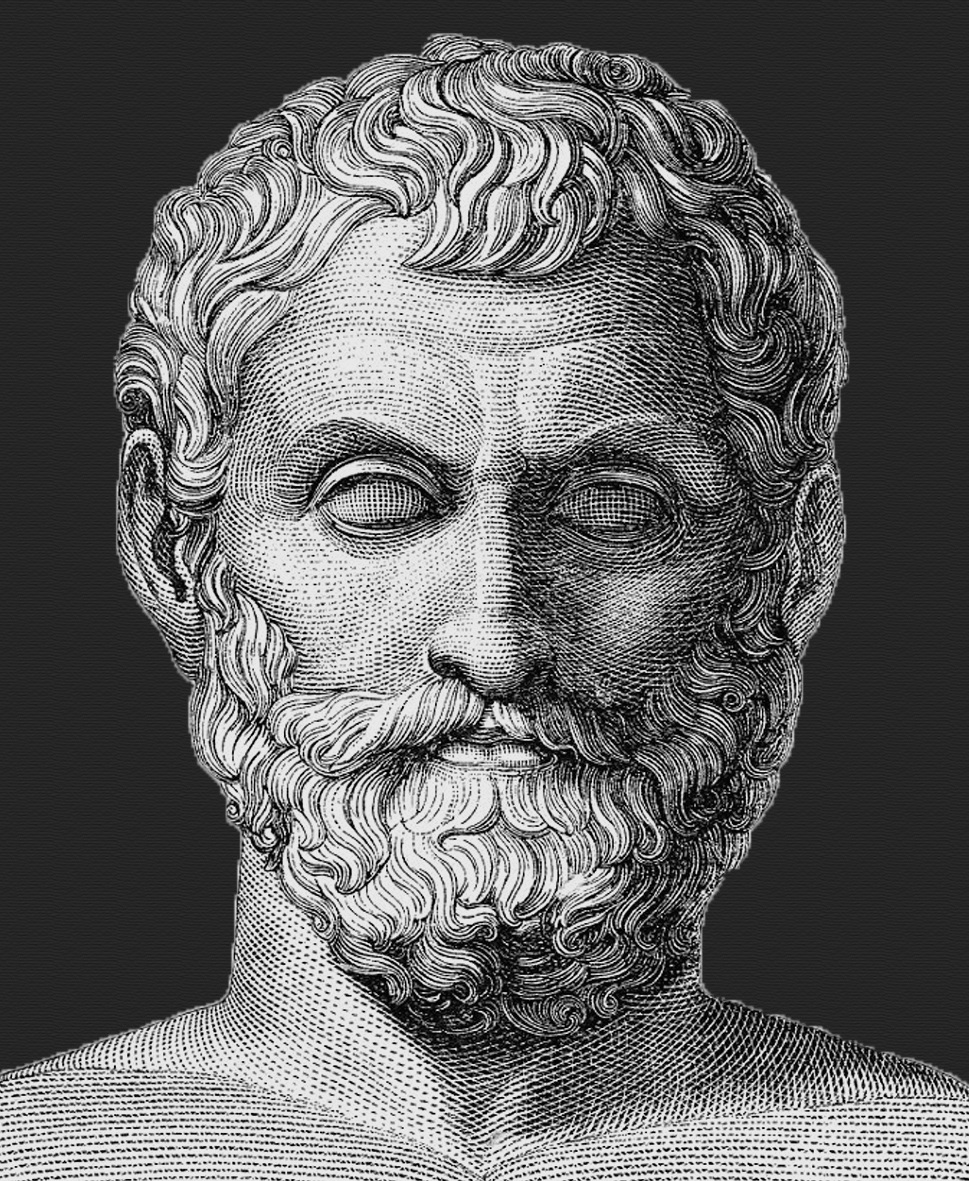
Image result for thales
Thales the “scientist”

    In order to understand and identify the “inadequate and misleading” elements of Russel’s work we must analyze his descriptions of certain philosophers. Some of the problematic elements of his descriptions can be found when he describes Thales, a thinker who was active in the 6th century BCE. To be frank, little is known about Thales specific work, as none of his writing survived. But despite that fact, society can get a general idea about Thales by reading some second hand accounts about his teachings.  Russell provides an introduction to Thales, writing: 

“There is…ample reason to feel respect for Thales, though perhaps rather as a man of science than as a philosopher in the modern sense of the word.” (Russell 24)

This sentence should warrant our attention because we can analyze and infer a few things from Russell’s statement. One, that Bertrand holds Thales in high regard compared to the other philosopher of that particular era. And secondly, we should hold a favorable opinion on him because compared to these philosophers Thales is a “man of science”. Why does Russell feel this way? Well, it all stems from a theory attributed to Thales which professes that everything is made of water. A problematic theory to credit onto Thales in the first place, but the reason for that will be addressed in a different section in this paper. Russell explains that Thales’s theory of water shouldn’t be taken as some “foolish” hypothesis but rather as a scientific hypothesis (Russell 26). 

Now the reason he feels like Thales warrants such high praise is due to some scientific discoveries made while he wrote his book. While Russell was writing his book in the 20th century, the scientific consensus seemed to match well with Thales water theory. The consensus was largely contingent on the fact that the theoretical work done by the scientist Willaim Prout on atoms was true. Prout hypothesized that the hydrogen atom was the only fundamental element of the universe. Furthermore, he said that the atoms of other elements were actually just collection of different hydrogen atoms (Rosenfeld). This is similar to Thales’s theory since hydrogen is a pretty important component when it comes to water, but is different since Prout specifies the element hydrogen.  So this background information helps explain why Russell felt so confident in Thales. And explains assertions such as this: 

The statement that everything is made of water is to be regarded as a scientific hypothesis… Twenty years ago, the received view was that everything is made of hydrogen, which is two thirds water…. His [Thales] science and his philosophy were both crude, but they were such as to stimulate both thought and observation.” (Russell 26)

Now the last part of that sentence describes how his science and philosophy were “crude” but are acceptable since they aimed to stimulate both thought and observation. So, one can infer that theoretical frameworks which stimulate thought and observation, are ones which Russell approves of. But Russell also lets readers know what kind of frameworks he doesn’t appreciate. That leads us to Russell’s description of Heraclitus. 

Bertrand’s Heraclitus

Related image
Heraclitus the “mystic”

    The way Heraclitus is portrayed in Russell’s book plays on the theme of science and theology interacting with each other overtime. Russell generally views Heraclitus in a negative light, but acknowledges the difficulty science has had in refuting Heraclitus’s theory of perpetual flux. Additionally, Heraclitus is strangely categorized as “mystical” rather than “scientific”. Russell describes the nature of Heraclitus thought as such: 

Heraclitus, though an Ionian, was not in the scientific tradition of the Milesians. He was a mystic, but of a peculiar kind. He regarded fire as the fundamental substance, everything… is born by the death of something else “ (Russell 41)

Russell doesn’t give us a clear reason why Heraclitus shouldn’t be considered scientific, but we can imply that it’s due to his heavy reliance on intuition and speculation. Heraclitus brand of mysticism is categorized as reforming the religion of his day (Russell 42). Additionally, elements of Heraclitus doctrine are criticized by Russell. Specifically he attacks Heraclitus views on war, contempt for mankind, and his disapproval of democracy. 

Now having outlined what Russell says about these thinkers. It’s time to shift focus on what Russell may have gotten wrong when discussing these philosophers.  For instance we can use the reasoning Bertrand used to praise Thales to talk about Heraclitus as a “scientific thinker”. Additionally, we can also conceive as Thales as a “mystic”. Furthermore, we can learn to understand how Russell came to these conceptions when investigating the sources he decided to use. 


Analysis of Russell’s claims 

  Our criticism of Russell should begin with looking at what kind of information Russell based his critiques on. He’s pretty transparent in letting the readers know where he got his information from, writing: 

“According to Aristotle, he thought that water is the original substance out of which all others are formed; and he maintained that the earth rests on water”(Russell 26)

But there’s an issue with Russell’s apparent transparency. In the next paragraph he goes on to take Aristotle’s account as pure fact, and basis his entire scientific description of Thales on it. Never once does the problematic nature of Aristotle’s account of Thales get mentioned. But thankfully, recent scholarship done by Frede tells us why Aristotle’s writings on Thales aren’t to be taken as absolute fact. Frede explains that:

it is not Aristotle’s aim to provide an account of his origin of philosophy and its evolution for its own sake, to satisfy his and his readers own historical interests “(Frede 503)

Basically, Frede notes that Aristotle wasn’t entirely fair when it came down to providing accurate descriptions of certain thinkers, but rather was using their doctrines to validate his work (Frede). Now having considered that fact Thales can be seen as a mystic because not a lot of his doctrine was written down, and getting an accurate description of his work is difficult. But the school of thought he was a part of (the Milesian school) had mystical tendencies that Bertrand speaks of.  Additionally, Aryeh Finkelberg notes that: 

“Heraclitus, and other early Greek thinkers, did not set out to found philosophy and science, or pave the way for Aristotle—who has long been criticized “for reading his philosophical concerns into the early thinkers (Finkelberg, Heraclitus and Thales’ Conceptual Scheme). “So the method Bertrand uses to put them in dialogue together is problematic since none of these thinkers thought of themselves as either scientists, philosophers or mystics.

    Now having mentioned the problematic nature of the sources, I will provide  sources which allow us to think of Thales as a “mystic” and Heraclitus as a “scientist”. To begin I will refer to a source used by Russell himself- Aristotle. As noted previously Russell relies on Aristotle’s account of Thales to prove that the thinker was indeed scientific. But he conveniently leaves out an account that could hint at him being less “scientific”. In Aristotle’s work On the Soul  Thales is framed as a thinker who’s influenced by “mysticism” and attempts to explain the world via religious terms.  The account goes as such: 

“Thales too (as far as we can judge from people’s memoirs) apparently took the soul to be a principle of movement…Some say that the universe is shot through with soul, which is perhaps why Thales too though that all things were full of Gods”( Aristotle, On the Soul 405a)

There’s a lot to unpack from this phrase. Firstly, Aristotle is relying on testimonials from various people to get Thales’s account on souls. So we can infer that Thales Soul/Movement Theory was one that was known and discussed among contemporaries that were familiar with Thales. Secondly, we can see that Thales theory is based on metaphysical concepts (soul), and that these concepts have at least some effect on our material world (movement). And lastly, we can surmise that Thales’s world view largely consists of things having Gods within them. Arguably, this is a pretty “mystical” way to perceive reality. But from this phrase it’s unclear if Gods and Soul are in the same realm in terms of metaphysics. From the quote, soul is something metaphysical since it’s “principal of movement” and not movement itself. But Gods can be seen as both physical and metaphysical, since the universe being “shot with Soul” would have impact if whether things were filled with Gods or not. But it’s unclear from this reading if Gods are physical, metaphysical, or both. What we can clearly analyze is that Thales does have some mystical element in his analysis. Rendering Russell’s description as inadequate and a bit misleading. 

    Furthermore, Thales theory of water as the fundamental source of everything isn’t necessarily true. He may have never postulated that. Aristotle explains that he did indeed say that water is the fundamental source, but he also claims that he may not have seen it that way after all. Explaining that the earth and water could be reinforcing each other as elements ( Aristotle,On the Heavens, 292-294b). Thales could’ve easily believed that there didn’t need to be one principal element that’s responsible for everything. For all we know Thales could’ve theorized that several elements contributed to the forces of the world. But because Aristotle is using Thales to justify his own theories, conceptualizing him as a philosopher who believes that one fundamental source is responsible for everything is necessary in order to legitimize Aristotle’s views . 

    Let’s transition over to Heraclitus, aka the “mystical” thinker. Firstly, I’d like to mention that Russell dismissal of the claim that “everything is fire” and approval of “everything is water” is absurd. The way he justifies his reasoning, though understandable, is equally as silly. He uses Prout’s work on atoms to back up that claim but you could do the same for Heraclitus. After all everything in the universe emits heat, and if we understand fire to mean “element that emits heat”, then (considering 21st century physics) Heraclitus theory shouldn’t be taken as foolish either. Further, he can been seen as scientific due to observations such as these: 

Sea: water most pure and most tainted, drinkable and wholesome for fish, but undrinkable and poisonous for people”( Hippolytus, Refutation of All Heresies,)

&

Corpses should be disposed of more readily than dung” (Strabo, Geography).

The first quote is an empirical observation on how one element can nourish one animal but yet be dangerous to another. While the second can be interpreted as a public service announcement that corpses are as unsanitary as dung. Though not completely “scientific” in our modern use of the term, these statements are observations on the general nature of the world, and are valid. Thales allegedly made similar observations but Russell holds him in higher esteem compared to Heraclitus. 

    In all we can see that Bertrand Russell’s claims in the  History of Western Philosophy are problematic. Mainly because the notion that these thinkers were either scientific or mystical are inaccurate conceptions in the first place,since the thinkers didn’t even see themselves as such. And since we can conceptualize each thinker as both a “mystic” and “scientist” Russel’s analysis is misleading. Furthermore, the evidence used by Russell isn’t the best since the source itself, Aristotle, is biased.


Source(s):

Frede, Michael. “Aristotle’s Account of the Origins of Philosophy – Oxford Handbooks.” Oxford Handbooks – Scholarly Research Reviews, 27 Apr. 2018, http://www.oxfordhandbooks.com/view/10.1093/oxfordhb/9780195146875.001.0001/oxfordhb-9780195146875-e-20.

“Heraclitus and Thales’ Conceptual Scheme.” Heraclitus and Thales’ Conceptual Scheme | Reading Religion, 31 May 2017, readingreligion.org/books/heraclitus-and-thales-conceptual-scheme.

Rosenfeld, Louis. “William Prout: Early 19th Century Physician-Chemist.” Clinical Chemistry, Clinical Chemistry, 1 Apr. 2003, clinchem.aaccjnls.org/content/49/4/699.

Russell, Bertrand. History of Western Philosophy. Routledge, 2015.


Aristotle: On the Soul and On the Heavens


Hippolytus: Refutation of All Heresies,


Strabo: Geography