Copyright Office’s AI Report: The Good, The Bad, and The Controversial
The Copyright Office just dropped Part 3 of its AI report, which aimed at addressing certain copyright law in regards to Artificial Intelligence. The thing that’s got everyone talking is the fact that the report was supposed to tackle infringement issues head on, but instead teased us by saying that answer will come up in “Part 4” that is expected to be released at a later date. Let’s dive into what was actually discussed.
Legal Theory: A Case by Case Basis
The report’s central thesis is a pretty straightforward legal theory. Basically, they recommend that there will be no blanket rule on whether training AI on copyrighted content constitutes infringement or fair use. Everything gets the case by case treatment, which is both realistic and frustrating depending on where you sit. That’s because most lawyers like clear bright line rules backed up by years of precedent, but when attempting to make legal frameworks regarding emerging technologies, the brightline approach is easier said than done.
The report acknowledges that scraping content for training data is different from generating outputs, and those are different from outputs that get used commercially. Each stage implicates different exclusive rights, and each deserves separate analysis. So in essence, what’s actually useful here is the recognition that AI development involves multiple stages, each with its’ unique copyright implications.
This multi stage approach makes sense, but it also means more complexity for everyone involved. Tech companies can’t just assume that fair use covers everything they’re doing and content creators can’t assume it covers nothing. The devil is in the details.
Transformative Use Gets Complicated
The report reaffirms that various uses of copyrighted works in AI training are “likely to be transformative,” but then immediately complicates things by noting that transformative doesn’t automatically mean fair. The fairness analysis depends on what works were used, where they came from, what purpose they served, and what controls exist on outputs.
This nuanced approach is probably correct legally, but it’s also a nightmare for anyone trying to build AI systems at scale. You can’t just slap a “transformative use” label on everything and call it a day. The source of the material matters, and whether the content was pirated or legally obtained can factor into the analysis. So clearly purpose also matters since commercial use and research use will likely yield different results in the copyright realm. Control and mitigation matter in this context because developing the necessary guardrails is paramount to preventing direct copying or market substitution.
Nothing too revolutionary here, but the emphasis on these factors signals that the Copyright Office is taking a more sophisticated approach than some of the more simplistic takes we’ve seen from various opinions on this matter. This should be reassuring since a one size fits all approach at such an early stage of developing AI could stifle innovation. However if things are left to be too uncontrolled copyrighted works may face infringements to their copyright.
The Fourth Factor Controversy
Here’s where things get interesting and controversial. The report takes an expansive view of the fourth fair use factor: which is the effect on the potential market for the copyrighted work. That is because too many copyrighted works flooding the market brings fears of market dilution, lost licensing opportunities, and broader economic impacts.
The Office’s position is that the statute covers any “effect” on the potential market, which is broad interpretation. But that broad interpretation has a reason, they are worried about the “speed and scale” at which AI systems can generate content, creating what they see as a “serious risk of diluting markets” for similar works. Imagine an artist creates a new masterpiece only to get it copied by an AI model which makes the piece easily recreatble by anyone, diluting the value of the original masterpiece. These types of things are happening on the market today.
This gets particularly thorny when it comes to style. The report acknowledges that copyright doesn’t protect style per se, but then argues that AI models generating “material stylistically similar to works in their training data” could still cause market harm. That’s a fascinating tension, you can’t copyright a style but you might be able to claim market harm from AI systems that replicate it too effectively. It is going to be interesting to see how a court applies these rules in the coming future.
This interpretation could be a game-changer, and not necessarily in a good way for AI developers. If every stylistic similarity becomes a potential market harm argument, the fair use analysis becomes much more restrictive than many in the tech industry have been assuming.
The Guardrails
One of the more practical takeaways from the report is its emphasis on “guardrails” as a way to reduce infringement risk. The message is clear: if you’re building AI systems, you better have robust controls in place to prevent direct copying, attribution failures, and market substitution.
This is where the rubber meets the road for AI companies. Technical safeguards, content filtering, attribution systems, and output controls aren’t just up to the discretion of the engineers anymore they’re becoming essential elements of any defensible fair use argument.
The report doesn’t specify exactly what guardrails are sufficient, which leaves everyone guessing. But the implication is clear: the more you can show you’re taking steps to prevent harmful outputs, the stronger your fair use position becomes. So theoretically if a model has enough guardrails they may be able to mitigate their damages if the model happens to accidently output copyrighted works.
RAG Gets Attention
The report also dives into Retrieval Augmented Generation (RAG), which is significant because RAG systems work differently from traditional training approaches. Instead of baking copyrighted content into model weights, RAG systems retrieve and reference content dynamically.
This creates different copyright implications: potentially more like traditional quotation and citation than wholesale copying. But it also creates new challenges around attribution, licensing, and fair use analysis. The report doesn’t resolve these issues, but it signals that the Copyright Office is paying attention to the technical details that matter.
Licensing
The report endorses voluntary licensing and extended collective licensing as potential solutions, while rejecting compulsory licensing schemes or new legislation “for now.” This is probably the most politically palatable position, but it doesn’t solve the practical problems.
Voluntary licensing sounds great in theory, but the transaction costs are enormous when you’re dealing with millions of works from thousands of rights holders. Extended collective licensing might work for some use cases, but it requires coordination that doesn’t currently exist in most creative industries.
The “for now” qualifier is doing a lot of work here. It suggests that if voluntary solutions don’t emerge, more aggressive interventions might be on the table later.
The Real Stakes
What makes this report particularly significant isn’t just what it says, but what it signals about the broader policy direction. The Copyright Office is clearly trying to thread the needle between protecting creators and enabling innovation, but the emphasis on expansive market harm analysis tilts toward the protection side.
For AI companies, this report is a warning shot. The days of assuming that everything falls under fair use are over. The need for licensing, guardrails, and careful legal analysis is becoming unavoidable.
For content creators, it’s a mixed bag. The report takes their concerns seriously and provides some theoretical protection, but it doesn’t offer the clear-cut prohibitions that some have been seeking.
The real test will come in the courts, where these theoretical frameworks meet practical disputes. But this report will likely influence how those cases get decided, making it required reading for anyone in the AI space.
As we can see AI and copyright law is becoming only more and more complex. The simple answers that everyone wants don’t exist, and this report makes that abundantly clear. The question now is whether the industry can adapt to this new reality or whether we’re heading for a collision that nobody really wants.
“It takes violent shocks to change an entire nations psychology.”
– John F. Kennedy
This quote written in John F. Kennedy’s Magnum Opus ‘Why England Slept’ encapsulates the current collective psychology of the United States after the tragic assassination of Brian Thompson. Some people celebrated the CEO’s death, a symbol of the frustration many Americans have been feeling regarding the nation’s healthcare system. Critiques of the healthcare system are definitely warranted, and Luigi Manginoni’s tragic act has once again put the nations healthcare debate at the forefront a public discourse.
President Kennedy’s quote is correct, often violent acts can change an entire nations collective psychology, there are plenty of examples in history that agree with that proposition. However, people are wrong assuming that the assassination will trigger meaningful change due to the fear healthcare insurance executives may feel after the assassination of Brian Thompson. People’s idealism can cloud the reality on how institutions operate in the real world. History has proven powerful players rarely relinquish control freely. The healthcare industry could hypothetically double down and refuse to budge, further entrenching an “us vs. them” mentality that pervades many contemporary national debates. Though, admittedly, the act could hypothetically result in meaningful change in the healthcare industry- but not in the way people celebrating the death would imagine. A good case study as to why that is the case would be the Ludlow Massacre.
On April 20, 1914, in Ludlow, Colorado, striking coal miners demanded better pay, safer working conditions, and the right to unionize ( more info on Ludlow here). The strikers were attacked by the Colorado National Guard and company-hired guards, killing the protestors and some of their family members. The Ludlow Massacre lead to the Colorado Coalfield War, where workers formed a militia and started attacking Colorado National Guardsmen and private law enforcement . The workers successfully attacked many of their oppositions positions and had a lower casualty count but when the dust settled the strikers’ demands were not met, the union did not obtain recognition and many striking workers were replaced. Further 408 strikers were arrested, 332 of them were indicted for murder. The institution decided to double down on the crackdowns resulting in none of the strikers work demands being met.
Though the workers themselves did not reach their goals, the tragedy of Ludlow spurred a greater national debate on workers rights in the United States. Slowly the grievances raised by the Ludlow massacre lead to the enactment of federal labor laws that we still use today. American society should turn this tragedy into a positive and reinvigorate the discussion and action that will lead to fundamental changes in the healthcare industry. The Ludlow Massacre forced the nation to confront workers’ rights, and similarly the tragic assassination of Brian Thompson could prompt similar discussions about the systemic failures in healthcare. However, history shows that institutional change is slow and often requires sustained public pressure. Hopefully, this time around the change will come sooner, if not there are indications that matters may get worse rather than better. Analyzing the economic incentives causing this turmoil will illuminate the problem areas in the sector and hopefully lead to some practical solutions.
Economic Moral Hazards
The problem with the healthcare sector is that it produces bad economic incentives. 1 Often healthy economic incentives encourage behavior that benefits both individuals and society, they are aimed at promoting positive economic action while discouraging negative consequence such as waste or harm. For example good economic incentives would be efficiency standards for cars, they incentivize manufacturers to produce efficient automobiles by offering various government benefits. For example, car companies may get tax breaks, recognition for meeting higher energy efficiency standards, or might get access to lucrative government contracts. This makes energy utilization effective, lowers bills for consumers, and helps reduce environmental impacts by using wasteful technology.
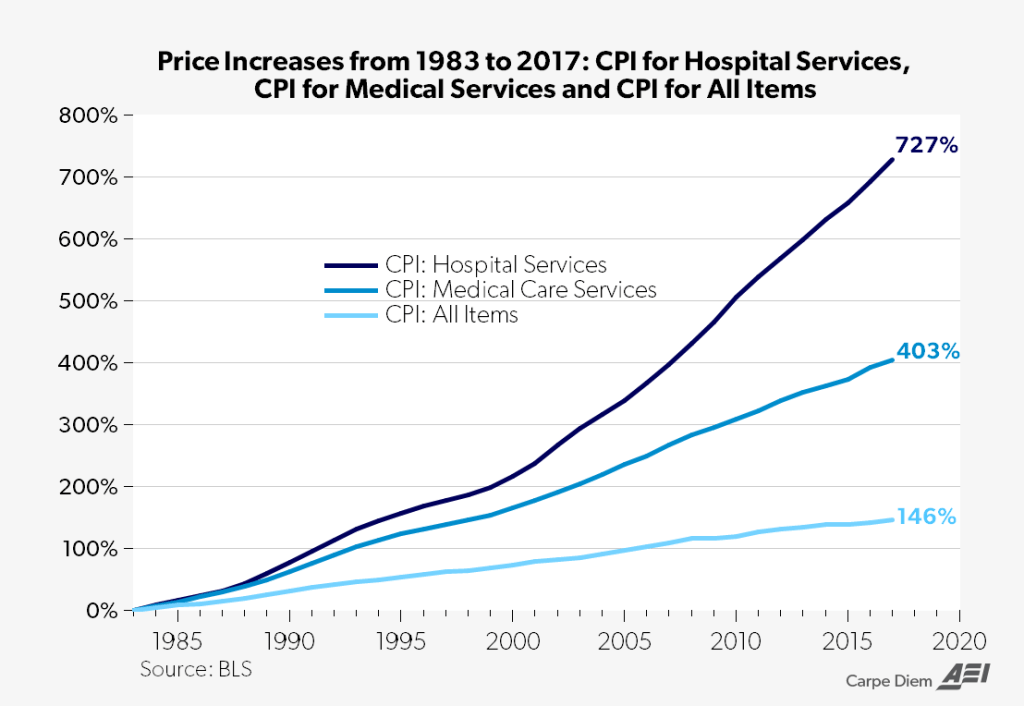
The healthcare industry seems to be running in the opposite direction regarding incentives. Large hospitals commonly increase prices for services and lab technology, knowing that insurers and government programs will foot the bill one way or the other. 2 A big reason hospitals can do this is due to lack of competition within the sector. 3 On average Americans have access to only a few healthcare providers, which incentives monopolistic practices such as price gouging. 4 These practices shift the financial burden onto patients, insurers, and taxpayers, exacerbating the system’s inefficiencies. Insurance companies also contribute to producing bad economic incentives but in a different way.
Source: American Enterprise Institute
Health care Insurers also contribute to overall inflated healthcare prices. That’s because insurance companies have few incentives to negotiate for better rates or challenge the high prices set by hospitals. They are well aware that they can pass those costs onto consumers in the form of higher premiums or deductibles in order to fulfill their fiduciary duty to their shareholders. 5 By passing those costs on to their consumers they ensure their shareholders are maximizing profits effectively fulfilling their duty. This leads to a disconnect between the price of healthcare and the actual cost to consumers leading to the inflated cost of healthcare of the healthcare system.
Additionally, some companies during economic downturns might only focus on the volume of services provided, rather than the quality or necessity of those services. This may encourage doctors to prescribe unnecessary treatments overuse of healthcare and can result in unnecessary tests or procedures, which drive up the overall healthcare costs. If you are fully covered getting extensive tests is beneficial for your health but unnecessary care drives up the price for people who do not have adequate coverage. That is because higher utilization of healthcare services- necessary or not artificially inflates demand, which providers often use to justify price increases. Most insurance companies operate within fee-for-service payment systems, where providers are reimbursed based on the volume of services delivered rather than the value or outcomes. This further incentivizes unnecessary treatments, tests, and procedures, as healthcare providers have a financial interest in maximizing billable services
Further, the administrative complexity of health insurance also adds significant costs to the healthcare system. Insurers maintain vast bureaucracies to process claims, determine coverage, and manage provider networks, which requires substantial resources. Anecdotally, after spending some time in the insurance sector, a lot of the administrative tasks incentivize an incredible amount of waste. These costs are ultimately passed on to consumers. For example, administrative expenses in the U.S. healthcare system account for nearly 8% of total spending, compared to 2-3% in countries with simpler, more centralized systems. 6
Action is Necessary
The tragic events surrounding Brian Thompson’s assassination have understandably stirred intense emotions and reignited a national conversation about the flaws in our healthcare system. While these tragedies can bring the issue to the forefront, history shows us that meaningful change doesn’t come from fleeting moments of outrage. The shockwaves from Thompson’s death can grab attention temporarily, but true change only happens when we confront the deeper economic incentives that drive the inefficiencies and inequalities in healthcare.
Reform, as we’ve seen in the past, is rarely quick or easy. It faces resistance from entrenched interests that benefit from the status quo. But the time to act is now. The monopolistic pricing, the disconnect between what healthcare actually costs and what patients pay, and the lack of meaningful negotiation from insurers- all of these must be tackled with urgency. It’s time to rethink the economic incentives behind the healthcare system and shift the focus toward transparency, competition, and patient-centered care. The current model is unsustainable, and the responsibility for change lies with all of us; policymakers, healthcare providers, insurers, and the public.
Let us use this tragedy not as a fleeting moment of anger but as a rallying point to demand systemic reform. By ensuring that economic incentives align with the well-being of patients and the long-term sustainability of the system, we can move toward a healthcare system that serves the needs of every American, not just the powerful few. Now is the time for thoughtful, deliberate action to reform the healthcare system in a way that reflects the values of justice, fairness, and efficiency for all.
“The time to repair the roof is when the sun is shining.”
-John F. Kennedy
Right now, I’m sad to say, it seems like we’re attempting to repair a roof in the middle of a tornado. Urgent action is needed.
Sources
According to the Journal of the American Medical Association (JAMA), the U.S. healthcare system is plagued by administrative inefficiencies, price inflation, and overuse of medical services, which are driven by poorly aligned incentives among providers, insurers, and payers.
Source: JAMA. “Waste in the US Health Care System: Estimated Costs and Potential for Savings.” (2019). ↩︎
Research from the RAND Corporation indicates that hospitals charge private insurers an average of 247% of Medicare rates for the same services. This price disparity exists because private insurers lack the bargaining power to negotiate rates effectively, and hospitals rely on these inflated payments to subsidize their operations.
Source: RAND Corporation. “Prices Paid to Hospitals by Private Health Plans Are High Relative to Medicare and Vary Widely.” (2020).. ↩︎
Research shows that hospital consolidation reduces competition and leads to higher prices. A study by the National Bureau of Economic Research (NBER) found that hospital mergers result in price increases of 6% to 18%, depending on the level of market concentration.
Source: NBER. “The Price Effects of Cross-Market Hospital Mergers.” (2018). The Health Care Cost Institute (HCCI) reports that the average price for hospital services is significantly higher in concentrated markets than in competitive ones.
The American Medical Association (AMA) found that in 2019, 90% of metropolitan areas in the U.S. were highly concentrated for hospital markets, meaning patients had limited choices among providers. This is also the case in more rural areas as well.
Source: AMA. “Competition in Health Insurance: A Comprehensive Study of U.S. Markets.” (2019). ↩︎
Premiums and deductibles for employer-sponsored health insurance have been steadily rising, with average family premiums increasing by 55% over the past decade. Insurers often attribute this to rising healthcare costs from hospitals and providers.
Source: KFF. “2022 Employer Health Benefits Survey.” ↩︎
The Study highlights the disproportionately high administrative costs in the U.S. healthcare system compared to other high-income nations with centralized systems, where administrative spending ranges between 2-3% of total healthcare expenditures
Source: Woolhandler, S., & Himmelstein, D. U. “Administrative Work Consumes One-Quarter of U.S. Physicians’ Working Hours and Lowers Their Career Satisfaction.” Health Affairs, 2014. ↩︎
Full Disclosure: I am not advocating Marxism, Neoliberal capitalism, or Communism. I disagree with Marxist ideology but it has been influential on the political scene.
My understanding of Marxism was influenced by lectures taken by me at Rutgers by Professor Sam Carter, an analytic philosopher with degrees from Oxford &Edinburgh. His research at Rutgers is conducted in linguistics and higher order logic. His work can be found here: https://www.samjbcarter.com/
This article will discuss how one of the founding fathers of Singapore, Lee Kuan Yew, was influenced by Marxist notions of the relations of production have helped Singapore’s economy since the 1950’s. Pioneering leaders, such as Lee Kuan Yew have pushed towards reform specifically targeting the relations of production in order to create economic prosperity in the nation. Arguably, it’s Yew’s Marxist influence which allowed him to actualize a form of state capitalism never before seen in Singapore.
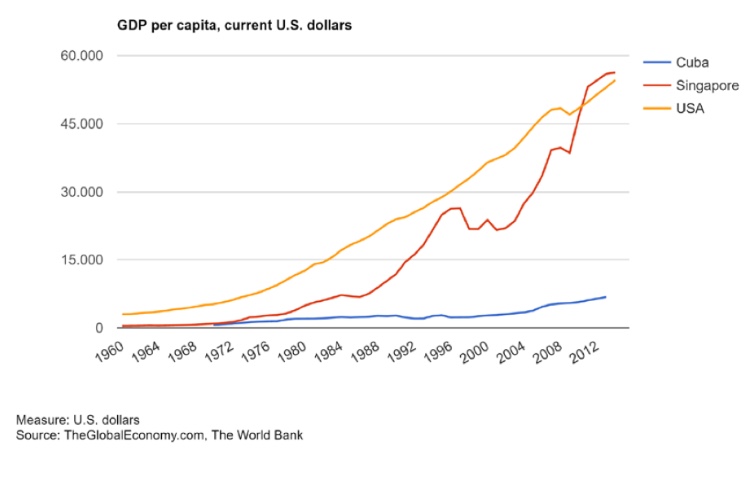
Yew was not an ardent communist as leader of Singapore but may have been influenced by his early encounters with the ideology as a youth. Lee was influenced by a Marxist organization called the Fabian Society in his youth. He asserted that “cooperation and competition between people” which he believed was a compromise between communism which relied too much on collectivism, and capitalism which he considered to rely too much on competition. This lead his focus on the plights of poor people in Singapore, allowing him to create favorably economic conditions for his constituents. This form of capitalism has allowed Singapore to outperform the USA in terms of Neoliberal economics used and popularized by the USA. This is the case because it’s clear that Singapore’s economic rise can be directly correlated to the enfranchisement of its working class and the use of various financial instruments popularized by Wall Street. And that was only possible via reforms that looked to reorganize certain relations of production. Specifically, reorganization was possible via the establishment of the Central Provident Fund. The reason why the Central Provident Fund was so important in changing the relations of production was that it enfranchised Singapore’s citizens in terms of healthcare, housing, and other financial means- enabling Singapore’s economy to grow at an exponential rate. But this enfranchisement didn’t come in the form of a “hand out”, rather it incentivized productivity and entrepreneurship.
This graph shows Singapore’s economic rise in terms of GDP over time compared to Cuba & The USA. Worthy to note Singapore achieved this growth with a lot less debt than the USA.
In order to understand Singapore’s exponential economic rise under a Marxist framework, a few Marxist terms Lee was likely familiar with must defined. These definitions will act as reference points which allow for a clear understanding on how Lee’s early exposure to Marxist ideology may have played a role in Singapore’s state capitalism. One of the fundamental Marxist notions that needs to be analyzed is the phrase “subsistence needs”. Arguably, it is nearly impossible to understand Karl Marx’s writings without defining this core phrase. Mainly, because Marx believes that without understanding that phrase, accurately conceptualizing how humans organize their material lives would be difficult. Marx emphasizes this point by saying that humans:
“…begin to distinguish themselves from animals as soon as they begin to produce their means of subsistence, a step which is conditioned by their physical organization. By producing their means of subsistence men are indirectly producing their actual material life.” (Marx German Ideology sec: A. Idealism and Materialism).
So clearly it’s an important definition because defining what a societies subsistence needs exactly are will give valuable insight on the physical organization of that society. Naturally, the next question ought to be: what are human subsistence needs? One could reason that human subsistence needs are reflective of natural human impulses. And it’s these impulses which drive humans to organize themselves the way they do. Furthermore, Marx seems to give insight on what these “human impulses” are, claiming that humans meet their subsistence needs via biological means (eating, drinking, delaying death etc) and cultivating individual gifts, and that is all done because humans have a natural tendency to do things for the community ( Marx German Ideology sec: D. Proletarians and Communism). This is important to the discussion regarding Singapore’s economic development because the way Singapore’s government institutions decided to improve their society was to make sure certain subsistence’s needs were facilitated and guaranteed to their citizenry. Under a Marxist framework, one can observe how Singapore addressed these subsistence needs of its populous by observing the societies relations of production.
The second and final term that needs to be properly analyzed is the phrase relations of production. For Marx, the relations of production seemed to serve as an important part of analysis in terms of understanding a particular society. The reason he thought this can be best explained by Marx:
“The totality of these relations of production constitutes the economic structure of society, the real foundation, on which arises a legal and political superstructure and to which correspond definite forms of social consciousness.” (Marx A Contribution to the Critique of Political Economy sec Preface).
So in essence the relations of productions for Marx are a reflection of a number of things such as: the economy, law, and political climate. The reason that Marx thinks the relation of production can provide an adequate description of society is due to the fact that it describes individuals’ relationship with productive forces. Mainly, he seems to pay close attention to who exactly owns these productive forces, because for Marx that determines how a particular society is organized. A brief excerpt from Marx’s magnus opus, Das Kapital allows for a more thorough explanation on the topic of relations of production:
“The latter is as much a production process of material conditions of human life as a process taking place under specific historical and economic production relations, producing and reproducing these production relations themselves, and thereby also the bearers of this process, their material conditions of existence and their mutual relations…their particular socio-economic form. For the aggregate of these relations, in which the agents of this production stand with respect to Nature and to one another, and in which they produce, is precisely society…”
The prose used by Marx gives insight on the importance of the relations of production if one is to fully grasp society via a Marxist framework. So, in order to understand Singapore’s economic rise under Marxist terms, we need to look at Singapore’s relations of production. But in order to do that a brief history of Singapore’s economic development must be discussed.
Singapore: A Brief Economic History.
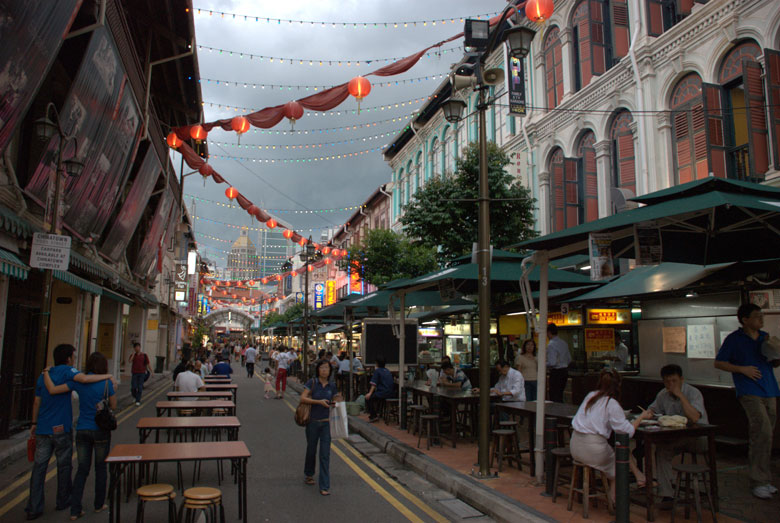
Sago Street in the 1960’s
Though Singapore has a rich history stretching back to antiquity, this work will focus on modern developments. Specifically, the scope will be limited to Singapore’s development from the mid-20th century to our present day. The two main reasons for that are: the data from this period is extensive, and this is the period Singapore’s contemporary national identity comes to fruition. Singapore’s story beings in 1965, after Malaysia expelled them from their political union via parliamentary resolution, due to growing racial tension that was perceived as directly undermining the Malaysian economy. (US Library of Congress). After this forced independence, Singapore immediately found itself in a fiscally disadvantaged situation. The situation for the citizenry was dismal. Over 70 percent of households lived in overcrowded communities, a third squatted in shanty towns outside of the urban center, and over half the population was illiterate. (World Bank). Additionally, Singapore faced a heavy influx of immigration before they were kicked out of the Malay political union, further exacerbating the situation. This wave contributed to a high level of unemployment (roughly 15-20%) (World Bank). A visitor living in Singapore during this tumultuous time provides a firsthand account on what this society looked like to him:
“The undercover walkways are usually taken over by hawker stalls and junk. Laundry hangs from poles thrust out of windows above—just like in old Shanghai. This is Singapore, in the early 1970s. We were all devastated at the time—we who didn’t live here. From 1871 to 1931 the city’s Chinese population rose from 100,000 to 500,000. By 1960 it is estimated that more than 500,000 Chinese were living in slum-like conditions—indoors. Equipped with only one kitchen and one bathroom, the shophouses were designed for two extended families at most. After extensive partitioning many of them housed up to 50 individuals.” (Yeo)
It’s worthy to note this person wasn’t in the outskirts where the shanty towns were prevalent. But rather close to the Urban center highlighting the destitute situation a majority of Singaporeans faced. Now this was all going on in the 1960’s-70’s. But now let’s fast forward 50 years, and look at the state of Singapore now.
Contemporary Singapore is far removed from its impoverished past. Their progress is reminiscent and analogous to the Rocky Balboa series. Once a land where
Sago Street in the 21st century
over half the population was illiterate, Singapore now boasts a literacy rate of 96.8% (Knoema). Furthermore, Singapore can take pride in being number one worldwide in terms of educational prowess in math, science and reading (OECD.)Additionally, the unemployment rate has drastically fallen to a staggering 2%. Now comapare that to the world average which falls roughly around 6% (World Bank). And not only that, but roughly 90.7 % of Singaporeans are home owners (Singapore State Government). Comparatively the USA, which is perceived to have a reputable standard in terms of homeownership, has about a 64% rate (US Census). How has the populous of Singapore improved so exponentially? A lot of credit should be given to the population itself. The large majority of the people who immigrated to Singapore in the early days were impoverished and looked to work hard in order to change their circumstances. However, it would be remiss not to mention the contribution of an individual who started at the grassroots level and would end up at the highest office in Singapore’s government, Lee Kuan Yew.
Lee Kuan Yew
It would be disingenuous to talk about Singapore’s meteoric rise without mentioning the contributions of its first prime minister Lee Kuan Yew. He grew up during the Japanese colonial occupation of Singapore which would influence his politics in the coming future. But a specific event would have profound effect on Yew. On his way home from work Yew was randomly ordered by a Japanese guard to join a group of Chinese people who were being round up for a “routine” inspection. Luckily for Yew, he spoke Japanese and was able to convince an Imperial soldier to let him go get a better pair of cloths from home. That “routine” inspection group ended up being the victims of the Sook Ching Massacre, a Japanese atrocity that would cause the deaths of roughly 50,000- 100,000 ethnic Chinese. Yew’s close encounter with Japanese oppression inspired him to say “My colleagues and I are of that generation of young men who went through… the Japanese Occupation and emerged determined that no one…had the right to push and kick us around”(Yeo 87). That sentiment inspired him to enter politics, joining the Communist Party of Malaya, where one can assume he was exposed to terms such as the relations of production and subsistence needs. After a complicated series of events Yew would find himself at the helm of Singapore’s newly independent state, inheriting an economic and humanitarian crisis few would ever want to deal with. But his early Marxist influence may have given him an idea on where to start. That can be argued by analyzing some of the reforms he introduced which set up a solid economic base for Singapore’s population to prosper in the future. But it is worthy to note that Singapore is NOT a Marxist state but rather a state influenced by Marxism.
The Central Provident Fund
In order to tackle the economic crisis that plagued Singapore in the 1960’s sweeping reforms that addressed these economic woes needed to be established. Luckily for Yew he inherited the Central Provident Fund which was created under the old Malay regime in 1955. The CPF was the social security system used by the previous regime as a retirement plan, which was funded via taxes. This fund is owned and controlled by individuals but it allows for a bit more autonomy in terms of where the money from the fund is spent, in comparison to other social security systems. Essentially, it creates a bank account for all of it’s citizens. But at the same time allows citizens to use private banks in conjunction with the CPF. Additionally, the CPF can be seen as a government voucher which allows users to save or spend the capital within it whenever they want. Another difference in social security lies in who is qualified for social security services. That’s because all that’s needed to be eligible for the CPF is Singaporean citizenship (CPF).But when Yew came to power the CPF’s power was limited in scope. However, he must’ve realized the potential of the social security system because his regime greatly expanded it over the years, and in hindsight it paid dividends. That’s because the CPF covers 3 layers of subsistence needs which arguably allow Singapore’s population to focus on other things such as: self-fulfillment, community engagement, or social leisure. The 3 layers that allow that are: Shelter, Health, and Education. Each of these would be addressed via the CPF, but the first expansion of the CPF occurred in 1968 and it aimed to address one of the biggest problems challenging Singapore’s prosperity.
Public Housing Scheme
In 1968 Lee Kuan Yews government was tasked with handling an economic crisis, and one of the first things they decided to address was the housing problem. They did this by expanding the CPF social security apparatus in order to foster viable living conditions, the government also mass produced housing units, which eased the burden felt by the populous during this tumultuous time. (CPF History of CPF). In addition to this, the government made it it’s priority to insure that citizen’s private wages didn’t go into buying houses but rather housing was paid via the CPF (CPF History of CPF). Having said that, this isn’t traditional public housing where the state owns the houses, but rather it insures citizens with an opportunity to become homeowners. That’s possible because the CPF essentially was expanded to act as a state sponsored investment account and as a social security system. When taxes are taken out the funds, they are immediately redistributed to everyone’s CPF account. In addition to that, individuals can choose to contribute more funds to this account via private wages, and if that’s done the private employer is expected to match that amount, similar to 401k schemes in the USA except more full in scope. Moreover, citizens have the option to use their CPF funds as resources to invest in global markets, individuals can invest in low risk accounts or high risk accounts at their discretion. All of these benefits of the CPF enfranchise individuals to become homeowners. These developments explain the aforementioned high percentage of homeowners in Singapore.
Under Marxist terms we can argue that the productive forces in terms of housing were aimed to eventually belong to the people of Singapore. Because when the development first started the government owned the productive forces since they built everything, but over time that debt was paid and individuals owned their houses. Furthermore, they could later sell them to other individuals. In essence, ownership of a house is predicated mainly on citizenship and partly on labor power. The reason it’s partly labor power is because individuals can contribute their private wages to the fund, increasing its value compared to someone who didn’t want to. Reducing the anxiety of shelter must’ve been a much needed relief for the citizenry, allowing them to focus on their own personal endeavors. But that’s not all, the healthcare sector would also be targeted by the CPF leading to further reform in their society.
Medisave
After an economic expansion in the face of the recessions of the early 1980’s, Singapore was able to further improve upon the CPF, guaranteeing yet another subsistence need. They addressed one of the essential parts of subsistence- healthcare. In 1984, the Singaporean government passed legislation which would expand the CPF’s role in its citizens lives. The expansion would be called Medisave. The financial mechanisms used by the CPF to guarantee housing are also used to finance the healthcare sector. At first the funds could only be used for public hospitals but after ample amounts of private economic expansion Medisave was combined with a new model Medishield which allowed CPF funds to be used at private hospitals. Arguably, this new expansion further diminished the worries of the populous. That’s because once subsistence needs are taken care of, people can free up their resources towards other societal endeavors. And certain societal endeavors taken by individuals can also have tremendous effect on the overall economy. More minds can focus on developments in medicine rather than survival. Singapore’s government seems like it incentivizes these private endeavors, and the data can back it up. It ranks number 2 in the index of economic freedom which measure what countries best protect the liberty of individuals to pursue their own economic interests allowing for greater prosperity for society at large (Heritage Foundation). Compare that to the USA, often perceived as the ideal in terms individual economic freedom, who currently ranks 18th . So in Marxist terms it seems as if the government of Singapore wants workers to make and own the productive forces in Singapore. In nontechnical language they want to develop as many entrepreneurs as possible.
In the end, Singapore’s development was exponential. Arguably, one could reason this was influenced by addressing Marxist concepts to improve their economy. Specifically, by addressing subsistence needs Singapore could improve the nations relations of production, effecting greater economic society. They were able to do that with a government financial instrument called the Central Provident Fund, which enabled and incentivized home ownership, entrepreneurship, and other personal endeavors. Though not a communist state, Singapore seems to have tried to help their citizens realize their potential. Capitalism and Marxist techniques have been used hand in hand to increase efficiency in a Neoliberal capitalist system.
Works used:
“Adult Literacy Rate by Countries, 2017.” Knoema, Knoema, knoema.com/atlas/topics/Education/Literacy/Adult-literacy-rate?baseRegion=SG.
Huff, W.g. “The Developmental State, Government, and Singapore’s Economic Development since 1960.” World Development, vol. 23, no. 8, 1995, pp. 1421–1438., doi:10.1016/0305-750x(95)00043-c.
“OECD Data.” The OECD, data.oecd.org/.
Yeo, Kim Wah. Political Development in Singapore, 1945-1955. U.P., 1973.
“Das Kapital” “A Contribution to the Critique of Political Economy” & “German Ideology” by Karl Marx
The Silk Road was one of the most important economic trade routes of antiquity. The road spanned from modern day Turkey to the Pacific side of China. Successfully connecting various markets along the route. Not only did the road create immense wealth but indirectly lead to cultural exchange. In effect, Europeans were exposed to new spices. That created new pallets for various people, leading to the development of foods such as spaghetti & lasagna. The information passed through the silk road was also valuable. Technological advancements such as paper making, printing, gunpowder, and the compass gained traction across the world. Effectively leading to other advancements in society. However, despite all the positive effects the Silk Road had it would eventually decline due to political turmoil in the heart of the trade route. That lead to less security for traders, translating into a risky investment. Making it fall out of favor as a venture.
Fast forward to the 21st century. From relative obscurity & poverty, China has developed into an economic powerhouse. Climbing up the GVC (global value chain) and effectively becoming one of the world’s leaders in logistics. This only seems like the start. General Secretary Xi Jinping has announced a plan that has the potential to propel China into economic dominance. The project is called ‘The Silk Road Economic Belt’.
Silk Road 2.0
The new Silk Road project aims to unify large markets through a connected infrastructure. Creating one diversified market which trades products, talent, information, and culture. Sound familiar? It should because this is exactly what the old Silk Road did. However, a key difference is the route of the road. Instead of going through the Middle East it will go through central Asia. Rightly so, since the Middle East is experiencing a period of extreme instability. From central Asia the road is supposed to expand into eastern Europe. That would be a clear gateway into western European markets.
Now looking at the project through an optimistic lens this seem like a great opportunity to; develop Central Asian countries, reignite the stagnating economy of Eastern Europe, and take China deeper into a market Economy. Central Asian countries would gain the opportunity to develop their infrastructure, as well as become deeply integrated into the global economy. The idea China has is that new communities will sprout up on the road because of the economic benefits.
The same applies to Eastern European nations but to a lesser degree. How Eastern Europe would mainly benefit is as the direct gateway to Western European markets. An attractive venture for people trying to make money via Western Europe.Hypothetically, that should increase investment in the region which would stimulate the local economy. Allowing for growth. Thus reversing the stagnation.
China would be able to capitalize on this road by allowing their products to flow through the route. Increasing their market dominance as a producer. Additionally, products from Western Europe would come through as well. Allowing for consumption by the Chinese population. Specifically the middle class. Bam! Market economy.
The project aims to generate profit but in the process it enfranchises the disenfranchised. That’s always advantageous. Being able to make money while producing something by helping those in need is beneficial for all parties.
Despite all it’s potential, it’d be naive to ignore the hurdles for this project.. Big projects need big money. The ambitious project is estimated to cost $5-8 trillion. In order for this to work a tremendous amount of cooperation & efficient execution. Only time will tell if this project gains traction.
While nations build walls, China plans to build roads. Times of economic growth (current growth is at 3.9% IMF) are the best times to plan for future. After all you want to fix the leaky roof while it’s sunny out.
Sources: IMF https://www.imf.org/en/Publications/WEO/Issues/2018/01/11/world-economic-outlook-update-january-2018



 Sermo Civilis