An American Sovereign Wealth Fund: The Key to American Prosperity?

President Donald Trump has officially signed into law the creation of a U.S. sovereign wealth fund. This is one of the few of his controversial executive orders that have been signed that may have a bit of merit when it comes to addressing the affordability crisis the United States is facing.

A sovereign wealth fund is a government investment fund that pools and manages a nation’s revenues, often derived from natural resources, trade surpluses, or foreign exchange reserves, to generate long term wealth and stabilize the economy. Several economic powerhouses have a wealth fund: Norway,  Singapore, Saudi Arabia, and the United Arab Emirates (Dubai Fund) have used SWFs to diversify their economies, invest in global assets, and provide financial security for the youth. These funds have enabled these nations to achieve high levels of economic stability, global influence, & sustained growth, even during periods of global economic uncertainty, all while empowering their citizenry.
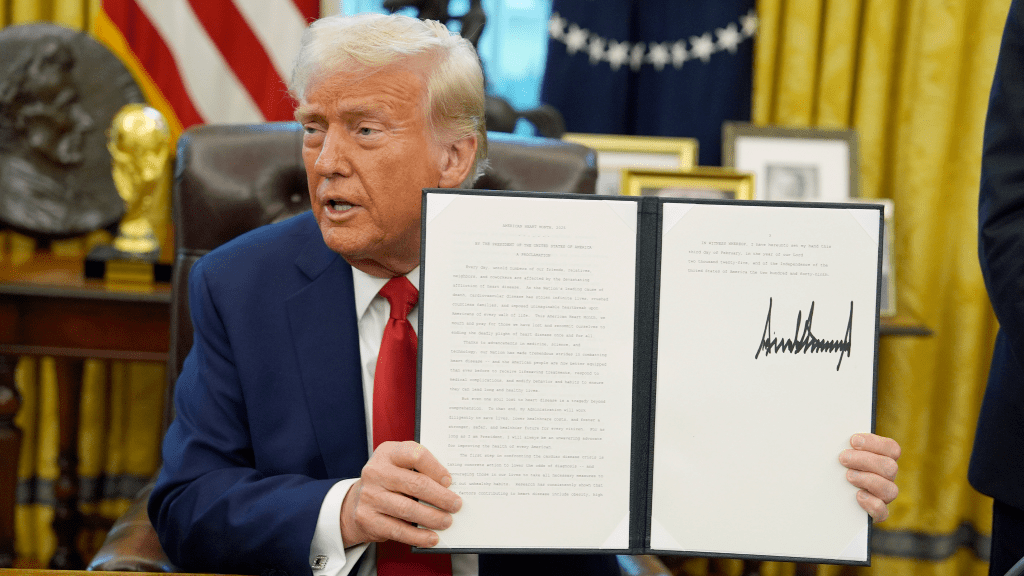
Trump signing the Executive Order 2/3/2023

The fund with the most long term exposure and demonstrated long term practical excellence is Singapore’s Central Provident Fund.

Singapore’s Central Provident Fund (CPF) offers a noteworthy model for the US. In the 1960s, Singapore faced significant economic challenges that necessitated comprehensive reforms. When Singapore became independent the nation faced significant economic challenges. Over 70% of households lived in overcrowded conditions, with a third residing in shanty towns on the city’s outskirts, and more than half of the population was illiterate. The situation was further exacerbated by a heavy influx of immigrants prior to Singapore’s expulsion from the Malaysian political union, leading to an unemployment rate of approximately 15-20%. (Asian Development Bank).

Fast forward 50 years, and Singapore’s transformation is remarkable. The literacy rate has soared to 97.65% as of 2021. The nation consistently ranks at the top globally in educational assessments for math, science, and reading. Unemployment has plummeted to around 2%, significantly lower than the global average of approximately 6%. Additionally, about 90.7% of Singaporeans are homeowners, a stark contrast to the United States, where the homeownership rate is at approximately 50%. This extraordinary progress can be largely attributed to the determination and hard work of Singapore’s populace,  as well as the Central Provident Fund. (Asian Development Bank).

The Central Provident Fund
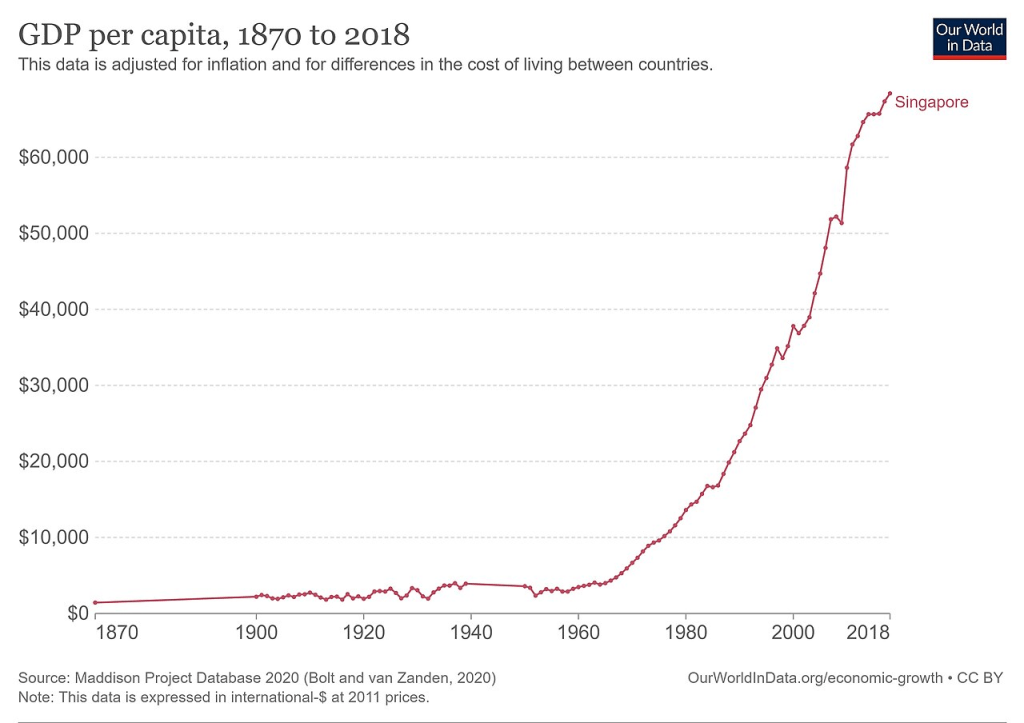
Singapore’s exponential growth after establishment of CPF

Prime Minister Lee Kuan Yew recognized the potential of the existing Central Provident Fund (CPF), established in 1955 during British colonial rule, as a tool to address economic challenges. The Fund was originally designed as a compulsory savings scheme for retirement, the CPF required contributions from both employers and employees. Unlike traditional social security systems funded by taxes, the CPF allowed individuals to own and control their savings, providing flexibility in how funds were utilized. This structure enabled citizens to manage their accounts while also engaging with private banking institutions.

In 1968, the government expanded the CPF’s scope to include housing, permitting withdrawals for the purchase of government flats. This policy not only addressed housing shortages but also fostered social stability and economic growth. Over time, the CPF’s functions further extended to cover healthcare and education, ensuring that citizens’ basic needs were met and allowing them to focus on personal development and community engagement. These strategic expansions of the CPF were instrumental in transforming Singapore’s economy and enhancing the well-being of its population (Asian Development Bank, n.d.).

After the CPF expanded its focus to housing, enabling citizens to use their savings to purchase government built housing units the homeownership rate is now up to 90% in Singapore. For the U.S., a sovereign wealth fund could potentially support housing initiatives, allowing Americans to leverage tax advantaged savings for home purchases, thereby fostering ownership and equity building. (International Monetary Fund).

Beyond housing, the CPF encompasses healthcare and education, allowing citizens to allocate savings toward medical insurance and lifelong learning. This approach reduces financial burdens and enhances productivity by alleviating concerns over essential services. A U.S. sovereign wealth fund could adopt similar strategies, offering dedicated accounts for healthcare and education expenses, possibly with employer matched contributions to accelerate wealth accumulation. (International Monetary Fund).

Implementing such a system in the U.S. presents significant challenges and hurdles . Political resistance to state managed savings programs and the complexities of federalism could impede adoption. Additionally, effective management is crucial to prevent issues like corruption or market volatility. Nevertheless, the potential benefits such as; reduced wealth inequality, increased productivity, and a buffer against economic downturns- are alluring. (PricewaterhouseCoopers).

While the executive order establishing a U.S. sovereign wealth fund is still in its early stages, Singapore’s CPF demonstrates that integrating state oversight with individual agency can transform citizens into stakeholders. For modern Americans burdened by housing costs, medical debt, and student loans, a similar fund could offer substantial relief and innovate on America’s financial institutions in a positive way.

Richard E. Carroll explores the potential for sovereign wealth funds at both the state and federal levels in the United States as a solution to financial challenges. At the state level, 20 U.S. states have established SWFs to manage natural resource revenues and benefit their citizens. For example the Alaska Permanent Fund, established in 1976, is the most well known, currently valued at over $5 billion. Many Alaskans get dividends from this fund, giving them expendable income for education or subsistence needs. New Mexico has done something similar, reducing the tax burden of the average citizen by about $1,000. I for one am a firm advocate for a SWF.

The Fund could be used to invest in infrastructure projects, such as roads, bridges, renewable energy, and broadband, creating jobs and stimulating economic growth. However, generally Americans are skeptical of government run programs, particularly those involving personal savings and investments. Therefore, building public trust would be essential for the fund’s success, perhaps including an opt out for citizens would be beneficial, but after their decision to opt out they should not be eligible to receive any benefits from the program- which is within their right. However, if the fund is managed properly, a steady stream of income from the SWF, the federal government could reduce income, corporate, or sales taxes, which could in theory put money back into the pockets of citizens and businesses. In essence America would be paying you for contributing positively to the American economy.

Having outlined all of that, the key question is whether the U.S. can adapt this model at the Federal level complicated by its diverse landscape. Time will tell.

Sources:

______________________________________________

  • International Monetary Fund. (2020). Sovereign wealth funds and public savings: Lessons from global models.  

The JFK Files: The Main Takeaways

Recently, The National Archives released thousands of classified government records on the John F. Kennedy assassination on October 23rd and November 3rd of 2017. Giving way for thousands of academics, journalists, & conspiracy theorists to sort through the ample amounts data. Though a great deal of the material is riddled with bureaucratic jargon, code names, and of course redacted info, the releases give an in depth and transparent look on these intelligence agencies at the time.

However, it’s worthy to note that thousands of other pages are being withheld for atleast 6 months. This coming after some slight pressure from the American intelligence community. Nonetheless, the recent releases have proved promising. The files cover a broad range of topics from detailing how intelligence was gathered from a stripper named “Kitty”, a 20 page “analysis” on Dr Martin Luther King, and even some  creative ideas on how Cuban leader Fidel Castro should be assassinated. But the main focus of this article will be on the intelligence gathered by the FBI and CIA in the midst of the JFK assassination. Here are 4 things the public should know about the recent releases.


1. The Anonymous Call

An intelligence cable from a CIA station in London received intel gathered by MI-5 (Britain’s Security Service) about a strange call a local news reporter received. On November 22, 1963 a senior reporter from the Cambridge News received a call from an anonymous caller who said “(The Reporter) should call the American Embassy in London for some big news” the caller promptly hung up. About 25 minutes later president John F Kennedy was assassinated.

The senior reporter said he’d never received a call like that ever in his life and the MI-5 went so far as to say he was ” (A) sound and loyal person with no security record”. The MI-5 found it worthy to also note that this call was similar to other calls received by various other journalist involving the Dr Ward Case ( a case which dealt with a sexual scandal & espionage that could’ve crippled the British government in 1963)

2. Oswald’s Visa Talk: Phone Call Intercepts from the Soviet & Cuban embassies

In the weeks prior to the murder of JFK Lee Harvey Oswald attempted to secure visas from Cuba and the Soviet Union while in Mexico City.  Both embassies seemed to try to help him get these long term visa’s despite his “terrible, hardly recognizable Russian” and poor Spanish. Silvia Duran (Cuban Consulate worker) was the first to be engaged in discussion with Oswald over a long term visa possibilities in Cuba. She tries to assist him in obtaining a Russian visa in order to make getting a Cuban Visa easier. She phones the Russian embassy and tries to see if they can come to some agreement over Oswald’s visa dilemma. Oswald claimed to be a part of a “pro-Cuban group”, but Silvia couldn’t get a visa for him initially because” he (knew) no one in Cuba” . Furthermore, obtaining a Russian Visa would take a long time, and evidently Oswald wasn’t worthy enough of a Russian recommendation. That didn’t stop his efforts.  Oswald would then go through a series of phone calls with Russian officials about his visa status (one being Kostikov a KGB Agent specialized in assassination). However a man called Obyedkov abruptly hangs up on him in the middle of a conversation about a telegram.

Now why is this whole visa situation important? Well, clearly it shows us that Oswald was trying to relocate to either Cuba or Russia. But that raises more questions. Specifically, what were his motivations for obtaining these visas? Was he trying to obtain them as an escape plan for him to use after his assassination plot? Or was he trying to defect to these countries for other purposes?

Moreover, “Obyedkov” hanging up on Oswald should be a cause for further questioning. Was “Obyedkov” simply frustrated with Oswald, did he finally find out about Oswald’s self caused hospitalization back when he visited the USSR, or was he aware of something else?


3. November 24, 1963: Tell ’em It was Oswald.

This document is the least legible of the documents covered in this article and was written around 45 minutes after Oswald died. Oddly, it has no title, the author of this document isn’t named (But it can be assumed the words came from Hoover) , and it’s prefaced with “Mr J. Edgar Hoover said as follows”.

Th Document starts off in a rather blunt tone the first sentence says ” There is nothing further on the Oswald case except that he is dead.” It goes on to talk about Jack Ruby as Oswald’s murder, and briefly mentions his background. In addition, it seems as if Hoover was worried that Dallas Police officials were revealing too much information on Oswald and Ruby. Hoover feared it could potentially compromise the legal process.

In the third to last paragraph Hoover seems to be concerned about “…having something issued so we can convince the public that Oswald is the real assassin.”. The paragraph goes on to talk about how the FBI could persuade the Attorney General that Oswald was the guy by using “pictures, laboratory work etc”. That would then lead the public to believe Oswald did it.


4. The Watson and Hoover Soviet MEMO

A couple sources working covertly in high Soviet and KGB positions offered some insight on how the Soviet government reacted to the Kennedy assassination.

The Soviets believed that the assassination wasn’t orchestrated by one man, but rather a highly organized “ultraright” group wishing to initiate a coup. In conjunction, they were fearful that some irresponsible general from the USA would launch a missile at the USSR. This coupled with other concerns instantly put the Soviet Union in a state of national alert.

The Soviets knew that Oswald was in the USSR for a period of time but they described him as “a neurotic maniac who was disloyal to his own country and everything else”. Additionally, they noted that he wasn’t involved in any organization in the Soviet Union and never received citizenship.

Also, the agents were able to infiltrate a high level KGB meeting, headed by Boris Ivanov (head of KGB)  in New York City. Ivanov felt that the recent assassination was a problem for the KGB. And that this problem needed to be brought to every KGB agents attention until it was solved. The KGB also felt that the assassination couldn’t have been conducted by a sole perpetrator. The agency then put forth a plan to gather as much data possible about any possible group that could’ve executed the assassination plot.

Furthermore, Ivanov emphasized collecting as much intel about Lyndon B Johnson as possible. Quite frankly the Soviets knew nothing about him. They wanted an in depth search on “his background, his past working experience and records in congress..”.

2 years later the KGB met again in NYC after gathering  intelligence about President Johnson. The source states that (per the instructions from Moscow) the KGB was in possession of data that would prove LBJ was responsible for the JFK assassination.

The document concludes with notes on several critical reports about the Warren Commission by Soviet media outlets.


Despite these main points, there is still plenty more to be uncovered by the recent data release. And the files that have revealed valuable information have in effect raised even more questions.


Feel free to indulge in the first hand declassified sources below. 


The Anonymous Call: https://www.archives.gov/files/research/jfk/releases/docid-32389606.pdf

VISA TALK: https://www.archives.gov/files/research/jfk/releases/104-10010-10249.pdf

TELL ‘EM IT WAS OSWALD: https://www.archives.gov/files/research/jfk/releases/docid-32263509.pdf

WATSON and HOOVER MEMO:  https://www.archives.gov/files/research/jfk/releases/docid-32204484.pdf


Trumps Climate Withdrawal: What It Means and International/Domestic Responses

Staying true to his campaign rhetoric, Trump has effectively decided to kill the Paris Climate Accord. Essentially ending government support for future innovation in the American economy. The move seems to be an attempt to bring back the dying American coal industry, despite the lack of evidence that pulling out will do just that. That’s because it’s hard to ignore that the cost of clean energy is plummeting in comparison to coal, making it more affordable to consumers.

Additionally, according to most “reputable” economists climate change will begin to have a net negative impact on the global economy (the median estimates say by 2025 is when the full effects will be felt). The economic sectors that would be most affected unsurprisingly include Agriculture (94% ) Fishing (74%) Tourism (72%) Insurance (66%) and Health Services (54%). And the United States could’ve used a overhaul of it’s current economic climate policy by further incentivizing corporations and individuals to innovate  by bolstering the American economy while at the same time curving pollution. Logically this is what will most likely help those disenfranchised by the economic collapse of the coal industry. A new industry equals new jobs for those effected by the coal decline. And a business oriented mind such as Trumps should easily recognize the economic benefits of going “green” namely: Incentivizing business by providing a revenue-neutral carbon tax, which enables a head start in a new and emerging market, and the creation of more jobs through a “going green” infrastructural overhaul.

But instead Trump has decided to go a different route by pulling out of the Paris Accord. Was it to satisfy constituents by fulfilling his campaign promises? Or perhaps to distract from the scandals going on in the White House(?) Whatever the reason the fact remains that the Trump Administration has pulled out as the symbolic administrative leader of the global climate initiative. And in effect an unsuspecting “green alliance” has been forged to combat the looming global climate crisis.

The European Union and China have agreed to fill the vacuum left by the USA as the leaders of innovation amidst the climate crisis. A week after Trump announced his withdrawal from the Paris Accord, China and the EU met in Brussels to talk about the future of their climate policies. The two parties (for the first time ever) are now  in agreement “to forge ahead” with measures to “lead the energy transition” towards a global low-carbon economy. Specifically by committing to cut back on fossil fuels, developing more green technology, and jointly working to raise $100 billion a year by 2020 to help poorer countries cut their emissions. This “green alliance” seems to be calculated response to the Trump administrations protectionist economic framework. After all the EU and China’s agreement seem to be in the favor of free trade, economic growth and innovation, while at the same time combating the climate change epidemic.  A stark contrast to Trump’s crony and isolationist economic tactics. Furthermore, China has committed to a plan to develop 150 gigawatts of solar energy by the end of the decade, the EU is leading in wind power energy and recently France (via Macron) has additionally incentivized scientists and business leaders alike to come to France, in order to “work on concrete climate solutions”. As of now the EU is the leader for positive climate policy implementation and China is well on it’s way towards that path. And this new green alliance will only seek to economically and environmentally improve both regions.

However there is a silver lining. Despite the Trump Administration withdrawal from the Paris Agreement top American business leaders are still working towards the global climate initiative. CEO’s from Apple, ExxonMobil, Jp Morgan, Goldman Sachs, and most notable Elon Musk (who left the President advisory council after the decision)were ALL in dissent after Trumps withdrawal. Yes that’s right! natural gas companies and big financial firms AREN’T in favor of the decision and will continue to uphold the Paris Accord’s framework. Nick Atkins (CEO of American Electric Power, Coal company) had this to say “(T)his  gets a lot of questions from investors, we get a lot of questions from customers, that … want renewable energy solutions, clean energy solutions. And we at AEP want to be as benign to the environment as we can”.  However, these businesses could’ve used additional tax incentives by going with clean energy (allowing for further economic growth) and Trump had the power to help. He clearly chose not to.

The majority of the American population doesn’t agree with Trumps withdrawal either, according to a recent Washington Post- ABC news poll that says 59 percent oppose the move. Having said that several states have formed a bipartisan group committed to upholding the Paris Accord, called the United States Climate Alliance. Among the members are New York and California, huge economic influencers. If the USCA was a country it’d be 4th in terms of GDP. Providing hope for the future. After all the President’s decision doesn’t matter if the societal collective refuses to obey.


EDIT: While I wrote this the US Ambassador to China David Rank resigned because of Trumps Climate withdrawal

Sources: “Expert Consensus on the Economics of Climate Change” by the Institute for Policy Integrity, NYU School of Law.

Click to access 20160527_1_a1_-_c_2016_2989_f1_annex_en_v1_p1_850173_en.pdf

http://www.economist.com/news/international/21722914-china-and-europe-plan-lead-climate-efforts-whither-world-after-americas-retreat

http://governor.wa.gov/news-media/united-states-climate-alliance-adds-10-new-members-coalition-committed-upholding-paris