Why’s America Sleeping? A Discussion Regarding The United Healthcare CEO’s Assassination.

“It takes violent shocks to change an entire nations psychology.”

– John F. Kennedy

This quote written in John F. Kennedy’s Magnum Opus ‘Why England Slept’ encapsulates the current collective psychology of the United States after the tragic assassination of Brian Thompson. Some people celebrated the CEO’s death, a symbol of the frustration many Americans have been feeling regarding the nation’s healthcare system. Critiques of the healthcare system are definitely warranted, and Luigi Manginoni’s tragic act has once again put the nations healthcare debate at the forefront a public discourse.  

President Kennedy’s quote is correct, often violent acts can change an entire nations collective psychology, there are plenty of examples in history that agree with that proposition. However, people are wrong assuming that the assassination will trigger meaningful change due to the fear healthcare insurance executives may feel after the assassination of Brian Thompson. People’s idealism can cloud the reality on how institutions operate in the real world. History has proven powerful players rarely relinquish control freely. The healthcare industry could hypothetically double down and refuse to budge, further entrenching an “us vs. them” mentality that pervades many contemporary national debates. Though, admittedly, the act could hypothetically result in meaningful change in the healthcare industry- but not in the way people celebrating the death would imagine. A good case study as to why that is the case would be the Ludlow Massacre.

On April 20, 1914, in Ludlow, Colorado, striking coal miners demanded better pay, safer working conditions, and the right to unionize ( more info on Ludlow here). The strikers were attacked by the Colorado National Guard and company-hired guards, killing the protestors and some of their family members. The Ludlow Massacre lead to the Colorado Coalfield War, where workers formed a militia and started attacking Colorado National Guardsmen and private law enforcement . The workers successfully attacked many of their oppositions positions and had a lower casualty count but when the dust settled the strikers’ demands were not met, the union did not obtain recognition and many striking workers were replaced. Further 408 strikers were arrested, 332 of them were indicted for murder. The institution decided to double down on the crackdowns resulting in none of the strikers work demands being met.

Though the workers themselves did not reach their goals, the tragedy of Ludlow spurred a greater national debate on workers rights in the United States. Slowly the grievances raised by the Ludlow massacre lead to the enactment of federal labor laws that we still use today. American society should turn this tragedy into a positive and reinvigorate the discussion and action that will lead to fundamental changes in the healthcare industry. The Ludlow Massacre forced the nation to confront workers’ rights, and similarly the tragic assassination of Brian Thompson could prompt similar discussions about the systemic failures in healthcare. However, history shows that institutional change is slow and often requires sustained public pressure. Hopefully, this time around the change will come sooner, if not there are indications that matters may get worse rather than better.  Analyzing the economic incentives causing this turmoil will illuminate the problem areas in the sector and hopefully lead to some practical solutions.

Economic Moral Hazards

The problem with the healthcare sector is that it produces bad economic incentives. 1 Often healthy economic incentives encourage behavior that benefits both individuals and society, they are aimed at promoting positive economic action while discouraging negative consequence such as waste or harm. For example good economic incentives would be efficiency standards for cars, they incentivize manufacturers to produce efficient automobiles by offering various government benefits. For example, car companies may get tax breaks,  recognition for meeting higher energy efficiency standards, or might get access to lucrative government contracts. This makes energy utilization effective, lowers bills for consumers, and helps reduce environmental impacts by using wasteful technology.

The healthcare industry seems to be running in the opposite direction regarding incentives. Large hospitals commonly increase prices for services and lab technology, knowing that insurers and government programs will foot the bill one way or the other. 2  A big reason hospitals can do this is due to lack of competition within the sector. 3 On average Americans have access to only a few healthcare providers, which incentives monopolistic practices such as price gouging. 4  These practices shift the financial burden onto patients, insurers, and taxpayers, exacerbating the system’s inefficiencies.  Insurance companies also contribute to producing bad economic incentives but in a different way.
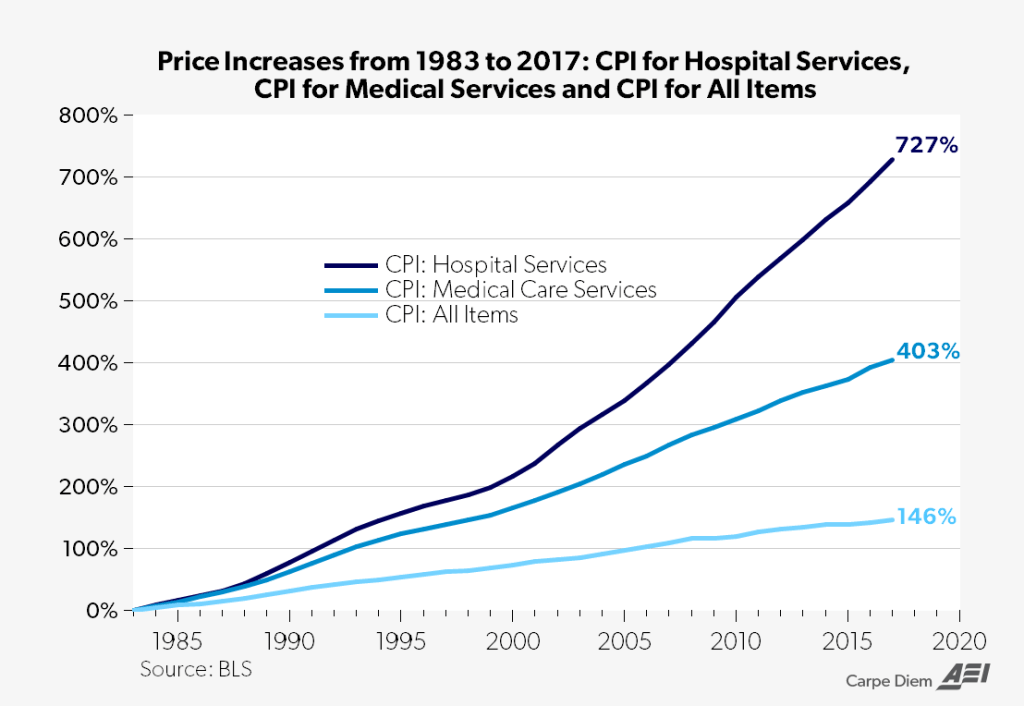
Source: American Enterprise Institute

Health care Insurers also contribute to overall inflated healthcare prices. That’s because insurance companies have few incentives to negotiate for better rates or challenge the high prices set by hospitals.  They are well aware that they can pass those costs onto consumers in the form of higher premiums or deductibles in order to fulfill their fiduciary duty to their shareholders. 5 By passing those costs on to their consumers they ensure their shareholders are maximizing profits effectively fulfilling their duty. This leads to a disconnect between the price of healthcare and the actual cost to consumers leading to the  inflated cost of healthcare of the healthcare system.

Additionally, some companies during economic downturns might only focus on the volume of services provided, rather than the quality or necessity of those services. This may encourage doctors to prescribe unnecessary treatments overuse of healthcare and can result in unnecessary tests or procedures, which drive up the overall healthcare costs. If you are fully covered getting extensive tests is beneficial for your health but unnecessary care drives up the price for people who do not have adequate coverage. That is because higher utilization of healthcare services- necessary or not artificially inflates demand, which providers often use to justify price increases. Most insurance companies operate within fee-for-service payment systems, where providers are reimbursed based on the volume of services delivered rather than the value or outcomes. This further incentivizes unnecessary treatments, tests, and procedures, as healthcare providers have a financial interest in maximizing billable services

Further, the administrative complexity of health insurance also adds significant costs to the healthcare system. Insurers maintain vast bureaucracies to process claims, determine coverage, and manage provider networks, which requires substantial resources. Anecdotally, after spending some time in the insurance sector, a lot of the administrative tasks incentivize an incredible amount of waste.  These costs are ultimately passed on to consumers. For example, administrative expenses in the U.S. healthcare system account for nearly 8% of total spending, compared to 2-3% in countries with simpler, more centralized systems. 6

Action is Necessary

The tragic events surrounding Brian Thompson’s assassination have understandably stirred intense emotions and reignited a national conversation about the flaws in our healthcare system. While these tragedies can bring the issue to the forefront, history shows us that meaningful change doesn’t come from fleeting moments of outrage. The shockwaves from Thompson’s death can grab attention temporarily, but true change only happens when we confront the deeper economic incentives that drive the inefficiencies and inequalities in healthcare.

Reform, as we’ve seen in the past, is rarely quick or easy. It faces resistance from entrenched interests that benefit from the status quo. But the time to act is now. The monopolistic pricing, the disconnect between what healthcare actually costs and what patients pay, and the lack of meaningful negotiation from insurers- all of these must be tackled with urgency. It’s time to rethink the economic incentives behind the healthcare system and shift the focus toward transparency, competition, and patient-centered care. The current model is unsustainable, and the responsibility for change lies with all of us; policymakers, healthcare providers, insurers, and the public.

Let us use this tragedy not as a fleeting moment of anger but as a rallying point to demand systemic reform. By ensuring that economic incentives align with the well-being of patients and the long-term sustainability of the system, we can move toward a healthcare system that serves the needs of every American, not just the powerful few. Now is the time for thoughtful, deliberate action to reform the healthcare system in a way that reflects the values of justice, fairness, and efficiency for all.

“The time to repair the roof is when the sun is shining.”

-John F. Kennedy

Right now, I’m sad to say, it seems like we’re attempting to repair a roof in the middle of a tornado. Urgent action is needed.


Sources

  1. According to the Journal of the American Medical Association (JAMA), the U.S. healthcare system is plagued by administrative inefficiencies, price inflation, and overuse of medical services, which are driven by poorly aligned incentives among providers, insurers, and payers.

    Source: JAMA. “Waste in the US Health Care System: Estimated Costs and Potential for Savings.” (2019). ↩︎
  2. Research from the RAND Corporation indicates that hospitals charge private insurers an average of 247% of Medicare rates for the same services. This price disparity exists because private insurers lack the bargaining power to negotiate rates effectively, and hospitals rely on these inflated payments to subsidize their operations.

    Source: RAND Corporation. “Prices Paid to Hospitals by Private Health Plans Are High Relative to Medicare and Vary Widely.” (2020).. ↩︎
  3. Research shows that hospital consolidation reduces competition and leads to higher prices. A study by the National Bureau of Economic Research (NBER) found that hospital mergers result in price increases of 6% to 18%, depending on the level of market concentration.

    Source: NBER. “The Price Effects of Cross-Market Hospital Mergers.” (2018).
     The Health Care Cost Institute (HCCI) reports that the average price for hospital services is significantly higher in concentrated markets than in competitive ones.

    Source: HCCI. “Healthy Marketplace Index.” (2020). ↩︎
  4. The American Medical Association (AMA) found that in 2019, 90% of metropolitan areas in the U.S. were highly concentrated for hospital markets, meaning patients had limited choices among providers. This is also the case in more rural areas as well.

    Source: AMA. “Competition in Health Insurance: A Comprehensive Study of U.S. Markets.” (2019). ↩︎
  5. Premiums and deductibles for employer-sponsored health insurance have been steadily rising, with average family premiums increasing by 55% over the past decade. Insurers often attribute this to rising healthcare costs from hospitals and providers.

    Source: KFF. “2022 Employer Health Benefits Survey.” ↩︎
  6. The Study highlights the disproportionately high administrative costs in the U.S. healthcare system compared to other high-income nations with centralized systems, where administrative spending ranges between 2-3% of total healthcare expenditures             

       Source: Woolhandler, S., & Himmelstein, D. U. “Administrative Work Consumes One-Quarter of U.S. Physicians’ Working Hours and Lowers Their Career Satisfaction.” Health Affairs, 2014. ↩︎
America’s Forgotten Civil War: Colorado’s Coalfield War

     The first article of the new five part Forgotten American History series! The Forgotten American History series aims to introduce readers to the less commonly known aspects of American history. The first edition takes us to Colorado! Hope you enjoy. 


Colorado’s Coalfield War is one of the most violent yet obscure events in American history. Which is a bit puzzling since The Coalfield War has all the allure of the quintessential American story. It has divisiveness, the quest for the American dream, violence, and an underdog. The Coalfield War took place after a rapid economic boom in the United States. The early 20th century saw the development of notable business magnates. Some you are most likely familiar with such as Andrew Carnegie, John D. Rockefeller, and Henry Ford. During their time they were commonly referred to as ‘industrialist”. That’s mainly due to the economic supremacy they had on industries such as fossil fuel, manufacturing, and transportation. The business strategies commonly used by these magnates were monopolistic. Common techniques used to monopolize included unilateral corporate acquisitions, price controls, and wage suppression. However, a new social development would attempt to countervail the monopolistic tendencies of these business tycoons.  The development being worker’s unions.

Laborers in the early 20th century worked in abhorrent conditions. An unnamed worker who grew up in one of Pennsylvania’s mining communities provides an account on what life was like for a miner:

Our daily life is not a pleasant one. When we put on our oil soaked suit in the morning we can’t guess all the dangers which threaten our lives. We walk sometimes miles to the place- to the man way or traveling way, or to the mouth of the shaft on top of the slope. Add then we enter the darkened chambers of the mines. On our right and on our left we see the logs that keep up the top and support the sides which may crush us into shapeless masses, as they have done to many of our comrades. We get old quickly. Powder, smoke, after-damp, bad air- all combine to bring furrows to our faces and asthma to our lungs.”

Wages were often not paid in US dollars. Rather, workers were paid with metallic strips which were redeemable in company stores. A stark contrast to how modern wage payment is facilitated. Furthermore, workers often lived at their work sites. Worker’s would often build their own dwellings which ranged from tents to shacks. This led to the development of work specific settlements.  In addition, workers often lacked representation in terms of corporate boardrooms. However, workers unions began to spring up providing an opportunity for representation. Exploited laborers could finally voice their frustration en masse.

Colorado’s Coalfield War gives us a perfect opportunity to examine the early relationship between industrialists and workers unions. The stereotypical relationship is often framed idealistically. The cliché often goes like this; workers are in discontent due to their impoverished work situation.  They then begin to band together and organize. Managers are often against organizing but after some convincing they slowly join the workers’ cause. And in one harmonious swoop the workers walk over to administrative offices and demand that the industrialist improve conditions. The industrialist, understanding the gravity of the situation, then succumbs to their demands. And after both parties reach an agreement. But realistically it was never that straightforward.  Colorado’s Coalfield War will give us a realistic glimpse of how a lot of early labor disputes panned out in the United States.

The story of Colorado’s Coalfield War begins in the coal mines of southern Colorado during the 1910’s. Colorado’s coal industry at the time was booming. So much so that roughly 10 percent of the state’s population was employed by the coal sector. At the time coal was highly profitable due to the demand of America’s expanding railroad system which needed coal to fuel their engines. One of the nation’s richest people were involved

Apr20family-298x300
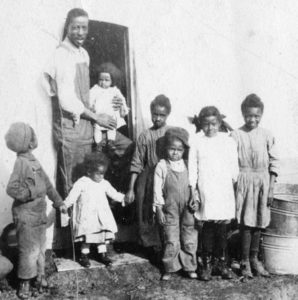
One of Colorado’s mining families that was living in a tent community

in the coal industry. For example, John D. Rockefeller Jr (heir to John D. Rockefeller) recognized an opportunity to capitalize and acquired ownership of the Colorado Fuel and Iron company (CFI).

Coal mining for the CFI was physically arduous and hazardous work. CFI’s coal miners were under a considerable amount of fatal risk compared to other American coal miners. Statistically, miners in Colorado were twice as likely to die on the job compared to their peers in other states. That’s not to say that the other states were a pleasant place work. But Colorado’s coal mines were considerably risky. The fear of explosion, suffocation and collapsing mines was the reality for many coal miners . Ironically, Colorado had some of the best mining laws in the country. But Colorado’s mining laws were rarely enforced. The United States House Committee on Mines once declared:

Colorado has good mining laws and such that ought to afford protection to the miners as to safety in the mine if they were enforced, yet in this State the percentage of fatalities is larger than any other, showing there is undoubtedly something wrong in reference to the management of its coal mines

Furthermore, mining labor in Colorado was egregiously exploited. Worker’s were paid for the tonnage of coal produced. However, their “dead work” (maintenance, supply runs, and infrastructure repairs) were unpaid.

By 1913, 10,000 of Colorado’s miners had enough with their work environment and decided to strike. The strikers attempted to unionize via the United Mine Workers of America. They demanded improved work conditions, better wages, strict enforcement of Colorado’s mining laws, and union recognition. The CFI responded by rejecting all of the union’s demands.


Ludlow_Death_Car
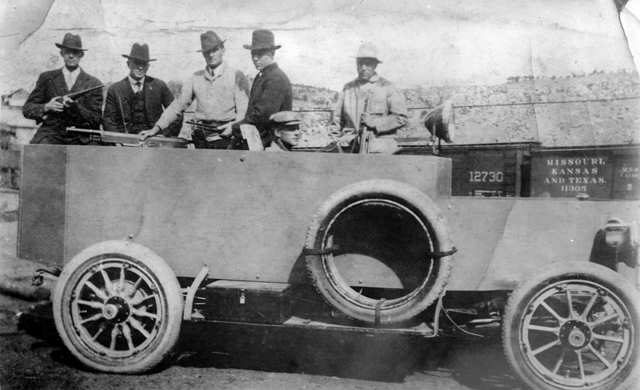
Baldwin- Felts employees with an armored car.

There were considerable measures taken to countervail unionization. The CFI employed strikebreakers to keep the company running. The company evicted strikers from their company homes forcing the striker to build tents for their families nearby. Under Rockefellers orders, the CFI hired Baldwin- Felts Detective Agency (a private detective agency) to harass the strikers.  The agency would shine spotlight on tents, fire live ammunition at strikers’ tents, and patrolled the tent communities with an armored vehicle that had a machine gun mounted unto it. Clearly these were terror tactics. The strikers were unphased. Strikers responded to the terror tactics by taking up arms and defending their tents. Eventually, the skirmishes were acknowledged by the governor of Colorado and he responded by sending the National Guard to the tent community in Ludlow. The strikers were under the impression that the National Guard was there to protect them. But several hundred strikers were arrested by them and often beat the strikers. The National Guard would add more fuel to the fire when they discovered that a strikebreaker had been murdered. The National Guard had been financed by the CFI to cover the expenses of deployment, so they had an implicit obligation to make sure the CFI’s interests were met. One day while the tent dwellers were at funerals commemorating two infants, the National Guard began to dismantle the tent community. However, the community members rebuilt the tents and they continued the strike, persevering through the winter. However, things would come to a boiling point on April of 1914.

The Ludlow Massacre

On April 20th 1914, two national guard posts were deployed on top of a hill, encircling the Ludlow tent community. They deployed an armed post with a machine gun overlooking the strikers. No one is exactly sure what instigated the violence. Some historical records suggest that the National Guard was demanding the release of a

Masses_1914_John_Sloan
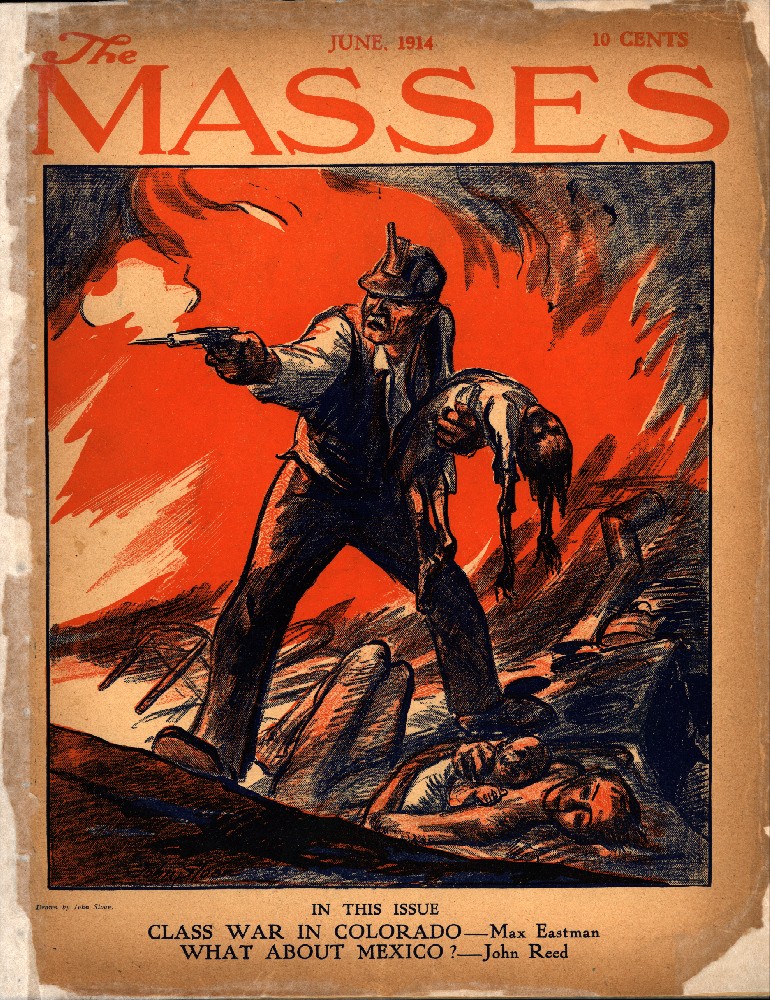
The Masses cover art depicting the Ludlow Massacre

hostage, but the strikers refused to give the hostage up. One of the sides then opened fire (it’s unclear who fired the first shot). Nevertheless, a battle would ensue which lasted the whole day. The casualties included high ranking union members such as Louis Tikas. Innocent bystanders (mainly women and children) hid in their tents to avoid the gunfire. The strikers retreated. The National guard then went to the tents, doused them with kerosene, and set them on fire. One of the tents that were set on fire housed 11 children and 2 women. The women and children all died, they were either burned or suffocated to death. These casualties were deemed a massacre by several periodicals in Colorado. The news of the National Guard’s atrocities would then spread across the nation like wild fire.

   Height of The Coalfield War

In Denver, the United Mine Workers declared “A Call to Arms”. They suggested that all union members should gather all “arms and ammunition legally available.” . Subsequently an insurgency would take place in Colorado. Three hundred armed strikers marched from all over Colorado to the Ludlow area. When they made it, the insurgents cut telephone and telegraph wires. And they prepared for battle. The New York Times described the event as such:

“With the deadliest weapons of civilization in the hands of savage-mined men, there can be no telling to what lengths the war in Colorado will go unless it is quelled by force … The President should turn his attention from Mexico long enough to take stern measures in Colorado

Furthermore, in an act of solidarity railroad workers refused to transport National Guard soldiers from Trinidad to Ludlow via railway. Up north in Colorado Springs, union

CC-X-60543
Colorado National Guardsman at an Outpost in Southern Colorado.

miners walked off their jobs and set off to Trinidad. They carried revolvers, rifles, and shotguns. Support was even shown on the East Coast. In New York City, picketers marched in front of the Rockefeller office located on 26 Broadway, New York City. However, these demonstrations were quickly quashed by local law enforcement.

When all the miners met in southern Colorado violence naturally ensued. They attacked antiunion town officials, supervisors/guards, and strikebreakers. Sporadic violence was rampant in southern Colorado as the miners carried out targeted killings, the statistical figures on fatalities vary considerably. So, a precise number can’t be drawn on how many people died. The insurgents also damaged a considerable amount of mining infrastructure.  The Associated Press estimated the financial losses at $18 million (which is about $450,239,203 in 2019).  The CFI alone lost $1.6 million. They were also able to strategically take control of an area that was roughly 50 miles long and 5 miles wide. However, this control didn’t last long. President Woodrow Wilson dispatched federal troops to Colorado, and the miners subsequently surrendered.

         Aftermath

After the Coalfield Wars, Congress held hearings with John D. Rockefeller Jr, union leaders, and several high-ranking members of the National Guard. Though atrocities were recognized by both sides during the hearing, no one was ever formally indicted for their crimes. Unfortunately, a lot of the tangible benefits the strikers were fighting didn’t materialize.  But all wasn’t lost. Rockefeller, feeling political pressure, lead an initiative so workers could have internal representation in the CFI. A measure akin to modern internal corporate arbitration. He also created an internal company union. And encouraged internal social services such as creating a YMCA for the Mining department. During this era, the YMCA played a substantial role in influencing morality and promoting athletic activity within American communities. But it’s important to remember these measures are a far cry from what the original demands the UMWA fought for. It can be argued that these measures were a bit of strategic marketing from Rockefeller. Think about internal company unions will always have corporate interest in mind. So full workers representation isn’t fulfilled. But there is a silver lining, the UMWA gained 4,000 new  members.

In all the Coalfield War gives us an interesting look into the dynamic relationship between industrialists, the government, and workers. Namely, that when disenfranchised workers sought better work conditions that undermined corporate interests, considerable measures were taken to curtail workers goals. Measures which would disgusts modern American sentiments.  Hiring private companies to terrorize workers, bringing in government officials to suppress workers, and massacring innocent bystanders would likely surprise many American households in the 21st century. We also get a key insight on what happens when “the people” get pushed too far in terms of getting their grievances acknowledged. Violent civil disobedience.


I’ll leave readers with song lyrics about the Ludlow massacre by Woody Guthrie:

It was early springtime when the strike was on,

800px-Ludlow_Monument_Cropped
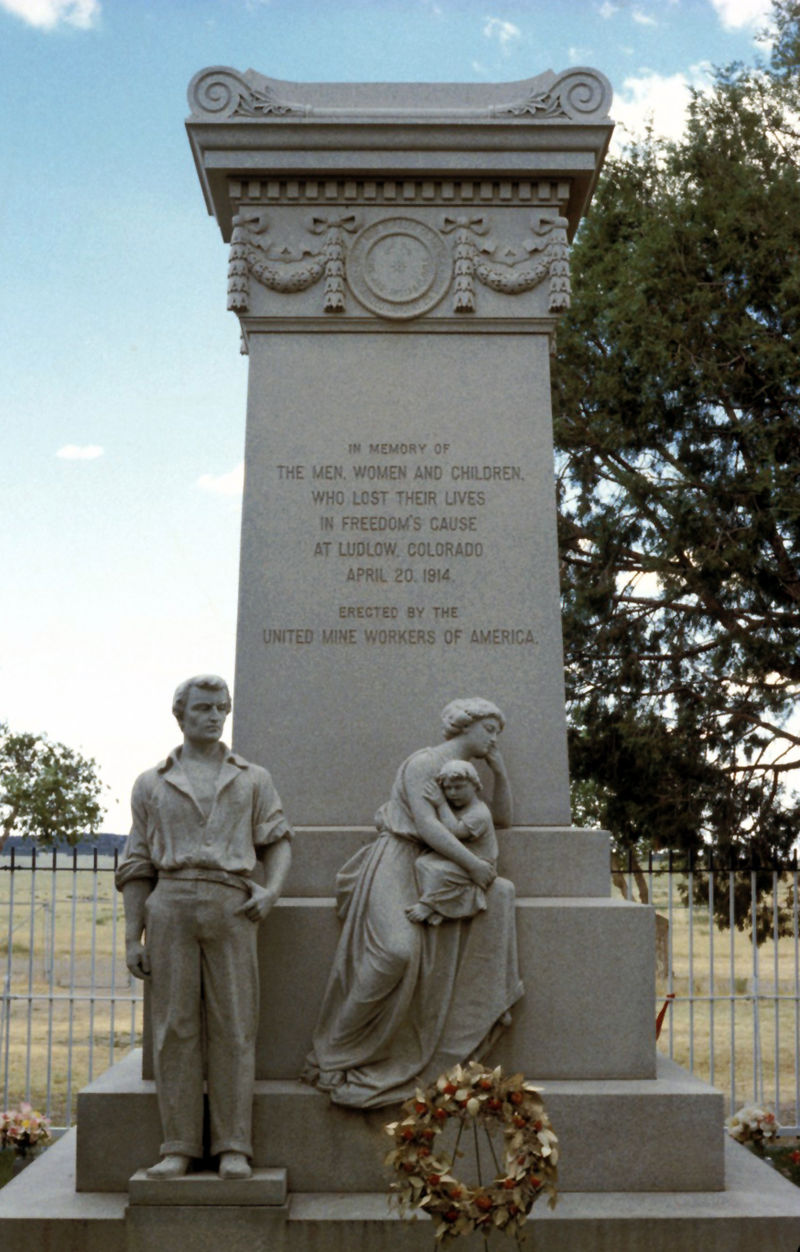
Ludlow Memorial

They drove us miners out of doors,

Out from the houses that the Company owned,

We moved into tents up at old Ludlow.


I was worried bad about my children,

Soldiers guarding the railroad bridge,

Every once in a while a bullet would fly,

Kick up gravel under my feet.


We were so afraid you would kill our children,

We dug us a cave that was seven foot deep,

Carried our young ones and pregnant women

Down inside the cave to sleep.


That very night your soldiers waited,

Until all us miners were asleep,

You snuck around our little tent town,

Soaked our tents with your kerosene


Works Cited:

https://coloradoencyclopedia.org/article/ludlow-massacre

https://www.zinnedproject.org/news/tdih/ludlow-massacre/

https://www.pbs.org/wgbh/americanexperience/features/rockefellers-ludlow/

https://upcolorado.com/university-press-of-colorado/item/download/301_0c3ef02f967b1fa4d978737d608bc159

The Ludlow Massacre: Class, Warfare, and Historical Memory in Southern Colorado by Mark Walker (Historical Archaeology Vol. 37, No. 3, Remembering Landscapes of Conflict (2003), pp. 66-80)

A Miner’s Story The Independent, LIV (June 12, 1902), 1407-10. (http://www.digitalhistory.uh.edu/voices/social_history/14miner.cfm)