Arbitration: A Key Piece To Africa’s Future Economic Success

This article is an excerpt of a larger working paper aimed at policy makers, economists, and investors. This article was aimed to be shorter and less technical than the larger paper.

International commercial arbitration has been touted by many members of the business community and legal profession as a suitable means of settling trade disputes outside of a formal court room. The reasons a person would want to choose to arbitrate a commercial dispute could range from the rapidness of arbitral proceedings in comparison to domestic courts to the ability to keep proceedings confidential. But the benefits of commercial arbitration are not strictly limited to the parties involved in the arbitrational proceedings. There have been numerous studies outlining how commercial arbitration also facilitates economic growth and social well being within nations. The United Nations has acknowledged the many benefits of commercial arbitration fact and has incentivized the use of arbitral institutions. No other continent can benefit more from arbitration than Africa.

The UN has facilitated arbitration by incentivizing a multilateral treaty regime for international commercial transactions. One of the main treaties that attempted to incentivize arbitral proceedings is formally known as United Nations Convention on the Recognition and Enforcement of Foreign Arbitral Awards (also known as the  ‘New York Convention’).  Every signatory to the New York Convention makes two fundamental promises. The first promise is to honor written agreements that call for parties to arbitrate matters that are capable of settlement by the arbitration agreement. And the second fundamental promise is that nations who are signatories to the New York Convention agree that their national domestic courts will recognize and enforce arbitral awards. (New York Convetion).  Out of 193 nations, 162 nations are signatories to the New York Convention. The 162 nations include some of the worlds trading powerhouses most notably China and the United States.

Africa is the continent with the least signatories to the New York Convention.  Further, in comparison to other continents, Africa is the least economically developed. (per the Global Policy Forum).  This is not a correlation that should be overlooked. International commercial arbitration attracts investment and can play a vital role in developing a nation’s overall political economy. At a surface level commercial arbitration facilities trade between nations increasing trade input and output, improving economic activity. However, there is subtle message being sent when a nation has a robust institutional system of commercial arbitration and has domestic courts willing to enforce arbitral awards. That message is simple, “we want to incentivize international trade in a fair and equitable manner”. When a nation does this business are more likely to invest and contract with people/entities within that nation, because they have the confidence that domestic courts will enforce arbitral awards. Continents which are considered to be ‘highly developed’, namely Europe and North America, have robust systems that facilitate international commercial arbitration. (Latham & Watkins).

During the 20th century Africa as a continent relied heavily on aid from other wealthier nations to develop. And foreign aid to this day still plays a major role in Africa, and has it’s benefits. However, research done by Mai Abdulaziz Alghamdi suggests that foreign aid may be doing more harm than good. (Alghamdi). He argues that burdensome amounts of foreign aid can have deleterious effects on aid-recipient countries. (Alghamdi). That is because Africa is the largest recipient of foreign aid. The effect of foreign aid on economic growth is positive however the net benefit of foreign aid is small, suggesting that foreign aid does not result in drastic increases in economic growth.( Alghamdi). Countries need aid to develop but there are negative consequences if a nation heavily relies on aid to fund its government and develop its economy. For example, Bazoumana Ouattara analyzed the effect of aid flow in Senegal. He found that that a large portion of aid flow (around 41%) is used to finance Senegal’s debt and 20% of the government’s resources are devoted to debt servicing. (Ouattara). Secondly, he found that the impact of aid flows on domestic expenditures is statistically insignificant, and that debt servicing has a significant negative effect on domestic expenditure. (Ouattara). In essence, the aid given to Senegal is used to finance the government and not neccesarily used to directly develop the economy as a whole. Several African nations seem to have recognized that in order to sustain meaningful economic development then they must not rely so much on foreign aid. Many nations have attempted to stimulate business activity within their jurisdiction via various economic initiatives. But Africa’s economic powerhouses seem to have one thing in common when it comes to economic/ legal development in the 21st century. They all are utilizing the tools of international commercial arbitration to stimulate economic growth.  One significant nation

Four years after Kenyan independence, that Kenya would enact its first sovereign arbitration legislation, The Arbitration Act of 1968. It was largely influenced by the Arbitration Ordinance of 1914 which was legislation used in colonial Kenya. However, for some unexplained reason, the act adopted outdated arbitral protocol when instead they ideally should have used the New York Convention as a model for Kenya’s arbitral legislation. So, in essence what occurred is that Kenya kept Britain’s colonial arbitral law intact. Unfortunately, the act allowed the court to retain their oversight over all arbitral proceedings in Kenya, meaning that parties could manipulate the court system to frustrate and delay the arbitral process. (Mbithi). In contrast to Kenya’s pre-colonial arbitral past. For example, in East African Power & Lightning Co. Ltd v Kilimanjaro Construction ltd, the Court of Appeals, declined to stay proceedings in favor of arbitration in spite of the fact of the existence of an arbitration agreement.

However a  comprehensive piece of arbitral legislation would come in to effect in 1995. After Kenya aggressively pursued policies that successfully attracted foreign direct investment, it quickly became apparent that the Arbitration Act of 1968 needed reform in order to keep foreign investment within Kenya high. (Mbithi). Kenya had some of its worst economic performances between the years of 1991-92. Growth stagnated. Inflation reached a historic level. Further the government’s budget deficit was over 10% of GDP. In effect, due to treaty requirements, bilateral and multilateral donors suspended their aid programs in Kenya in 1991, resulting in economic uncertainty. One of the ways Kenyan legislature attempted to remedy the dire economic situation was by repealing the old arbitration act and creating a new framework. (Mbithi).  The legislature enacted the Arbitration Act, No. 4 of 1995. The new piece of legislation adopted the UNCITRAL model law, a more modern framework arbitral framework. It also was expanded to include both domestic and international arbitration. (Mbithi).  But despite these major improvements, there was a profound change to the new piece legislation.  Section X of the Arbitration Act stipulated “except as provided in this Act, no court shall intervene in matters governed by this Act”. This not only had ramifications in international commercial arbitration, but it also was a check on the judiciary by the legislature, prior to this act the courts had absolute oversight over all adjudicative functions in the country.

In 2006, Kenya’s government drafted a new developmental program that would make sure that by 2030 Kenya is “newly industrialized, middle income country that provides a high quality of life to all it’s citizens”. (Vision 2030).  The plan is called Kenya Vision 2030.  As of 2020, the initiative has proven fruitful. (World Bank). Kenya far at performs its neighbors economically, mainly due to the influx of foreign investment and their well developed social and physical infrastructure. (World Bank). Further, in 2020 Kenya ranked number 56 in the Ease of Doing Business Index. This is a significant jump in rankings when compared to Kenya’s position in 2010 which was 95. This improvement can be partly explained by changes made within Kenya’s Constitution. In order to facilitate the Kenya Vision 2030 plan, the constitution was changed to include this provision: “alternative forms of dispute resolution including reconciliation, mediation, arbitration and traditional dispute resolution mechanisms shall be promoted, subject to clause”. (Muigua). Arbitration was now backed via statute and Kenya’s constitution. This signaled to foreign investors and businesses that commercial arbitration is being incentivized within the nation. After the constitution was changed, Kenya made exponential improvements economically, and their rankings in the Ease of Doing business index would continue to rise. (Muigua) Kenya will likely fulfill the goals set out in the Kenya Vision 2030 plan.
Section 230: From Jordan Belfort to Gonzalez- The Law That Made The Modern Internet

On May 24, 1995, Jordan Belfort’s brokerage firm Stratton Oakmont successfully sued Prodigy Communications Corporation in a New York court for defamation. Little did anyone know Stratton’s win over Prodigy would be the catalyst that changed the internet forever. The so called Wolves of Wallstreet had unknowingly set a dangerous precedent that threated the tech industry.

Stratton Oakmont v. Prodigy Services

Prodigy was an online internet service which more or less mirrored modern day social media sites, it serviced over 2 million people at its peak. Users were able to utilize a broad range of services such as getting access to news, weather updates, shopping, and bulletin boards. One of Prodigy’s notorious bulletin boards was called Money Talk, a popular forum where members would discuss economics, finance, and stocks- similar to Reddit’s  Wallstreet Bets forum. Prodigy also contracted with independent moderators to vet and participate in the board discussions, similar to editors in a Newspaper but who engaged with their audience a lot more.

In 1994, two posts would subject Prodigy to legal liability. An unidentified user posted on the Money Talk bulletin on the dates of October 23rd & 25th, claiming that Stratton Oakmont was committing SEC violations and engaging in fraud in regards to an IPO they were involved in (Solomon-Page’s IPO) . The poster claimed:

  • the Solomon-Page IPO  was a “major criminal fraud” and “100% criminal fraud”
  • Daniel Porush was a “soon to be proven criminal”
  • Stratton was a “cult of brokers who either lie for a living or get fired.”

Ironically many of these claims would turn out to be true, however at the time they were unsubstantiated since there was no concrete evidence to back them up. After Stratton was made aware of the posts, the company and Daniel Porush (aka Jonah Hill’s character in the movie) commenced legal action against Prodigy for defamation due to the libelous statements made on Money Talks.

In the United States defamation claims are not plaintiff friendly due to the strong protections the 1st Amendment offers. In general in order to succeed in a defamation, a plaintiff must prove four elements:

1) a false statement purporting to be fact;

2) publication or communication of that statement to a third person;

3) fault amounting to at least negligence; and

4) damages, or some harm caused to the reputation of the person or entity who is the subject of the statement.

In the suit brought by Stratton against Prodigy the court focused on element 2 and 3. Namely whether or not Prodigy was a publisher & if the moderator’s acts or omissions while editing the Money Talk bulletin board amounted to at least negligence. The court ruled in favor for Stratton Oakmont.

  The court reasoned that an operator of an online message board is considered a publisher for purposes of defamation liability. Specifically, if the online operator holds itself out as controlling the content of the message board and implements such control through guidelines and screening programs. An entity that repeats or otherwise republishes a libel post is subject to liability as if he had originally published it. But a party disseminating others’ content only faces libel liability if the party qualifies as a publisher rather than a distributor. If a party merely “distributes” others’ content, then the party is a distributor and is not subject to liability. The court used the phrase “passive conduits” to describe distributors. A passive conduit doesn’t face liability for libel absent a finding that the distributor knew or had reason to know that distributed content contained defamatory statements. Basically, if you had a content moderation system for user generated content your website was likely liable for defamation. Defenses such as the impracticability of moderating millions of user generated posts had no merit and would still subject the website to defamation claims. This ruling would shake the tech and internet industry, threatening to stunt and undo years of innovation.

To avoid a barrage of lawsuits the tech industry successfully lobbied Congress to act after the Stratton ruling. In 1996 Congress passed the Communications Decency Act which dealt with various internet related issues. The one most pertinent to us is Section 230(c).

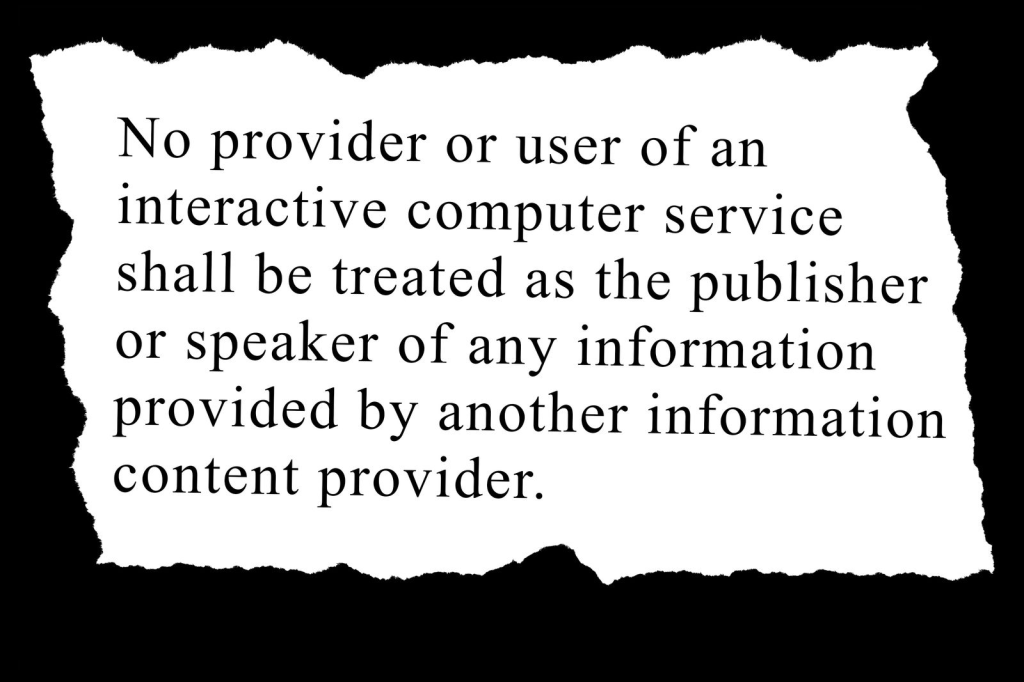
Jeff Kosseff one of the leading scholars on Section 230 describes it as “the twenty-six words that created the internet.” The 26 words are:

 “No provider or user of an interactive computer service shall be treated as the publisher or speaker of any information provided by another information content provider.”

These words provide immunity to online platforms from being held liable for user-generated content. Basically, it means that online platforms such as social media sites, forums, and search engines cannot be sued or prosecuted for what a user posts on their platforms. Even if the posts themselves are defamatory, false, or harmful .

This immunity has been vital in enabling the growth of the internet and the rise of social media platforms. It has allowed these platforms to provide a space for free expression and to facilitate the exchange of information and ideas without fear of legal consequences, unlike Prodigy who was a victim of pre Section 230 protection. This has also allowed smaller and newer online platforms to compete with established ones without having to worry about legal liabilities. Without Section 230, the internet me and you know and love would not exist- I likely would not be able to publish my articles without exposing myself to liability.

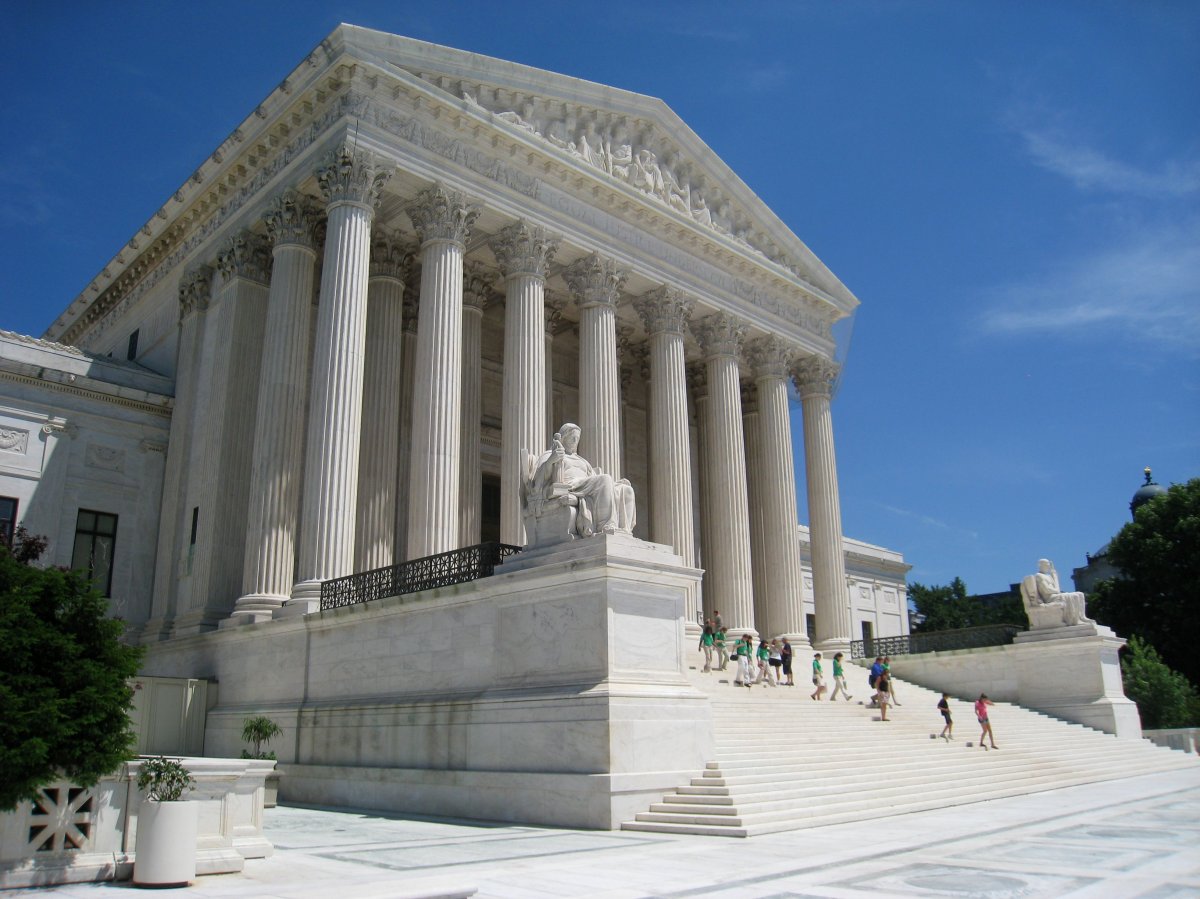
However, recently there have been attacks and concerns over the immunity Section 230 provides. Specifically that online platforms are basically not responsible  for any harmful content on their platforms, such as hate speech, harassment, and misinformation. Basically, people not in favor of the immunity argue that Section 230 has created an environment in which online hate speech and harassment can thrive. One recent case that puts forth such an argument Gonzalez v Google, has made it all the way to Supreme Court.

Gonzalez v. Google & It’s Implications

Gonzalez alleges ISIS generally used YouTube (owned by Google) to recruit members into its terror cells and “communicate its (ISIS’) desired messages.” which lead to the horrific events that occurred in Paris in 2015. Nohemi Gonzalez, a US citizen was unfortunately killed during the ISIS terror attacks that gripped the world in 2015. ISIS would later claim full responsibility for the attacks that lead to the untimely passing of Gonzalez.

Gonzalez argues that since YouTube videos helped fuel “the rise of ISIS” by knowingly recommending ISIS videos to its users, they are directly responsible for causing the Paris attack. They back up their argument that Google knew of such activity by claiming “[d]espite extensive media coverage, complaints, legal warnings, congressional hearings, and other attention for providing online social media platform and communications services to ISIS, prior to the Paris attacks Google continued to provide those resources and services to ISIS and its affiliates, refusing to actively identify ISIS YouTube accounts and only reviewing accounts reported by other YouTube users.” Their argument suggests that Google’s algorithms fall out of the scope of Section 230 and therefore subject them to liability.

Google contends that Section 230 fully immunizes them from such a suit based on judicial precedent and congressional intent, that their terms of services directly prohibit content that promotes terrorism, and they actively blocked such content when it was published by hiring Middle Eastern content moderators that worked 24/7 to flag terroristic content. Before the case arrived to the Supreme Court, all lower courts found in favor for Google.

Jess Miers a prominent Section 230 scholar mentions that this case “tees up a contentious question for the Supreme Court: whether Section 230 — a law that empowers websites to host, display and moderate user content — covers algorithmic curation.”. She points out that a vast majority of websites use non neutral algorithms, and that if the Supreme Court were to side in favor of Gonzalez it would open the flood gates of litigation against online services providers that rely on algorithms to function. Not only that but this ruling could incentivize states to curate the internet to achieve their ideological means, such as punishing websites for cracking down on misinformation or providing information for abortion services. This would give states too much power, and could lead to arbitrary curation of the information you see on the internet. A significant blow to consumers and arguably the facilitation of the 1st Amendment for Americans.

Only time will tell what happens with Section 230 as the court is expected to makes in ruling this summer. Hopefully, they make the right decision.

Sources:

STRATTON OAKMONT, INC. and Daniel Porush, Plaintiff(s),
v. PRODIGY SERVICES COMPANY, a Partnership of Joint Venture with IBM Corporation and Sears-Roebuck & Company, “John Doe” and “Mary Doe”, Defendant(s). Supreme Court, Nassau County, New York, Trial IAS Part 34.

Jeff Kosef: https://www.propublica.org/article/nsu-section-230

Jess Miers: High Court Should Protect Section 230 In Google Case https://www.law360.com/articles/1567399


Briefs of both parties in Supreme Court: REYNALDO GONZALEZ, et al., v. GOOGLE LLC,

How The Supreme Court Justified Eugenics: The Curious Case Of ‘Buck V Bell’

It’s no secret that the U.S. Supreme Court has a tumultuous past with certain rulings. A few examples being the infamous Dred Scott case which erroneously reasoned that certain set of humans were deemed property, Hammer v Dager which justified child labor, or Plessy v Ferguson the case that set the precedent for Jim Crow. People who’ve taken an American History course will more or less be familiar with the aforementioned cases. However, there’s an ambiguous case titled ‘Buck v Bell’ that deals with the controversial topic of eugenics. If you aren’t familiar with eugenics it’s basically a method of social engineering used to create the “best” race of humans. The method being notoriously implemented by Nazi Germany. Interestingly enough, it wasn’t just Nazis trying to make these plans come to fruition. The U.S. legal system had to deal with the topic of eugenics. Here’s how they addressed it.

Historical Context

In order to get a full understanding of the case some historical context on eugenics is necessary.  The theory of eugenics begins in the late 19th century, sometime after Charles Darwin publishes his magnum opus On the Origin of Species. During that time people rush to apply the theory of natural selection to human society. This movement gains traction throughout the western world. Peaking around the 1920’s. Universities in the USA begin to offer courses on eugenics. Increasing its popularity among academics. Despite the popularity of eugenics, academics begin to debate which humans were the superior ones. Some said the Anglos were & others argued that the Germans, Italians, Frenchs etc, were. Obviously in hindsight advancements in biology & genetics debunk all those aforementioned statements. But for the time this was the scientific truth. That lead the politicians of that era to make it their “moral” duty to prevent the degeneration of their race. This is similar to when the American Psychiatric Association classified homosexuality as a mental disorder in DSM III (published 1980), which falsely influenced societies perception on homosexuality. The same happened to eugenics in America. False research was given, debate ensued, and  legislation was implemented which leads us to the curious case of ‘Buck v Bell’.

The Case

The case begins with Carrie Buck. A resident of The State Colony for Epileptics and Feeble Minded at Lynchburg, Virginia which is headed by Albert Priddy. Carrie Buck finds herself at this institution after a series of unfortunate events in 1924.  Buck, a victim of rape, became pregnant and her adopted family had her committed to the SCEFM due to the “immorality” of having a child out of wedlock ( turns out they falsified she was raped). While at the institution they discover she has the “mental age of a 9 year old”, Priddy is a staunch supporter of eugenical sterilization, and suggests sterilization of Ms Buck due to her “moral delinquency”. Reasoning that it was probably passed down from her mother who was also known to be promiscuous and “feeble minded”.

Priddy was warned by a court in 1918 of his personal liability in sterilization operations and stopped for some time. However, realizing an opportunity to legally validate his operations, he takes the Buck case to the board of SCEFM. At the hearing Priddy argued his case to the board and it’s approved. It is then taken to local circuit court where evidence provided by an “expert”  detailed Buck’s “clear” lineage of moral delinquency. It also helped that Bucks consul (Irving Whitehead a founder of SCEFM) brought forth no arguments against Bell . The reason being was Whitehead sought the same end as Priddy; legal eugenical sterilization. The case would end up at the Supreme Court.


During the appeals process Mr. Priddy dies and the case is taken up by John H Bell. Who argues to the Court that due process was given to Buck and state police powers allowed them to protect and decide for persons such as Buck. Whitehead argued that institutions such as SCEFM could easily become havens where

” (The) worst forms of tyranny practiced…inaugurated in the name of science.” Furthermore, Bucks legal guardian argued that her right to procreate infringed on the due process clause of the constitution. Buck would lose the case 8-1. Supreme Court Justice Holmes writing for the court rejected Bucks arguments. The equal protection argument was shot down by Holmes because the policy applied to all within the institution. Furthermore, he adds that if the nation can call upon its “best citizens” in times of war, a lesser sacrifice can be made by those “lesser” that “sap the strength of society”.

The prevention of procreation is justified because “(t)hree generations of imbeciles are enough”. Strong words, iffy ruling.

Conclusion

After all was said and done Carrie Buck was sterilized in the name of eugenics. That ruling set the precedent for other states to enact similar laws. On the bright side after the Nazi’s were defeated and advancements in science, eugenics laws slowly began to fade. Despite this ‘Buck v Bell’ stands as the law of the land. The case has yet to be overturned.


Sources: The Oxford Guide to United States Supreme Court Decisions

Sapiens A Brief History of Human Kind by Yuval Noah Harari

Gerrymandering & Redistricting; A Supreme Court Affair

Gerrymandering, a technique that has helped fuel various political machines, is a topic of great debate within the Untied States. Gerrymandering on the surface is undemocratic. Allowing a political party that’s in power to redraw voting lines will naturally lead them to misuse their power. Partly because parties have used the technique to maintain political power by redrawing districts in their favor by diluting voting power. As was the case in 2011 in Wisconsin, where Republicans received a majority of house seats (60%) with only 49% of the state wide vote. How is this possible? Simple; Gerrymandering. It’s this overt case of the corrupt technique that has brought the debate to the Supreme Court. The Court plans to issue it’s ruling on Gill v. Whitford (The Wisconsin casein June 2018. Whatever side the court rules on, one thing is for sure: it will set a monumental precedent in terms of governing in the USA. (I’ve included a video explaining gerrymandering further down below.)

However, gerrymandering has two sides. Interestingly enough it’s been used to empower disenfranchised voices that have been diluted (usually by gerrymandering). Though the Court didn’t directly state it, racial redistricting was deemed somewhat constitutional. Here’s how they justified it.

The case involved in the debate was called United Jewish Organization of Williamsburg v Carey. In short, Kings County administrators followed the District Attorneys of New York’s plan of redistricting (In conjunction with the Civil Rights Act). Part of the provision called for certain districts to reach a nonwhite majority of 65 percent. Coincidentally, a Hasidic Jewish community was located in one of these districts. The effect of the provision was that the community was split in half, and was reassigned to an adjoining district. The Jewish community would then bring a suit for injunctive and declaratory relief, alleging that the 1974 plan violated their rights under the Fourteenth and Fifteenth Amendments, arguing that the plan diluted their franchise. The case would soon make it’s self up the ladder to the eyes of the Supreme Court.

The Court tip toed on it reasoning of the case. For the sake of simplicity and to save you time on the legal jargon here are the main points of the Courts justification of  New York’s redistricting plan:


  1. The Court mentions that racial discriminatory redistricting is unconstitutional.
  2.  Since the redistricting follows the provisions in the Civil Rights Act it isn’t discriminatory but rather hopes to reverse discrimination.
  3. So the use of racial criteria in drawing district lines may be required per Civil Rights Act (Specifically Voting Act)
  4. Additionally, the use of racial criteria is not limited to remedies of explicit prior discrimination.
  5. The use of numerical racial quotas in establishing certain black majority districts does not automatically violate the Fourteenth and Fifteenth Amendments
  6. The Court also says the constitution doesn’t recognize the Jewish Communities right to reapportionment as a separate entity.

Clearly the court relied heavily on the Civil Rights Act legislation and rightly so, in terms of the specific justification for enfranchisement of persecuted communities. But also seems to undermine the Jewish community. American history shows that those people haven’t necessarily been treated fairly either. Furthermore, gerrymandering is totally ignored in the Courts argument. Perhaps trying to devout their attention to the pressing societal challenges plaguing the era at the time. Racial tensions were high and The Court justified the means to combat racial injustice. However, in that pursuit the Court  may have indirectly set a precedent for justifying gerrymandering.

In all, gerrymandering is a complicated and nuanced subject; making it justified in multiple idiosyncratic realms. But the core of the issue is undemocratic. It gives room for manipulation by people seeking to fulfill their own sinister interests. If those sinister acts are possible then shouldn’t it be abolished? We’ll see what the Supreme Court has to say when confronted with the core issue in June.


LINK


Sources: http://caselaw.findlaw.com/us-supreme-court/430/144.html


A Case For Free Speech: Abrams v United States

Background

On August 23rd 1918, four political anarchist were arrested in New York City for handing out ‘anti war leaflets’ in the streets. Among the people arrested for passing out the leaflets were Jacob Abrams, a Russian immigrant and anarchist, along with his other ‘comrades’; Molly Steitmer, Samuel Lipman, and Hyman Lachowsky. The leaflets were written/printed in two languages, one version was written in Yiddish and another in English. They were distributed throughout the city, and condemned Woodrow Wilson’s involvement in World War I (The Yiddish leaflet called for a general strike to protest against government intervention). The group of protesters were indicted under the Sedition Act of 16 May 1918 which made it a crime to “willfully utter, print, write,or publish any disloyal, profane, scurrilous, or abusive language” about the United States government, additionally it was against the law to  “willfully urge, incite or advocate any curtailment of production” of things “necessary or essential to the prosecution of the war… with intent by such curtailment to cripple or hinder the United States in the prosecution of the war.”. The group of protesters were found guilty before federal district court judge Henry DeLamar Clayton, Jr., they were sentenced to serve between 15- 20 years in federal prison. The defendants appealed their conviction on the grounds of free speech and it went all the way up to the Supreme Court. Their case arguments began on the 21st of October 1919 and a final decision was made in November of that same year.

Majority opinion (with a vote of 7 to 2 Written by Justice John Hessien Clarke) 

In the middle of the appeals process the Supreme Court upheld the convictions of antiwar socialist under the Espionage Act of 1917 (Schneck v United States) and under the Sedition Act of 1918 (Debs v United States). Both cases would be influential in the reasoning behind the Abram’s case. Additionally, both decisions were unanimous and were written by Justice Oliver Wendell Holmes who reasoned in the Schneck case that “[t]he question in every case is whether the words used are used in such a circumstance and are of such a nature as to create a clear and present danger that they will bring substantive evils that congress has a right to prevent”. A similar line of reasoning would be used in the Abrams case by the majority opinion written by Justice Clarke. The leaflets were indeed a ‘clear and present danger’, Clarke rationalized that because they had been handed out “at the supreme crisis of the war” and could be simplified as “an attempt to defeat the war plans of the Government”. Any form of speech that impeded (or could impeded) the American war effort was now deemed the law of the land.


Dissenting Opinion (Written by  Justice Oliver Wendell Holmes )


Ironically, the dissenting opinion would come from the man who had written the opinions which set the precedent for the reasoning behind the argument for Abrams conviction. His dissent went against his previous definition of ” clear and present danger”. Justice Holmes had drastically modified his point of view by the time he’d have to see the Abrams case. Having been personally disturbed by the oppression resulting from the anti radical hysteria of the time, and being influenced by lawyers with libertarian interpretation of the law, Holmes began to lean towards a more libertarian point of view on the “clear and present” danger precedent.

Holmes now reasoned, “(congress) constitutionally may punish speech that produces or is intended to produce a clear and imminent danger that will bring about forthwith certain substantive evils that the United States constitutionally may seek to prevent” Furthermore, Holmes denied that ” the surreptitious publishing of a silly leaflet by an unknown man” created an imminent threat to the government. For Holmes the First Amendment protected the expression of all opinions ” unless they imminently threaten immediate interference with the lawful and pressing purposes of the law that an immediate check is required to save the country”.

The Supreme Courts would continue to battle with the definition of “clear and imminent” danger when it came to free speech, and the Abrams case is an important case for this fight for free speech. What stands out the most in this case is the eloquent and well articulated dissent of Justice Holmes. He opens up the discussion for future generations of the connection between freedom of speech, the search for the truth, and the importance of worldly experimentation:holmes-and-supreme-court

” But when men have realized that time has upset many fighting faiths, they may come to believe even more than they believe the very foundations of their own conduct that the ultimate good desired is better reached by free trade in ideas — that the best test of truth is the power of the thought to get itself accepted in the competition of the market, and that truth is the only ground upon which their wishes safely can be carried out. That at any rate is the theory of our Constitution. It is an experiment, as all life is an experiment”


Wise words from a decent man.


Sources: https://scholar.google.com/scholar_case?case=14321466231676186426&hl=en&as_sdt=6&as_vis=1&oi=scholarr