
There’s been a debate raging regarding an immigration program known as the H1b visa program. The H1b program is a program used to source specialized foreign workers into jobs that require specialized skills such as tech or engineering. Two prominent individuals in the tech and political sphere spurred the debate. Republicans, Vivek Ramasway and Elon Musk, claimed the program was necessary because Americans were ‘too dumb and stupid’ to do the high level work America desperately needs to continue to be the haven of scientific research, innovation, and technical development. I suspect they thought this messaging would go down well with their MAGA base- it did not.
Instead, countless Americans from backgrounds ranging from CEOs of tech companies, common workers, and Democrats challenged Vivek & Elon’s assertions that Americans were too stupid to work in tech and high skilled labor jobs.
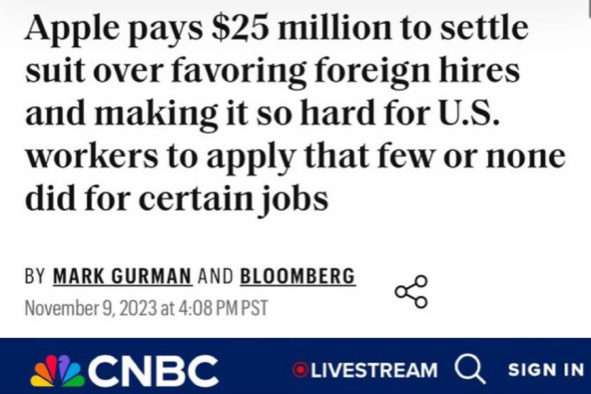
This inspired people to dig into the H1b visa program since a lot of the visas issued are within the public domain. What was revealed was a long list of fraud, discriminatory hiring, and deceptive practices. For example, it was found that several big companies such as Google and Apple settled multi million dollar settlements acknowledging they discriminated against American workers by undercutting them to hire cheaper foreign nationals from countries they preferred, mainly India, a country known for poor working conditions and subservient workers who do not fight labor abuses. Furthermore, it seems over 70% of H1b visas have been allocated to India at a disproportionate rate in comparison to other nations.
Here, we dissect four common misconceptions about the H1B visa, providing a clearer picture of its impact and operation.
Misconception 1: H1B is Necessary Because Americans Are Dumb
This sweeping statement is not only offensive but also a gross oversimplification of the program’s purpose. People claim the H1B visa aims to address specific skill shortages in fields like STEM, where there might be a lack of local talent or where companies need highly specialized skills. But that is not the case, the narrative of a skill shortage is often a facade for wage suppression, rather than an actual need for foreign talent due to intellectual inadequacy of Americans.
Numerous reports from the Economic Policy Institute highlight that the labor market’s dynamics are more complex, involving wage competition rather than a lack of skilled U.S. workers. The truth to the matter is that it is not about intelligence and more about under cutting American workers to hirer cheaper labor abroad. Simply put companies might find it more cost effective or convenient to employ foreign nationals rather than investing in domestic training or offering competitive wages to American workers.
American universities consistently produce graduates in STEM fields who are highly skilled, thanks to top tier education and research opportunities. Moreover, the U.S. has a rich ecosystem of tech education beyond traditional universities, including coding bootcamps, online learning platforms, and community colleges, which are turning out a steady stream of tech professionals equipped with the latest skills. The adaptability of the American workforce is a key factor; many professionals from diverse backgrounds are successfully transitioning into tech roles through reskilling and upskilling programs. The tech industry’s expansion across the U.S., not just in Silicon Valley, further supports the idea that domestic talent is abundant and capable. This diversity in tech roles, from software development to cybersecurity, means there’s a broad spectrum of jobs being filled by American workers. The issue, therefore, isn’t a shortage of American talent ready for tech jobs but rather ensuring that companies invest in this domestic workforce through competitive hiring practices, rather than automatically defaulting to hiring from abroad under the H1B visa program for cost efficiencies.
Misconception 2: H1B Gets the Best and Brightest
While the H1B visa does aim to attract highly skilled workers, the reality on the ground often differs from this ideal. Not every H1B visa holder is necessarily at the pinnacle of their profession. Research from UC Berkeley has shown that a substantial number of these workers are engaged in routine tasks rather than innovative or high level work, challenging the notion that the program solely brings in top tier talent. The Immigration Innovation Act of 2018 sought to refine this by prioritizing education and skills, but implementation has been inconsistent.
Research from UC Berkeley has shown that a substantial number of these workers are engaged in routine tasks rather than innovative or high level work, challenging the notion that the program solely brings in top tier talent. The Immigration Innovation Act of 2018 sought to refine this by prioritizing education and skills, but implementation has been inconsistent.
Further, Indian nationals and companies have been found engaging in widespread fraud, falsifying academic and work records, stealing from h1b salaries. Over the years, several high profile cases have come to light, highlighting a pattern of misuse and potential fraud. Companies like Infosys, TCS (Tata Consultancy Services), and Wipro, all Indian IT giants, have faced legal scrutiny for practices that include falsifying job roles, underpaying workers, and engaging in what’s colloquially known as the “bench and switch” scheme. This involves bringing workers into the country under the pretense of a specific job that does not exist, only to place them with another company or keep them on “bench” (unpaid or underpaid time) until a project becomes available.
One of the most significant cases involved Infosys, which in 2017 agreed to pay $34 million for allegedly misusing B1 visas instead of the more scrutinized H1B visas, thereby circumventing legal processes and wage regulations. Similarly, there have been instances where Indian consultancies were accused of submitting multiple applications for the same candidate to increase their chances in the H1B lottery, a practice that undermines the system’s integrity. This “gaming” of the lottery has been widely discussed on platforms like X, where users like @USTechWorkers have pointed out how these actions make the visa process a nightmare for genuine applicants.
Moreover, individual cases of fraud have been documented, such as the arrest of Ashish Sawhney in 2020, accused of a $21 million H1B visa fraud conspiracy by generating profits through fraudulent visa applications. Another case involved three Indian-origin men who pleaded guilty in 2024 to visa fraud, having operated a tech staffing firm that submitted fake job offers to secure H1B visas. These fraudulent activities not only exploit the visa system but also impact American workers by potentially displacing them with less expensive labor or filling positions with workers who might not meet the actual job requirements.
The broader implications include not just the legal ramifications for those involved but also a tarnished image of the H1B program, which was meant to benefit both the U.S. economy and the global talent pool.
Misconception 3: H1B Is A Fully Fair Practice with No Civil Rights Issues
There’s mounting evidence that the H1B visa could be part of a broader issue of workplace discrimination. Legal actions against companies like Cognizant, where a federal jury found discriminatory practices against non-Indian workers, illustrate this concern.
The U.S. Department of Labor and bodies like the EEOC are tasked with ensuring compliance with anti-discrimination laws, yet there are persistent allegations of preferential treatment for certain nationalities, particularly from India, in tech hiring. This raises significant civil rights questions about fairness and equality in employment opportunities.
The U.S. Department of Labor and the EEOC are tasked with ensuring compliance with anti-discrimination laws, yet there are persistent allegations and court dececiosn proving that preferential treatment for certain
nationalities, particularly from India, in tech hiring exists. This raises significant civil rights questions about fairness and equality in employment opportunities. The misuse of the H1B visa for cost-cutting rather than talent acquisition could lead to systemic discrimination against U.S. workers or workers from other nations, potentially violating civil rights by creating a workforce that does not reflect the diversity or merit of the broader talent pool.
Misconception 4: Indians Are Just Good at IT, Hence More H1B Visas
The dominance of Indian nationals in receiving H1B visas in the tech sector isn’t solely due to their aptitude in IT. Instead, it might reflect discriminatory practices by some firms. Indian IT consultancies have been accused of bias towards hiring from their own country, not just for cultural fit but also to leverage lower labor costs. This practice has led to lawsuits, with companies like Infosys and Wipro facing legal scrutiny for potentially discriminatory hiring practices.
While India has shown growth in its IT sector, its overall ranking in the World Competitiveness Yearbook by the Institute for Management Development (IMD) for IT infrastructure and digital competitiveness has not always placed India at the top. For instance, in the 2022 rankings, India was at 37th place, indicating it lags behind several countries in terms of overall IT competitiveness. Reports from companies like NASSCOM have pointed out that only a fraction of engineering graduates are employable in industries needing high-level IT skills.
Despite India’s significant strides in adopting and developing technologies such as machine learning, and blockchain, there’s a stark contrast in the skill readiness of its engineering workforce. Specifically, a report from TeamLease digital, an Indian research firm, indicates that only 2.5% of Indian engineers possess AI skills, and a mere 5.5% have basic programming capabilities. This statistic is alarming considering the technological ambitions of the nation and the USA’s receipt of their technical workers. The implications of this skills gap are profound. For India to maintain its competitive edge in the global tech landscape, it must not only invest in technology but also ensure that its workforce is equipped to leverage these advancements. For the USA we under utlizie the h1b program and undercut Americans who can actually do the job.
Big Tech and H1B Visas: A Closer Look
The involvement of big tech companies in H1B visa hiring practices adds another layer to this discussion. These tech giants are significant employers of H1B workers, with a notable number from India. Allegations of discriminatory hiring practices have surfaced, with lawsuits against companies like Google and Amazon for allegedly favoring foreign nationals, particularly from India, over U.S. workers. These companies have faced criticism for potentially sidelining American talent in favor of visa holders, which could be seen as an economic strategy to reduce labor costs. Despite diversity initiatives, the high reliance on
For example, Google, settled a lawsuit with the U.S. Department of Labor in 2018 for $11 million, accused of favoring H1B visa holders over American workers, indicating a systemic bias in hiring that might prioritize cost over local talent. Similarly, Amazon has faced allegations suggesting a preference for foreign workers through the H1B program, potentially at lower wages, though specific legal outcomes or settlements directly tied to these practices are less publicly documented. While not directly connected to H1B issues, Meta (formerly Facebook) has also been embroiled in allegations of broader discriminatory employment practices, which could indirectly influence perceptions of its visa hiring strategies.
The H1B visa program is not without its merits, offering a pathway for global talent to contribute to American innovation. Further Indian nationals have worked hard and contributed to the American economy in tremendous ways. However, it’s crucial to dispel myths with facts, understand the nuances of discrimination claims, and ensure that the program benefits both the economy and all workers fairly. The ongoing discussions and legal battles are essential in shaping a visa system that truly reflects the values of merit, diversity, and justice.
Overall one thing is certain: H1b reform is necessary if America wants to continue to prosper in the future.
Sources
- Economic Policy Institute Reports on Labor Market Dynamics
- Economic Policy Institute. “H-1B Visa Program: Frequently Asked Questions.” epi.org.
- UC Berkeley Research on H-1B Visa
- Mithas, Sunil, et al. “Skill Requirements in the H-1B Visa Program: Evidence from Job Postings.” UC Berkeley Research Papers, berkeley.edu.
- Infosys Legal Case
- U.S. Department of Justice. “Infosys Agrees to Pay $34 Million to Settle Allegations of Visa Fraud and Abuse.” DOJ Press Release, 2017. justice.gov.
- Tata Consultancy Services (TCS) and Discrimination Allegations
- Gupta, P. “Discrimination Allegations Against TCS.” Legal News, law360.com.
- Cognizant Discrimination Case
- U.S. Equal Employment Opportunity Commission. “Cognizant Discrimination Verdict.” EEOC Case Files, eeoc.gov.
- Infosys and Other Companies’ Practices
- National Association of Software and Service Companies (NASSCOM). “IT Practices and Worker Dynamics.” NASSCOM Reports, nasscom.in.
- Bench and Switch Schemes
- Choudhury, Prithwiraj. “Gaming the H-1B Visa Lottery.” Research Papers, Harvard Business School. hbs.edu.
- TeamLease Digital Report on Indian Engineers
- TeamLease Digital. “State of India’s Engineering Talent: AI and Programming Readiness.” TeamLease Research, teamlease.com.
- World Competitiveness Yearbook Rankings
- Institute for Management Development. “World Competitiveness Yearbook: IT Infrastructure Rankings.” imd.org.
- Google Discrimination Settlement
- U.S. Department of Labor. “Google Settles Allegations of Discrimination with $11 Million Fine.” DOL Press Release, 2018. dol.gov.
- Meta/Facebook Broader Employment Discrimination Issues
- Lev-Ram, Michal. “Facebook Pays $14 Million to Settle Discrimination Allegations.” Fortune, 2021. fortune.com.
- Fraud Cases Involving H-1B Visa Holders
- U.S. Immigration and Customs Enforcement. “Ashish Sawhney Arrested for H-1B Visa Fraud.” ICE Press Release, 2020. ice.gov.
- U.S. Tech Workers Advocacy
- U.S. Tech Workers. “Investigations Into H-1B Fraud and Discrimination.” ustechworkers.com.
- Immigration Innovation Act of 2018
- U.S. Congress. “Immigration Innovation Act (I-Squared).” Congressional Research Service Reports. congress.gov.
- Reports on Wage Competition and Visa Abuse
- Hira, Ron. “The H-1B Program: Changes Needed to Better Protect U.S. and Foreign Workers.” Testimony Before the Senate Judiciary Committee, 2019. judiciary.senate.gov.
- National Foundation for American Policy
- Anderson, Stuart. “H-1B Visas and America’s Global Competitiveness.” NFAP Policy Briefs. nfap.com.
- NASSCOM Reports on Employability
- National Association of Software and Service Companies. “Analysis of STEM Education and Employability.” nasscom.in.
- EEOC and Labor Law Compliance
- Equal Employment Opportunity Commission. “Discrimination Issues and Foreign Labor.” EEOC Reports. eeoc.gov.
- Indian IT Industry and Competitiveness
- Nasscom Foundation. “India’s IT Competitiveness in the Global Market.” nasscomfoundation.org.
 Sermo Civilis