
On May 24, 1995, Jordan Belfort’s brokerage firm Stratton Oakmont successfully sued Prodigy Communications Corporation in a New York court for defamation. Little did anyone know Stratton’s win over Prodigy would be the catalyst that changed the internet forever. The so called Wolves of Wallstreet had unknowingly set a dangerous precedent that threated the tech industry.
Stratton Oakmont v. Prodigy Services
Prodigy was an online internet service which more or less mirrored modern day social media sites, it serviced over 2 million people at its peak. Users were able to utilize a broad range of services such as getting access to news, weather updates, shopping, and bulletin boards. One of Prodigy’s notorious bulletin boards was called Money Talk, a popular forum where members would discuss economics, finance, and stocks- similar to Reddit’s Wallstreet Bets forum. Prodigy also contracted with independent moderators to vet and participate in the board discussions, similar to editors in a Newspaper but who engaged with their audience a lot more.
In 1994, two posts would subject Prodigy to legal liability. An unidentified user posted on the Money Talk bulletin on the dates of October 23rd & 25th, claiming that Stratton Oakmont was committing SEC violations and engaging in fraud in regards to an IPO they were involved in (Solomon-Page’s IPO) . The poster claimed:
- the Solomon-Page IPO was a “major criminal fraud” and “100% criminal fraud”
- Daniel Porush was a “soon to be proven criminal”
- Stratton was a “cult of brokers who either lie for a living or get fired.”
Ironically many of these claims would turn out to be true, however at the time they were unsubstantiated since there was no concrete evidence to back them up. After Stratton was made aware of the posts, the company and Daniel Porush (aka Jonah Hill’s character in the movie) commenced legal action against Prodigy for defamation due to the libelous statements made on Money Talks.
In the United States defamation claims are not plaintiff friendly due to the strong protections the 1st Amendment offers. In general in order to succeed in a defamation, a plaintiff must prove four elements:
1) a false statement purporting to be fact;
2) publication or communication of that statement to a third person;
3) fault amounting to at least negligence; and
4) damages, or some harm caused to the reputation of the person or entity who is the subject of the statement.
In the suit brought by Stratton against Prodigy the court focused on element 2 and 3. Namely whether or not Prodigy was a publisher & if the moderator’s acts or omissions while editing the Money Talk bulletin board amounted to at least negligence. The court ruled in favor for Stratton Oakmont.
The court reasoned that an operator of an online message board is considered a publisher for purposes of defamation liability. Specifically, if the online operator holds itself out as controlling the content of the message board and implements such control through guidelines and screening programs. An entity that repeats or otherwise republishes a libel post is subject to liability as if he had originally published it. But a party disseminating others’ content only faces libel liability if the party qualifies as a publisher rather than a distributor. If a party merely “distributes” others’ content, then the party is a distributor and is not subject to liability. The court used the phrase “passive conduits” to describe distributors. A passive conduit doesn’t face liability for libel absent a finding that the distributor knew or had reason to know that distributed content contained defamatory statements. Basically, if you had a content moderation system for user generated content your website was likely liable for defamation. Defenses such as the impracticability of moderating millions of user generated posts had no merit and would still subject the website to defamation claims. This ruling would shake the tech and internet industry, threatening to stunt and undo years of innovation.
To avoid a barrage of lawsuits the tech industry successfully lobbied Congress to act after the Stratton ruling. In 1996 Congress passed the Communications Decency Act which dealt with various internet related issues. The one most pertinent to us is Section 230(c).
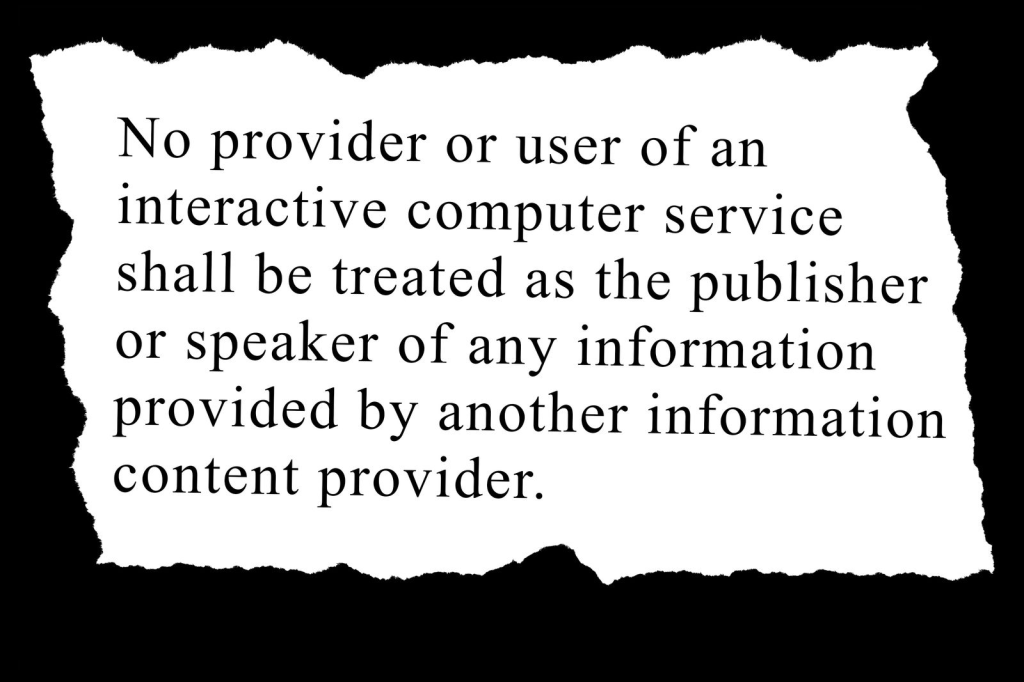
Jeff Kosseff one of the leading scholars on Section 230 describes it as “the twenty-six words that created the internet.” The 26 words are:
“No provider or user of an interactive computer service shall be treated as the publisher or speaker of any information provided by another information content provider.”
These words provide immunity to online platforms from being held liable for user-generated content. Basically, it means that online platforms such as social media sites, forums, and search engines cannot be sued or prosecuted for what a user posts on their platforms. Even if the posts themselves are defamatory, false, or harmful .
This immunity has been vital in enabling the growth of the internet and the rise of social media platforms. It has allowed these platforms to provide a space for free expression and to facilitate the exchange of information and ideas without fear of legal consequences, unlike Prodigy who was a victim of pre Section 230 protection. This has also allowed smaller and newer online platforms to compete with established ones without having to worry about legal liabilities. Without Section 230, the internet me and you know and love would not exist- I likely would not be able to publish my articles without exposing myself to liability.
However, recently there have been attacks and concerns over the immunity Section 230 provides. Specifically that online platforms are basically not responsible for any harmful content on their platforms, such as hate speech, harassment, and misinformation. Basically, people not in favor of the immunity argue that Section 230 has created an environment in which online hate speech and harassment can thrive. One recent case that puts forth such an argument Gonzalez v Google, has made it all the way to Supreme Court.
Gonzalez v. Google & It’s Implications
Gonzalez alleges ISIS generally used YouTube (owned by Google) to recruit members into its terror cells and “communicate its (ISIS’) desired messages.” which lead to the horrific events that occurred in Paris in 2015. Nohemi Gonzalez, a US citizen was unfortunately killed during the ISIS terror attacks that gripped the world in 2015. ISIS would later claim full responsibility for the attacks that lead to the untimely passing of Gonzalez.
Gonzalez argues that since YouTube videos helped fuel “the rise of ISIS” by knowingly recommending ISIS videos to its users, they are directly responsible for causing the Paris attack. They back up their argument that Google knew of such activity by claiming “[d]espite extensive media coverage, complaints, legal warnings, congressional hearings, and other attention for providing online social media platform and communications services to ISIS, prior to the Paris attacks Google continued to provide those resources and services to ISIS and its affiliates, refusing to actively identify ISIS YouTube accounts and only reviewing accounts reported by other YouTube users.” Their argument suggests that Google’s algorithms fall out of the scope of Section 230 and therefore subject them to liability.
Google contends that Section 230 fully immunizes them from such a suit based on judicial precedent and congressional intent, that their terms of services directly prohibit content that promotes terrorism, and they actively blocked such content when it was published by hiring Middle Eastern content moderators that worked 24/7 to flag terroristic content. Before the case arrived to the Supreme Court, all lower courts found in favor for Google.
Jess Miers a prominent Section 230 scholar mentions that this case “tees up a contentious question for the Supreme Court: whether Section 230 — a law that empowers websites to host, display and moderate user content — covers algorithmic curation.”. She points out that a vast majority of websites use non neutral algorithms, and that if the Supreme Court were to side in favor of Gonzalez it would open the flood gates of litigation against online services providers that rely on algorithms to function. Not only that but this ruling could incentivize states to curate the internet to achieve their ideological means, such as punishing websites for cracking down on misinformation or providing information for abortion services. This would give states too much power, and could lead to arbitrary curation of the information you see on the internet. A significant blow to consumers and arguably the facilitation of the 1st Amendment for Americans.
Only time will tell what happens with Section 230 as the court is expected to makes in ruling this summer. Hopefully, they make the right decision.
Sources:
STRATTON OAKMONT, INC. and Daniel Porush, Plaintiff(s),
v. PRODIGY SERVICES COMPANY, a Partnership of Joint Venture with IBM Corporation and Sears-Roebuck & Company, “John Doe” and “Mary Doe”, Defendant(s). Supreme Court, Nassau County, New York, Trial IAS Part 34.
Jeff Kosef: https://www.propublica.org/article/nsu-section-230
Jess Miers: High Court Should Protect Section 230 In Google Case https://www.law360.com/articles/1567399
Briefs of both parties in Supreme Court: REYNALDO GONZALEZ, et al., v. GOOGLE LLC,
 Sermo Civilis