Catalonia: Spain’s Savage Hypocrisy

Catalonia, a region in Northeastern Spain with a unique culture, language, and identity. A culture and history you can argue that is distinctly not “Spanish”.

Catalonia has seemed to have it’s identity trapped within the walls of Spain throughout it’s history. Before the kingdoms of Castille and Aragon combined their lands in the 15th century (this would later become modern day Spain), Catalonia was largely independent. It wasn’t until later centuries of Spanish conquest that Catalonia found itself on the losing side of a series of wars, which led to it’s absorption into Spain. But despite this, the Catalan culture and economy remained vibrant and vehemently independent.

EP603
“The Boatman Of Barcelona” by Dionisio Baixeras y Verdaguer (Spanish, Barcelona 1862–1943 Barcelona)

Fast forward to the 1930’s in Catalonia. Nationalism is running high and the Spanish Civil War is in full effect in the region. The Catalans recognized the void and decided to fight for their independence.However, despite their efforts the separatist would lose. That resulted in a win for Francisco Franco, a dictator backed by Nazi Germany. He went on to suppress civil liberties by banning the Catalan language, books, and other cultural events. He imprisoned and killed many Catalan leaders and activists in the process. This suppression would last until 1975 when Franco died.

Now the argument for the separation of Spanish and Catalan culture in it’s essence could be chalked up as subjective. People perhaps might say that they are different yet synonymous, along the lines of a symbiotic relationship. But one thing that isn’t subjective (or symbiotic) is Catalonia’s huge economic contributions to Spain’s overall GDP (Catalonia’s nominal GDP in 2014 was €200 billion the highest in Spain). Which is excellent for Spain’s tax revenue, but undermines a majority of Catalans who feel as if they’re being ‘robbed’ by the central government in Madrid. Because often, the way the tax revenue is used neglects Catalonia’s regional interests. Giving way for feelings of neglect and exploitation. Symbiotic relationships require two parties to benefit, but by definition when only one party benefits it becomes a PARASITIC relationship. It’s these idiosyncratic differences (both cultural and economic) that have put the region at odds with the Spain’s central government throughout history, and even more so in our modern political sphere.

The modern Catalan sentiment is that the region does more for Spain in terms of the economy than what it gets in return from Spain. That frustration, mixed with the Catalan historical identity has been fuel for recent separatist movements. Recently the regional Catalan parliament passed a law on Sept. 6th 2017 to hold a referendum on independence, Spain’s national government said it was illegal and filed a complaint to the National Constitutional Court. Spain ruled that the referendum was unconstitutional. Nevertheless the Catalans went on with referendum process. Spain responded by shutting down the referendums website, sending the police to stop any polls that had been set up for the referendum, and they confiscated about 10 million ballot papers/ millions of advertising posters. Successfully suppressing the democratic process. Additionally, around 700 of Catalonia’s about 900 mayors are being held under investigation for their role for preparing the referendum. Many of them could possibly face bans on holding democratically elected public office. Despite this many of them will continue to represent their constituents in Catalonia.

At the moment it’s unclear what’s going to happen in Spain amidst this democratic and political crisis. Things seem to be a bit rocky in terms of institutional implementation. Regardless, the world is watching.


Sources: AP

https://www.britannica.com/place/Catalonia

My Junior Year Research Paper

and Wikipedia for dates


Imprisonment & Economics: The Art of Legislation

You are who you imprison. Well, that’s what Plato would’ve said if he would’ve written The Republic in the modern era. Actually maybe not, but he would’ve been able to see the connection between modern economics, legislation and imprisonment. Being the genius that he was he’d probably devise a theory about this correlation, it’d be lofty, and well articulated. But since he’s no longer with us you’ll have to settle for my condensed version.

The first aggressive and transparent instances of this correlation emerge around the age of Mercantilism. They would debut in the form of legislative mandates all across Europe, particularly the Anglo-sphere. Michele Foucault (Historian and author of Madness and Civlisation) argues and points out that during this period:

“The first houses of corrections were opened in England during a full economic recession. The act of 1610 recommended only certain mills and weaving & carding shops to all houses of correction in order to occupy the pensioners. But what had been a moral requirement became an economic tactic when commerce and industry recovered after 1651, the economic situation having been re-established by the Navigation act and the lowering of the discount rate. All able-bodied manpower was to be used to the best advantage, that is, as cheaply as possible. When John Carey established his workhouse project in Bristol he ranked the need for work first: “the poor of both sexes…. May be employed in beating hemp,dressing and spinning flax, or in carding wool and cotton”…Sometimes there were even arrangements which permitted private entrepreneurs to utilize the manpower of the asylums for their own profit” (Madness and Civilisation 52-53) 1834titlepage5.jpg
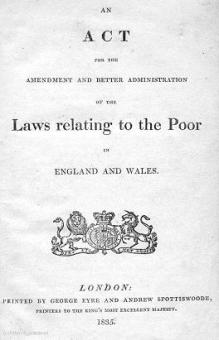
In a nutshell, Foucault emphasizes the interdependence between economics/legislation, and the effect they had on the development of correctional facilities in the age of Mercantilism. In this case an economic recession has hit England and in response the government passed legislation in order to regulate the economy. A fairly normal measure for governments trying to lessen the effects of an economic catastrophe. But it’s the methods that are deployed which raise cause for alarm.

In a desperate attempt to save the economy England outlawed abject poverty, homelessness, and “loose, idle  and disordley behavior(the latter was never given a clear legal definition) . They sent all “offenders” to correctional facilities, where they were locked in a cell and forced to work . The proper terminology for this systemic means of punishment is called Poor Relief. It was a way for the government to absorb the “non productive” members of society into a system of regulated labor. That newly established labor pool was then used by the big businesses of the time to make a profit during the economic recession.  These organizations would come into these ‘houses of correction’ and use the free prison labor enabling them to turn a profit during a recession. Basically they exploited the new source slave labor.

Additionally, Poor Relief should be looked at as a form of societal control in the face of economic hardship. By rounding up the impoverished of society, England was able to mask how catastrophic things were by forcing everyone to be economically productive. This enables a suppression of any societal/political agitation. After all people without jobs can’t protest the state of the economic climate if they’ve already been arrested for not having a job.  That allowed England to ‘kill two birds with one stone’:( 1) because more of the population is able contribute to the economy (increasing economic efficiency) and (2 )the threat of civil unrest is suppressed. The first instances of modern mass incarceration have begun to take shape.

(in hindsight England was able to fully recover from their economic catastrophe)

Fast forward to the latter part of the 20th century. A time of extreme ideological tension across the globe. Perpetrated by an ongoing Cold War between two world superpowers, the USSR and the USA. During the Reagan administration the goal was clear; the Soviets had to be stopped. The administration would spend their time conducting extensive research to determine the Soviet’s systemic weaknesses. One of the weaknesses identified was an economic one. The administration figured out that by strangling the USSR with economic sanctions and making sure the US economy expanded at an exponential rate, the USA could win the Cold War. Rendering the Soviet economist Leonid Kantorovich’s  Nobel prize winning work on optimal resource allocation useless. In hindsight, Reagan’s supply side economics (Reaganomics)  would prove to be an effective strategy in the aim to stimulate and grow the American financial sector, albeit artificially. By stripping away and adding new red tape, laissez-faire economics dominated and took American capitalism to places it had never been before. Despite all that, some sectors of the American economy needed artificial legislative means to achieve that record growth.

In the 1980’s the number of arrests of drug offenses rose by 126% (National Council on Crime and Delinguency 1989). Mainly due to legislative acts such as the Comprehensive Crime Control Act of 1984. It was a mandate which radically revised the American criminal code system;It gave the government more power in civil forfeiture, reinstated the federal death penalty, and increased federal penalties for cultivation, possession, or sale of Marijuana. This was an indirect effect of Reagan’s supply driven economic stimulus. Because in order for the USA to beat out the Soviets, the US market needed to be operating at near full capacity. That meant everyone was needed to contribute to the system. No matter who you were. What followed these mandates was the rapid development of the ‘for profit privatized prison industrial complex’ . In these new prisons a new criminal was cultivated to populate them, the non-violent drug offender.  As the prison industry grew so did the abundance of this newly cultivated criminal. This in effect meant more free labor for the American economic system as prisons became a new place for corporations to use “outsourced” prison labor.  Leading to even more diverse growth in the corporate structure. For example, if Walmart uses prison labor to create an assembly line for a product (which it does) , then that product is cheaper for consumers, which incentivizes them to shop at Walmart.

But a lot of the economic growth in this era was feigned under complicated laws which inflated economic statistics. An example of this would be corporate share buy back schemes. This financial technique is used by corporations to inflate numbers by buying shares of the company back from individuals who’ve bought them. Share prices are inflated because less shares are out in the public’s hands. But this alone doesn’t necessitate growth.  The reason why the profit margins grow is because investors are ignorant of the fact that the company is buying back it’s own shares. Generally, if people were aware of that corporate behavior confidence in that corporation would diminish. Ideally you’ll want the company to invest it’s money on the product/service it’s providing in order to turn a profit. When a company starts buying back shares that shows a lack of focus in terms of direct capital accumulation from the business. Instead buying back shares shows that a firm is more focused on marketing the fact they are still profitable. A desperate attempt to save their reputation. In principal nothing is wrong with this. But it’s wrong when the US legislation allows corporations to mask the fact they are buying back shares. This allows corporations to lie and potentially defraud investors. But ever since the 1980’s share buybacks have been allowed to remain nontransparent.  Practices such as these can result in big economic bubbles. This is especially concerning when considering the fact that Goldman Sachs has recently bought back $780 billion worth of it’s own shares to avoid public scrutiny, giving us insight that this behavior is alive and well in the 21st century. Subtly, there’s an implication that the  prison system may not have even played a significant part in the economic war waged by the USSR and USA. If it did generate growth then it must’ve been minimal. What seemingly played a significant role is the non transparency of certain economic strategies, one of them being corporate buy back schemes. But the creation of the non violent drug offender allowed the US private prison system a new source of labor, and therefore created growth within that industry. Nevertheless, Reaganomics resulted in a exponential growth for the American economy, one of the key factors that resulted in the collapse of the Soviet Union. Just another concrete example of the relationship shared between legislation, economics, and imprisonment.

In all, when economic instability is on the horizon, one should expect a response from those controlling the resources within a given society. This response will often translate into laws and it’s effect can be easily mapped overtime.

(Sources)

Madness and Civilisation By Michelle Foucault

The 1989 NCCD Prison Population Forecast: The Impact of the War on Drugs By James Austin Aaron David McVey


Trumps Climate Withdrawal: What It Means and International/Domestic Responses

Staying true to his campaign rhetoric, Trump has effectively decided to kill the Paris Climate Accord. Essentially ending government support for future innovation in the American economy. The move seems to be an attempt to bring back the dying American coal industry, despite the lack of evidence that pulling out will do just that. That’s because it’s hard to ignore that the cost of clean energy is plummeting in comparison to coal, making it more affordable to consumers.

Additionally, according to most “reputable” economists climate change will begin to have a net negative impact on the global economy (the median estimates say by 2025 is when the full effects will be felt). The economic sectors that would be most affected unsurprisingly include Agriculture (94% ) Fishing (74%) Tourism (72%) Insurance (66%) and Health Services (54%). And the United States could’ve used a overhaul of it’s current economic climate policy by further incentivizing corporations and individuals to innovate  by bolstering the American economy while at the same time curving pollution. Logically this is what will most likely help those disenfranchised by the economic collapse of the coal industry. A new industry equals new jobs for those effected by the coal decline. And a business oriented mind such as Trumps should easily recognize the economic benefits of going “green” namely: Incentivizing business by providing a revenue-neutral carbon tax, which enables a head start in a new and emerging market, and the creation of more jobs through a “going green” infrastructural overhaul.

But instead Trump has decided to go a different route by pulling out of the Paris Accord. Was it to satisfy constituents by fulfilling his campaign promises? Or perhaps to distract from the scandals going on in the White House(?) Whatever the reason the fact remains that the Trump Administration has pulled out as the symbolic administrative leader of the global climate initiative. And in effect an unsuspecting “green alliance” has been forged to combat the looming global climate crisis.

The European Union and China have agreed to fill the vacuum left by the USA as the leaders of innovation amidst the climate crisis. A week after Trump announced his withdrawal from the Paris Accord, China and the EU met in Brussels to talk about the future of their climate policies. The two parties (for the first time ever) are now  in agreement “to forge ahead” with measures to “lead the energy transition” towards a global low-carbon economy. Specifically by committing to cut back on fossil fuels, developing more green technology, and jointly working to raise $100 billion a year by 2020 to help poorer countries cut their emissions. This “green alliance” seems to be calculated response to the Trump administrations protectionist economic framework. After all the EU and China’s agreement seem to be in the favor of free trade, economic growth and innovation, while at the same time combating the climate change epidemic.  A stark contrast to Trump’s crony and isolationist economic tactics. Furthermore, China has committed to a plan to develop 150 gigawatts of solar energy by the end of the decade, the EU is leading in wind power energy and recently France (via Macron) has additionally incentivized scientists and business leaders alike to come to France, in order to “work on concrete climate solutions”. As of now the EU is the leader for positive climate policy implementation and China is well on it’s way towards that path. And this new green alliance will only seek to economically and environmentally improve both regions.

However there is a silver lining. Despite the Trump Administration withdrawal from the Paris Agreement top American business leaders are still working towards the global climate initiative. CEO’s from Apple, ExxonMobil, Jp Morgan, Goldman Sachs, and most notable Elon Musk (who left the President advisory council after the decision)were ALL in dissent after Trumps withdrawal. Yes that’s right! natural gas companies and big financial firms AREN’T in favor of the decision and will continue to uphold the Paris Accord’s framework. Nick Atkins (CEO of American Electric Power, Coal company) had this to say “(T)his  gets a lot of questions from investors, we get a lot of questions from customers, that … want renewable energy solutions, clean energy solutions. And we at AEP want to be as benign to the environment as we can”.  However, these businesses could’ve used additional tax incentives by going with clean energy (allowing for further economic growth) and Trump had the power to help. He clearly chose not to.

The majority of the American population doesn’t agree with Trumps withdrawal either, according to a recent Washington Post- ABC news poll that says 59 percent oppose the move. Having said that several states have formed a bipartisan group committed to upholding the Paris Accord, called the United States Climate Alliance. Among the members are New York and California, huge economic influencers. If the USCA was a country it’d be 4th in terms of GDP. Providing hope for the future. After all the President’s decision doesn’t matter if the societal collective refuses to obey.


EDIT: While I wrote this the US Ambassador to China David Rank resigned because of Trumps Climate withdrawal

Sources: “Expert Consensus on the Economics of Climate Change” by the Institute for Policy Integrity, NYU School of Law.

Click to access 20160527_1_a1_-_c_2016_2989_f1_annex_en_v1_p1_850173_en.pdf

http://www.economist.com/news/international/21722914-china-and-europe-plan-lead-climate-efforts-whither-world-after-americas-retreat

http://governor.wa.gov/news-media/united-states-climate-alliance-adds-10-new-members-coalition-committed-upholding-paris