Ad Hoc Tribunals: A Human Rights Based Approach to Combat Human Trafficking

It’s no secret that human trafficking is an issue that must be dealt with. Human trafficking involves the use of force, fraud or coercion to transport persons across international borders or within countries to exploit them for labor or sex.[1] The International Labour Organization estimates that 40.3 million people are victims of human trafficking.[2] These statistics mean that on any given day over 40 million people are being trafficked for the purposes of either forced labor or sexual exploitation. Sex trafficking has dominated headlines in the 21st century, and rightly so, since UN reports stipulate that 50 percent of detected human trafficking victims were sex trafficked. [3]Additionally, over 38 percent of detected victims were trafficked for forced labor purposes.[4] These alarming
figures are a wakeup call for the international community, leading to the 2030 Sustainable Development Goals (SDGs) which are committed to ending modern slavery and human trafficking by the year 2030.[5] There have also been several initiatives to combat human trafficking such as the Palermo Protocols and the 2014 protocol to the Forced Labour Convention (1930).[6] The Palermo Protocols are more focused on combating human trafficking with two of the three protocols being focused on trafficking, while the 2014 Forced Labor Protocol is focused on combating forced labor trafficking and “slavery-like practices”. [7] [8]

It is worth noting that trafficking crimes are actionable under customary international law, even when asserted against private actors.[9] Since they are actionable crimes, the United Nations Office on Drugs and Crime has the right to enact measures against these crimes. However, despite these ambitious goals and protocols, there have been notable lapses in enforcing the crime on the international scale. Behavior from states following these protocols suggests that they usually attempt to address trafficking from either an immigration perspective or from a solely criminal perspective, which is limiting.[10] This is a cause for concern since, with a multifaceted issue such as human trafficking, the implementation of all possible international initiatives to combat trafficking is a priority. One legal instrument that could help facilitate the enforcement of international human trafficking would be a human rights-based approach to help tackle the issue via the establishment of ad hoc tribunals.  The main argument put forth by this piece will be to suggest that human trafficking is a crime against humanity, and that the creation of an ad hoc tribunal operating under the Forced Labour Convention (1930) would likely have a positive immediate impact on efforts to enforce the law on human trafficking.

            Methodology

            This piece will discuss this issue in three parts. The first part will use three places as case studies to describe the large scale nature of the human rights atrocities that are occurring which are also facilitating human trafficking, making the issue of persecuting human trafficking a human rights concern. The second part will argue that human trafficking should be a crime against humanity and can likely be brought forth to the ICC. However realistically this may not happen considering the nature of the ICC.  The third part will discuss the importance of creating ad hoc tribunals under the framework of the Forced Labor Convention of 1930 to combat human trafficking.  Arguably this will help set further precedent to make sure it is a crime against humanity under Article 7 of the Rome Statute and therefore actionable by the ICC.

I. Modern Trafficking Issues

            The reason it is important to discuss modern trafficking is show that human trafficking is a pressing issue. Framing both human rights abuses and human trafficking in context with one another will allow us to investigate the relationship between the two. This will allow us to see strong correlations between human rights atrocities and human trafficking, setting up the discussion as to how human trafficking is essentially a crime against humanity. In order to further this discussion several modern human rights abuses will be examined to show how they have facilitated the rise of human trafficking on an international scale. The first example will be the Rohingya genocide perpetuated by Myanmar; the second example will describe the human trafficking occurring to fund Boko Harams terrorism; thirdly we will describe the rise of human trafficking in Libya after the Libyan Revolutionary War.  These examples will further the argument that human trafficking should be seen as a crime against humanity due to the endemic rise of various atrocities occurring in the world.  It’s important to note that these are not the only instances of large scale international human trafficking. There are plenty of examples across the world that could help further the discussion.[11] [12] [13] These particular nations were selected due to the lack of enforcement found within their jurisdictions.

            A. The Ethnic Cleansing of The Rohingya in Myanmar

            The Southeast Asian nation of Myanmar has recently ramped up its campaign of discrimination and violent persecution of the Rohingya peoples.[14] The Rohingya are an ethnic minority in Myanmar and differ from the majority in several ways.[15] The main difference is that the Rohingya commonly practice Islam while the majority practice Buddhism.[16] Additionally, the Rohingya have a different physical racial makeup then the majority. [17] The first major instances of state sponsored persecution of the Rohingya can be traced back to

the Nationality Law of Myanmar.[18] [19] This piece of legislation was enacted in October 15th, 1982 and basically rendered the Rohingya stateless, making them eligible for state prosecution since they did not fall under the 135 “national races”. [20]  [21] That meant they had no rights in the eyes of the Myanmar Government. Over time there was systematic persecution of the Rohingya, cumulating into the eventual 2012 pogroms against the ethnic minority.[22] The state of Myanmar has also been accused of requiring the Rohingyas to perform forced labor.[23] According to the Special Rapporteur on the Situation of Human Rights in Myanmar, the military has been making use of forced labor, since they have been lacking in labor resources.[24] Additionally, the government has been involved in the enslavement and trafficking of the Rohingya in Myanmar, with the Rohingya being forced to participate in the construction of various government projects.[25] Men and boys are arbitrarily picked up and are forced to immediately follow the authorities to the construction sites.[26] Rejecting these forced labor demands often results in killings, torture and rape of other family members unless the person concerned pays financial compensation to the authorities.[27]

            The atrocities in Myanmar have forced residents to flee the area to avoid prosecution.[28] Unfortunately, this has led human traffickers to prey on the vulnerability of Rohingyan refugees. For example, families have been selling their children to labor and sex traffickers to raise money.[29] So far in Bangladeshi refugee camps at least more than 1,000 individuals have been identified as victims of human trafficking.[30] Further, there is evidence to suggest that officials in Thailand and Malaysia have actively participated in the trafficking of the Rohingya when they attempt to seek asylum.[31] This has resulted in countless numbers of Rohingya being trafficked for the purposes of forced labor and prostitution. According to victim’s stories, several hundred Rohingya have been deprived of their liberty by traffickers and tortured while extorted for money.[32] The Rohingya case shows us how intertwined human rights atrocities such as genocide can incentivize human trafficking of the persecuted group. Not only will the oppressors attempt to traffic the vulnerable population, but other nefarious actors will attempt to capitalize on the situation.[33]

            B.  Boko Haram: Funding Terrorism Through Human Trafficking

            Boko Haram is a terrorist organization founded in Nigeria in the 20th century.[34] Boko Haram’s terroristic operations have been mostly focused within northeastern Nigeria and other contiguous countries such as Chad, Niger, and Cameroon. Its ideology has been centered around the teachings of Mohamed Marwa who expressed the abandonment of all western ideology, declaring that the Quran is the only book that should be read.[35] Overtime the group has become notorious for trafficking women and children for the purposes of forced marriages, forced labor, military conscription and selling victims to the highest bidder in order to finance their ideological goals.[36] Boko Haram has begun operating “baby farms.” A baby farm is where women who are trafficked have babies, and those babies are then sold to people for a profit.[37] Philip Obaji reports that “women and girls are held captive to deliver babies who are then sold illegally to adoptive parents, forced into child labor, trafficked into prostitution or, as several reports suggest, ritually killed”.[38] Prosecuting Boko Haram’s human trafficking activity has proved difficult, despite Nigerian anti-trafficking laws.[39] This can largely be attributed to enforcement issues such as the lack of funding, corruption, and inappropriate application of trafficking law by the judiciary.[40] If Nigeria cannot properly prosecute Boko Haram for their human trafficking operations, perhaps an international tribunal especially dedicated to handle these matters would prove beneficial.[41]

C. The Horrific Effects of the Libyan Revolution

                Libya has gone through major institutional reforms since the fall of Muammar Gaddafi. [42] Though the revolution was supposed to liberalize Libya, the opposite seems to have occurred. After the revolution there has been a lack of institutional capacity and enforcement of human trafficking laws.[43] The current administration that is in power has failed to facilitate a fully functioning judicial system and enforcement agencies. [44] This has resulted in extrajudicial proceedings maintained and enforced by armed bans of militants.[45] These “enforcers” have committed a plethora of human rights abuses ranging from unlawful killing, forcible military recruitment, forced labor, and human trafficking.[46] Trafficking victims have included both adults and children who are vulnerable to the instability and violence that is occurring within Libya.[47] Furthermore, refugees from Sub-Saharan Africa looking to enter Europe through Libya have been subject to human trafficking, in some instances these venerable refugees are trafficked for forced labor or into prostitution.[48] These atrocities were made infamous after a couple of videos showing chained people being sold in an auction reminiscent of the times of the Trans-Atlantic slave trade were widely publicized in mainstream media outlets in the western world[49]. To this day the government of Libya has not provided any reports on prosecuting or convicting any individuals on the grounds of human trafficking.[50] Additionally, the government has no programs that encourage victims to participate in investigations and prosecutions against their traffickers.[51] This is problematic since Libya is a signatory of the Convention Concerning Forced or Compulsory Labour (1930).[52] This begs the question of what institutions will hold these people accountable for committing these atrocities when the domestic instutions fail to fulfill their obligations on international human trafficking and forced labor agreements?

II. Human Trafficking: A Crime Against Humanity Under Article 7 of The Rome Statute?

                Because human trafficking has proven to be a persistent problem for the international community, it should be recognized as a crime against humanity. There has been a fair amount of scholarship advocating for human trafficking to be a crime against humanity.[53] For example scholar Tomoya Obokata has noted that “trafficking… is not an ordinary crime with transnational dimensions. It has increasingly been recognized that trafficking can rank among the ‚most serious crimes of concern to the international community as a whole‘or delict juris gentium.” [54] Furthermore, he notes that in the context of human trafficking , subsequent exploitation can be regarded as slavery which would mean that trafficking would be a crime against humanity under Article 7 of the Rome Statute. [55] This is significant since the Rome Statute established the jurisdictional parameters of the International Criminal Court.[56] Further state actors are not the only people that can be prosecuted under the ICC. Courts have noted that criminal gangs and other organized groups can also be prosecuted.[57] Furthermore, the opinion in Prosecutor v.Kunarac, decided by the International Criminal Tribunal for the Former Yugoslavia,  held that “ the duration of the suspected exercise of powers attaching to the right of ownership is another factor that may be considered when determining whether someone was enslaved’”.[58] On its face the durational acknowledgement by the court seems to insinuate human trafficking is a crime against humanity under the umbrella of “enslavement” under article 7 of the Rome Statute since human traffickers exercise control over a victim to perform forced labor or sex acts.[59] But the court notes that the buying, selling, or trading in humans, although an important factor to be taken into consideration, is in itself insufficient in determining whether or not that enslavement has been committed.[60] This is a problematic narrowing by the court.  In order for human trafficking to become a crime against humanity under Article 7 of the Rome Statute, human trafficking would need to fall under the definition of enslavement which requires a higher level of scrutiny since “buying, selling, and trading of humans” is insufficient to prove that a crime was enslavement, according to the Kunarac court.[61] Therefore, it is paramount that human trafficking be enumerated within the Article 7 of the Rome Statute as a crime against humanity itself. The United Nations defines human trafficking as the recruitment, transportation, transfer, harboring, or receipt of persons by improper means (such as force, abduction, fraud, or coercion) for an improper purpose including forced labor or sexual exploitation, this exact definition would render the “buying, selling, and trading” of humans as crime against humanity itself had human trafficking been enumerated within Article 7 of the Rome Statute. [62] However, despite the validity of these arguments it would take a significant lobbying effort to get such a measure passed.[63]

            Though all of the above may be true it is unlikely that the Rome Statute would be amended to include human trafficking within Article 7 anytime soon.  Further, there are large number of nations who are not signatories of the Rome Statute, so even if human trafficking were to become a crime against humanity 43 of nations would not fall under the jurisdiction of the ICC.[64] Hypothetically these nations could become safe harbors for human traffickers. However, if a tribunal was created under an amendment of the Forced Labor Convention 2014 Protocol then arguably proper judicial remedies would be available for human trafficking atrocities that are occurring around the world. Additionally, this tribunal operating under the FLC 2014 protocol could facilitate adjudication for the ICC by setting the appropriate precedent for the ICC. History has proven that past tribunals have been instrumental in how the ICC has proceeded in its present case load. For example, the first case tried by the ICTY was Prosecutor v. Tadic. In that case the main argument Tadic had was that the court lacked jurisdiction since neither he nor Serbia ever consented to the jurisdiction of the court.[65] Proponents for the ineffectiveness of this international tribunal likely found tremendous merit in Tadic’s argument. Thankfully the court was able to assert its jurisdiction by citing prior tribunal precedent, namely the Nuremburg trials and other customary international law; the court was able to carefully dismantle the jurisdictional argument made by Tadic.[66] The court laid the criteria for establishing an International Tribunal which includes the establishment in accordance with proper international standards, the provision of guarantees of fairness, justice, and even-handedness that have been full conformity with internationally recognized human rights instruments.[67] This meant that tribunals like those created in the Tadic case are often endowed with primacy over national courts when enforcement cannot properly occur within a nation’s jurisdiction. The Tadic case provided the precedent for future adjudication for the ICTY, International Criminal Tribunal for Rwanda, and ICC, consistently being cited as the prima facie case that asserts the legitimacy of international courts when dealing with human rights atrocities. Further, since the precedent set in Tadic over 200 war criminals have been fully prosecuted under the law in international courts. Though more could always be done in regards to adjudication of international crimes in international tribunals, there has been considerable progress in regards to adjudication of crimes on the international scale. Let’s remember international courts are relatively young and need more time to fully develop their potential. After all national courts often go through a similar “infancy” stage. For example, it took the US judiciary years after its inception to develop judicial review and the idea of substantive due process.[68]  [69] In light of the effectiveness of international tribunals that I have outlined, another tribunal focused on combating human trafficking would likely be effective and would not be hindered by challenges to its jurisdiction.

III. Ad Hoc Tribunals That Enforce the Forced Labor Convention Would Be An Effective Way to Counter Human Trafficking When National Courts Lack the Capacity to Enforce Anti Trafficking Laws

            A. The Case for an Additional Amendment to the FLC 2014

            The FLC 2014 protocol puts an obligation on states to “provide protection and appropriate remedies, including compensation, to victims of forced labour and to sanction the perpetrators of forced labour.[70] It also obligates states parties to develop “a national policy and plan of action for the effective and sustained suppression of forced or compulsory labour”. [71] Considering the aforementioned case studies this has not significantly deterred human trafficking in areas where enforcement is minimal to say the least. The protocol could be further amended to include a provision which makes the failure to uphold the FLC 2014 protocol a trigger for an investigation and if ineffective implementation is found then an ad hoc tribunal would be created to make sure that the protocol is enforced via adjudication. Furthermore, a provision could be included to allow voluntary investigations, allowing nations that do not have the enforcement/ adjudicatory capacity to call upon an ad hoc tribunal to deal with a matter a national court may no be equipped to handle. The option for voluntary investigations is important considering the fact that a large amount of the ICC’s cases have come from self-referrals. [72] Often people criticize the ICC for selective enforcement, particularly in Africa. However, most of the ICC’s jurisdiction in Africa comes from self-referrals.[73] These provisions would be necessary in order to create a court that could handle human trafficking crimes on the on international scale. The main reason the FLC would be the proper vehicle to facilitate adjudication of international human trafficking is because of its broad mission to “suppress the use of forced labour in all its forms irrespective of the nature of the work or the sector of activity in which it may be performed”.[74] This would include both forced labor and sex trafficking. Additionally, all but fifteen nations have ratified the 1930 FLC convention, which makes it a powerful legal instrument on the international scale. Additionally, the 2014 protocol was approved with 437 votes in favor and 8 against (each member state has 3 votes).

            B. Consistent Enforcement

            If an ad hoc tribunal provision were to be promulgated under the FLC of 1930 then we could expect consistent enforcement of norms against human trafficking, especially in nations that have had issues with the rule of law. For example, the Democratic Republic of Congo and Mali have had trouble prosecuting war criminals and invited the ICC via self-referral to ensure that crimes against humanity are being punished in a consistent fashion. [75] [76]. Scholars have noted that consistency of enforcing international human rights principles is one of the primary factors for establishing the rule of law within a region. [77] Establishing an ad hoc tribunal in places where human trafficking enforcement has been substandard, for example in Libya and Nigeria, would be a proper step forward in combating human trafficking.

            C. General Deterrence

            Furthermore, the ad hoc tribunal could serve as a symbolic deterrent since, if there is an active tribunal prosecuting human trafficking cases, potential perpetrators would be deterred for fear of prosecution. Though the deterrent effect of international tribunals is a contentious topic within international legal scholarship, there is evidence to suggest that the ICC does have a deterrent effect.[78] For example, in the Democratic Republic of the Congo, there is evidence that ICC prosecutions are having at least some impact on the militaristic behavior of troop commanders. Media reports from the region have highlighted that a significant number of ex-combatants have noticed a modification in the behavior of rebel commanders which have been designed to avoid the possibility of ICC prosecution. This phenomena has been noted in the region of Ituri, which has been the focus of the ICC’s investigative and prosecutorial activities.[79] Furthermore, after the ICC expressed interest in investigating Colombia for crime against humanity, the government subsequently took measures to promulgate laws that made sure their officers were not committing war crimes and crimes against humanity. Investigations by the Crisis Group have noted that:

“The threat of ICC prosecution appears to not only have influenced the calculations of the Colombian government – including former President Pastrana who, according to cables published by Wikileaks, expressed (unwarranted) concern that he may be prosecuted by the ICC for his actions while in power from 1998-2002 – but also by key rebels. And at least one of the leading paramilitary leaders, Vincente Castrano (AUC), was apparently sharply aware and fearful of the possibility of ICC prosecution, a fear that reportedly directly contributed to his demobilisation.”[80]

Though opponents of the ICC’s deterrent effect are plenty, the main argument against the ICC is for “specific deterrence” which is not the kind of deterrence this paper is discussing. [81] Rather this paper is concerned with “general deterance”. General deterrence focuses more on educating the general public on the legal ramifications of illegal behavior, rather than just the individual being charged with a crime.[82] The idea is that, if an individual is punished for a crime that was not enforced, the public will be aware of the punishment and be dissuaded from engaging in the same or similar activity.[83] Specific deterrence is variable and can mainly be studied on case by case basis, since specific deterrence emphasizes the deterrent effect on specific individuals charged with crimes. [84]

            D. Crystallization of Legal Precedent

            Creating an ad hoc tribunal via the FLC of 1930 would also allow for the crystallization of legal precedent on the international scale. Much like how Tadic solidified the jurisdiction of international tribunals, a tribunal specializing on human trafficking issues would be setting the appropriate legal precedent for human trafficking internationally. The merit of that would be that the establishment of legal norms in regard to human trafficking. Nations could use the judgments of the ad hoc tribunal as guides for court rulings, establishment of legislation, and enforcement.[85] There has been a trend for domestic courts to rely on international law and cases as guiding principless that influence court rulings, most notably in Asian nations.[86] Furthermore, if this ad hoc tribunal were allowed to function it could facilitate the ICC when the ICC is dealing with human trafficking issues. By having systemic pieces of legal precedent solidifying the norms for adjudicating human trafficking on the international scale this could facilitate the crime of human trafficking becoming a crime against humanity under Article 7 of the Rome Statute.

Conclusion

           In conclusion, this piece highlighted various human rights abuses around the world that have helped facilitate human trafficking, showing us that the two offences are intertwined. If war crimes or crimes against humanity are occurring then there is the strong likelihood  that human trafficking is also occurring. Additionally, the case studies in Myanmar, Nigeria, and Libya have shown us that the issue of human trafficking is a problem that must be dealt with on an international scale due to the failures of enforcement within various regions in the world. Those case studies are not the only instances of large-scale human trafficking operations but are only a few cases across a wide spectrum of human trafficking. The argument that human trafficking should be enumerated as a crime against humanity within the Article 7 of the Rome Statute has merit and should be considered. However, lobbying for such a cause would likely take a considerable amount of time. Having recognized these difficulties, this paper discussed the merits of creating an ad hoc tribunal under the FLC of 1930. Specifically amending the 2014 Protocol under the FLC of 1930 would be the best route to create the necessary triggering mechanisms to create a tribunal that can investigate human trafficking. The benefits of this ad hoc tribunal would be centered around consistent enforcement, deterrence, and the establishment of legal precedent for the prosecution of human trafficking. Though more research needs to be done to analyze the potential negatives of such a measure, the creation of ad hoc tribunals to combat human trafficking would be the right step forward in mitigating the severity of the issue.


[1] “Human Trafficking.” United Nations : Office on Drugs and Crime, https://www.unodc.org/unodc/en/human-trafficking/human-trafficking.html.

[2] Global Estimates of Modern Slavery . International Labour Organization, https://www.ilo.org/wcmsp5/groups/public/—dgreports/—dcomm/documents/publication/wcms_575479.pdf.

[3] “Covid-19 Seen Worsening Overall Trend in Human Trafficking.” United Nations: Office on Drugs and Crime, https://www.unodc.org/unodc/frontpage/2021/February/share-of-children-among-trafficking-victimsincreases–boys-five-times-covid-19-seen-worsening-overall-trend-in-human-trafficking–says-unodc-report.html.

[4] Id.

[5] Id.

[6] Id.

[7]Protocol to Prevent, Suppress and Punish Trafficking in Persons Especially Women and Children, Supplementing the United Nations Convention against Transnational Organized Crime.” OHCHR, https://www.ohchr.org/en/instruments-mechanisms/instruments/protocol-prevent-suppress-and-punish-trafficking-persons.

[8] “Forced Labour Convention, 1930 (No. 29).” Convention C029 – Forced Labour Convention, 1930 (No. 29), https://www.ilo.org/dyn/normlex/en/f?p=NORMLEXPUB%3A12100%3A0%3A%3ANO%3A%3AP12100_ILO_CODE%3AC029.

[9] See Doe v. Nestle USA, Inc., 766 F.3d 1013, 1022 (9th Cir. 2014); Abdullahi v. Pfizer, Inc., 562 F.3d 163, 206, 64 A.L.R. Fed. 2d 685 (2d Cir. 2009)

[10]“International Instruments Concerning Trafficking in Persons.” United Nations Human Rights Office of The High Commissioner , Aug. 2014, https://www.ohchr.org/sites/default/files/Documents/Issues/Women/WRGS/OnePagers/Maternal_mortality_morbidity.pdf.

[11] https://borgenproject.org/human-trafficking-in-peru/ Peruvian Trafficking

[12] https://www.state.gov/reports/2021-trafficking-in-persons-report/liberia/ The Government of Liberia does not fully meet the minimum standards for the elimination of trafficking but is making significant efforts to do so. These efforts included opening a new shelter for child trafficking victims, initiating an investigation into a high-profile labor trafficking case in cooperation with foreign governments, and allocating funding to NGOs to conduct awareness raising campaigns.

[13] https://www.state.gov/reports/2020-trafficking-in-persons-report/ukraine/ noting that traffickers kidnap women and girls from conflict-affected areas for sex and labor trafficking in Ukraine and Russia. Traffickers targeted internally displaced persons and subjected some Ukrainians to forced labor on territory not under government control, often via kidnapping, torture, and extortion.

[14] Rohingya. Human Rights Watch, 7 June 2021, https://www.hrw.org/tag/rohingya.

[15] Id.

[16] Id.

[17] Id.

[18] Id.

[19] See Burma Citizenship Law ,  15 October 1982, https://www.refworld.org/docid/3ae6b4f71b.html 

[20] “Burma Citizenship Act.” Religion and Public Life at Harvard Divinity School, https://rpl.hds.harvard.edu/faq/burma-citizenship-act.

[21] See Burma Citizenship Law ,  15 October 1982, https://www.refworld.org/docid/3ae6b4f71b.html 

[22] “Burma’s Path to Genocide.” United States Holocaust Memorial , https://exhibitions.ushmm.org/burmas-path-to-genocide/timeline.

[23] “Myanmar: Ongoing Human Rights Violations Against Rohingya.” Fortify Rights, 5 Nov. 2020, https://www.fortifyrights.org/mya-inv-2019-12-07/.

[24] “Special Rapporteur on the Situation of Human Rights in Myanmar.” OHCHR, 21 Mar. 2022, https://www.ohchr.org/en/special-procedures/sr-myanmar.

[25] Id.

[26] Haraldsen, Janne. Human Trafficking as a Crime Against Humanity . University of Osolo, https://www.duo.uio.no/bitstream/handle/10852/40117/LLM-PIL-THESIS-MAY-2014.pdf?sequence=1.

[27] Id.

[28] Id.

[29] Ferrie, Jared. “U.N. Says Rohingya Refugee Girls Sold Into Forced Labor in Bangladesh.Reuters, Thomson Reuters, 17 Oct. 2018, https://www.reuters.com/article/us-bangladesh-refugees-trafficking/u-n-says-rohingya-refugee-girls-sold-into-forced-labor-in-bangladesh-idUSKCN1MR15Z.

[30] Id.

[31] Belford, Aubrey. “Rohingya Refugees Say Traffickers in Malaysia Abuse and Kill.” Reuters, Thomson Reuters, 28 Jan. 2015, https://www.reuters.com/article/myanmar-malaysia-rohingya/rohingya-refugees-say-traffickers-in-malaysia-abuse-and-kill-idINKBN0L12MF20150128

[32] Id.

[33] Shishir, Nazmun Naher. “Human Traffickers Prey on Rohingya Refugees.” The Third Pole, 12 Jan. 2022, https://www.thethirdpole.net/en/livelihoods/human-traffickers-prey-on-rohingya-refugees/.

[34] Nctc. “National Counterterrorism Center: Groups.” National Counterterrorism Center | Groups, https://www.dni.gov/nctc/groups/boko_haram.html.

[35] Id.

[36] “Nigeria: Tier 2 Watch List.” U.S. Department of State, U.S. Department of State, 1 Dec. 2020, https://www.state.gov/reports/2020-trafficking-in-persons-report/nigeria/.

[37] Philip Obaji Jr. “Survivors of Nigeria’s ‘Baby Factories’ Share Their Stories.” Human Trafficking | Al Jazeera, Al Jazeera, 3 May 2020, https://www.aljazeera.com/features/2020/5/3/survivors-of-nigerias-baby-factories-share-their-stories.

[38]  Id.

[39] “NIGERIA: Tier 2 Watch List.” U.S. Department of State, U.S. Department of State, 1 Dec. 2020, https://www.state.gov/reports/2020-trafficking-in-persons-report/nigeria/.

[40] Id.

[41] Id.

[42]Vanessa A. Arslanian, Beyond Revolution: Ending Lawlessness and Impunity During Revolutionary Periods, 36 B.C. Int’l & Comp. L. Rev. 121, 125 (2013) noting that “leaders seek a return to pre-Gaddafi federalism, and demand their own legislature, courts, and police. Such increased demand for regional autonomy threatens the NTC’s plan to form a constituent assembly

[43] “2021 Trafficking in Persons Report: Libya.” U.S. Department of State, U.S. Department of State, 5 Aug. 2021, https://www.state.gov/reports/2021-trafficking-in-persons-report/libya/.

[44] Id.

[45] Id.

[46] Id.

[47] Id.

[48] Id.

[49] https://www.bbc.com/news/world-africa-42038451

[50] “2021 Trafficking in Persons Report: Libya.” U.S. Department of State, U.S. Department of State, 5 Aug. 2021, https://www.state.gov/reports/2021-trafficking-in-persons-report/libya/.

[51] “2019 Trafficking in Persons Report – Libya.” U.S. Embassy in Libya, 20 June 2019, https://ly.usembassy.gov/2019-trafficking-in-persons-report-libya/.

[52] “ILO Ratifications for Libya.” Ratifications of ILO Conventions: Ratifications for Libya, https://www.ilo.org/dyn/normlex/en/f?p=NORMLEXPUB%3A11200%3A0%3A%3ANO%3A%3AP11200_COUNTRY_ID%3A103130.

[53] Haraldsen, Janne. Human Trafficking as a Crime Against Humanity . University of Osolo, https://www.duo.uio.no/bitstream/handle/10852/40117/LLM-PIL-THESIS-MAY-2014.pdf?sequence=1.

[54] Tom Obokata, Trafficking of Human Beings as a Crime against Humanity: Some Implications for the International Legal System, 2005, vol. 54, no. 2, pp. 445–457.

[55] Id.

[56] See Rome Statute

[57] See 53rd International Law Commission ‘Opinion of the International Law Commission work of its 43rd Session’ 1991 ILC Report 266. which stipulates that a crime again committed ‘in a systematic manner or on a large scale and instigated or directed by or by any organization or group.’the ILC states on direction of a Government or any organization or group, which may or may not be afflicted with a Government,  can be a crime against humanity.

[58] Prosecutor v. Kunarac, Nos. IT–96–23 ¶ 58 (Int’l Crim. Trib. for the Former Yugoslavia June 12, 2002)

[59] Traffickers target victims using tailored methods of recruitment and control they find to be effective in compelling that individual into forced labor or commercial sex. 

[60] See Prosecutor v. Kunarac, Nos. IT–96–23 ¶ 58 (Int’l Crim. Trib. for the Former Yugoslavia June 12, 2002)  the court noting that: “The Prosecutor also submitted that the mere ability to buy, sell, trade or inherit a person or his or her labours or services could be a relevant factor. The Trial Chamber considers that the mere ability to do so is insufficient, such actions actually occurring could be a relevant factor”

[61] Id.

[62] “Human Trafficking.” United Nations : Office on Drugs and Crime, https://www.unodc.org/unodc/en/human-trafficking/human-trafficking.html.

[63] See Articles 121(3), (4), and (6) of the Rome Statute of the International Criminal Court. Amending Rome Statute would necessity a two thirds majority of the 123 signatories. The process of inclusion into the Rome Statute has 4 stages: proposal, admissibility, amendment, ratification. Further after a year it is amended another seven eighths must ratify for it to come into force for all state parties.

[64] “The States Parties to the Rome Statute.” International Criminal Court, https://asp.icc-cpi.int/states-parties.

[65] See Prosecutor v. Tadić, Case No. IT–94–1 (App. Chambers Oct. 2, 1995)

[66] Id.

[67] Id.

[68] See Marbury v. Madison, 5 U.S. 137, 137, 2 L. Ed. 60 (1803) which developed the standard of Judicial Review h

[69]See  Lochner v. New York, 198 U.S. 45, 25 S. Ct. 539, 49 L. Ed. 937 (1905), overruled in part by Day-Brite Lighting Inc. v. State of Mo., 342 U.S. 421, 72 S. Ct. 405, 96 L. Ed. 469 (1952), and overruled in part by Ferguson v. Skrupa, 372 U.S. 726, 83 S. Ct. 1028, 10 L. Ed. 2d 93 (1963), and abrogated by W. Coast Hotel Co. v. Parrish, 300 U.S. 379, 57 S. Ct. 578, 81 L. Ed. 703 (1937); Adair v. United States, 208 U.S. 161, 167, 28 S. Ct. 277, 277, 52 L. Ed. 436 (1908), overruled in part by Phelps Dodge Corp. v. N.L.R.B., 313 U.S. 177, 61 S. Ct. 845, 85 L. Ed. 1271 (1941) which helped refine the notions of substantive due process

[70]See Ratifications of P029 – Protocol of 2014 to the Forced Labour Convention, 1930

https://www.ilo.org/dyn/normlex/en/f?p=NORMLEXPUB:11300:0::NO::P11300_INSTRUMENT_ID:3174672

[71] Id.

[72] Lorien Giles. “The Future of Self-Referrals to the ICC: A Path to Greater Legitimacy with State Parties and the International Community.” The International Criminal Court Forum, https://iccforum.com/forum/permalink/113/31219.

[73] Patricia Hobbs  “The Catalysing Effect of the Rome Statute in Africa: Positive Complementarity and Self-Referrals.” Springer Netherlands, 2 June 2020, https://link.springer.com/article/10.1007/s10609-020-09398-7.

[74] See Article 2 of Forced Labor Convention of 1932

[75] Democratic Republic of Congo. Coalition for the International Criminal Court, 11 Apr. 2002, https://www.coalitionfortheicc.org/country/democratic-republic-congo#:~:text=Unable%20to%20bring%20the%20perpetrators,to%20the%20ICC%20in%202004.&text=In%20April%202004%2C%20DRC%20invited,armed%20conflict%20in%20its%20territory.

[76] 2012 Mali Self Referral. ABA Center for Human Rights, 3 Aug. 2017, https://how-the-icc-works.aba-icc.org/cases/2012-mali-referral/.

[77] Overview – Rule of Law. Overview – Rule of Law, https://www.uscourts.gov/educational-resources/educational-activities/overview-rule-law.

[78] Nick Grono & Anna de Courcy Wheeler. “The Deterrent Effect of the ICC on The Commission of International Crimes by Government Leaders.” Crisis Group, 28 Dec. 2016, https://www.crisisgroup.org/global/deterrent-effect-icc-commission-international-crimes-government-leaders.

[79] Id.

[80] Id

[81] John Dietrich. The Limited Prospects of Deterrence by the International Criminal Court: Lessons from Domestic Experience. International Social Science Review, https://www.jstor.org/stable/intesociscierevi.88.3.03.

[82] Stafford , Mark, and Mark Warr. Reconceptualization of General and Specific Deterrence. Journal of Research in Crime and Delinquency, https://www.ojp.gov/ncjrs/virtual-library/abstracts/reconceptualization-general-and-specific-deterrence.

[83] Id.

[84] Id.

[85] Sloss, David, and Michael Van Alstine. International Law in Domestic Courts . Santa Clara Law Digital Commons, https://digitalcommons.law.scu.edu/cgi/viewcontent.cgi?article=1891&context=facpubs.

[86] Venkatachala Hegde. “International Law in the Courts of India.” Asian Yearbook of International Law, Volume 19 (2013), 2018, pp. 63–87., https://doi.org/10.1163/9789004379756_003.

A Snapshot of Environmental Law: The Differences Between The Equal Footing Doctrine & Public Trust Doctrine

By Hamza Karoumia & Erica Peralta

Broadly speaking the equal footing doctrine stipulates that all states admitted to the Union under the Constitution in 1789 enter on “equal footing” with the 13 states already in the Union. This doctrine has implications for natural resources law, specifically, state’s title interests in their public lands. Under the Equal Footing Doctrine States’ have title to land that was navigable at the time the State entered the Union. This established equality between the states regarding their political power and state sovereignty. Several landmark cases illustrate this point.

In Pollard v. Hagan, the Supreme Court held that the shores of and land beneath navigable waters were reserved for that state. The proper test to determine navigability for Equal Footing purposes is the Daniel Ball test. The test necessitates making a factual determination about whether a source of water was navigable at the time of a state’s unionization. For example, in Ball the issue was whether a federal law mandating a permit to transport merchandise or passengers extended to wholly state activity. The court determined that it was navigable because the water way’s capacity was customarily used as a “highway for commerce” and “travel”, implicating the commerce clause. 

Hagan outlined the limitations on Federal power on state lands. This case was decided during a period of growth for state rights advocacy which may have had a slight influence on the outcome of the case. The issue was whether Alabama had title to the submerged lands between the shores of navigable waters within their border. The court held that Alabama had title to the lands since the land underneath navigable waters was vested to the states under the Equal Footing Doctrine. Even dried lands that are intrastate and are modestly used for commerce are subject to the Equal Footing Doctrine (see Utah v US). The implications of that are that states hold title via the Equal Footing Doctrine but are limited in use by the Public Trust Doctrine.

In contrast, the Public Trust Doctrine comes from state law and controls what the states can and cannot do with lands underneath navigable and tidal waters that were acquired under the Equal Footing Doctrine. However, this discretion is limited by the federal government. States cannot abdicate this trust duty in the same way they cannot give up their police power (Defenders of Wildlife v. Hull (2001)). States may also not discriminate between residents and non-residents in granting access to these areas that fall under the Public Trust Doctrine (Neptune City v. Avon-By-The-Sea (1972)).  

Despite these federal limits, the scope of the public trust is quite expansive and includes non-navigable tributaries (National Audubon Society v. Superior Court (1983)), as well as lands influenced by the tides, whether or not they are navigable (Philips Petroleum Co v. Mississippi (1988)). 

The purpose of the public trust is to provide for navigation, commerce, fishing, and preservation (Illinois Central Railroad Co v. Illinois (1892)). The navigability “for title” test is further broken down into navigable in fact and tidal. Whether the state, using the Public Trust Doctrine, has discretion depends on whether the waters were navigable at the time the state entered the union, which falls under the Equal Footing Doctrine.       

While the Public Trust Doctrine provides a method for separating public waters from private waters based on the federal Daniel Ball test, this distinction is further complicated by recreation. This led to the development of the navigability “for use” test. States vary in their application of this test. Some states like Colorado hold there is no right to recreational use over private property containing non-navigable waters (People v. Emmert (1979)) whereas other states like Montana hold that there is (Montana Coalition for Stream Access, Inc. V. Hildreth (1984)). 

In conclusion there are similarities between the two doctrines, but they operate differently. The Equal Footing Doctrine allows states equal title for lands underneath navigable waters. While the states are limited by this federal doctrine, the Public Trust Doctrine allows for discretion by the states through the use of the other navigability tests.

A Critique of Ordoliberalism: What the German Economic School of Thought Gets Wrong.

As the world approaches another economic recession due to COVID-19, the Frugal Five (Austria, Denmark, Germany, the Netherlands, and Sweden) have decided that southern Europe is at fault for not preparing enough for the crisis. After an emergency meeting conducted by the European Union, the Frugal Four voiced their discontent for having to be punished for saving for a rainy day. This outcry has reopened an old “beef” between northern and southern European nations. Remember that in the early stages of the eurozone crisis in 2008 the Frugal Four were among the most vocal opponents of the initial Greek “bailout”. They demanded drastic austerity measures in return for emergency bailouts. The former Dutch finance minister Jeroen Dijsselbloem gained widespread notoriety for his pocket watching while negotiating the Greek debt response. Let’s remember at one time he suggested that his southern European neighbors had wasted their money on  “booze and women”. He wasn’t the only high level representative to hold such views. Angela Merkel complained that southern Europeans retire too early and don’t work as hard as their northern counter parts. The Frugal Four have continuously obstructed sound responses to economic crisis for the sake of upholding an economic ideology called ordoliberalism. But times like this call for action detached from fervent idealism.

The work below will show you how ordoliberalism has negatively influenced the EU’s response to economic catastrophes. Germany will be scrutinized since it is the most influential in terms of monetary policy in the EU.

Germany’s Economic Miracle

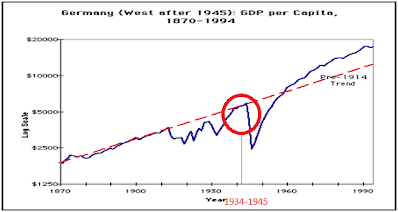
Ever since Germany’s ’economic miracle’ that followed World War II, there’s been a plethora of research and literature investigating the methods used to bring Germany out of their economic crisis. Generally, scholars often identify ordoliberalism as the economic policy utilized by the German government to overcome the economic

graph-ww2
Germany’s Economic Miracle in a graph

catastrophe. The framework of ordoliberalism was developed prior to World War II.  In the 1930s, a few professors from the University of Freiburg in Germany developed a robust and conducive economic/legal framework that could curtail monopolistic encroachments, respond to economic burdens, and maintain a certain degree of freedom for the populous. The professors often credited for the early development are the economist Walter Eucken and two legal scholars Franz Böhm and Hans Grossmann-Doerth. Over time ordoliberalism began to solidify and was identifiable by its distinct characteristics. But what exactly is ordoliberalism? Well,  like everything, it depends who you ask.


In general, ordoliberal principals can be summarized as a state centric approach that provides a viable economic framework which supports the state’s social and economic interests. In terms of monetary policy, stability is key for ordoliberalism. Fiscal stimulus measures should be avoided if they make the overall economy unstable. The direct inverse of French and U.S. fiscal policies which don’t want to necessarily intervene fiscally but if things are dire the state will apply fiscal stimuli to help the economy.

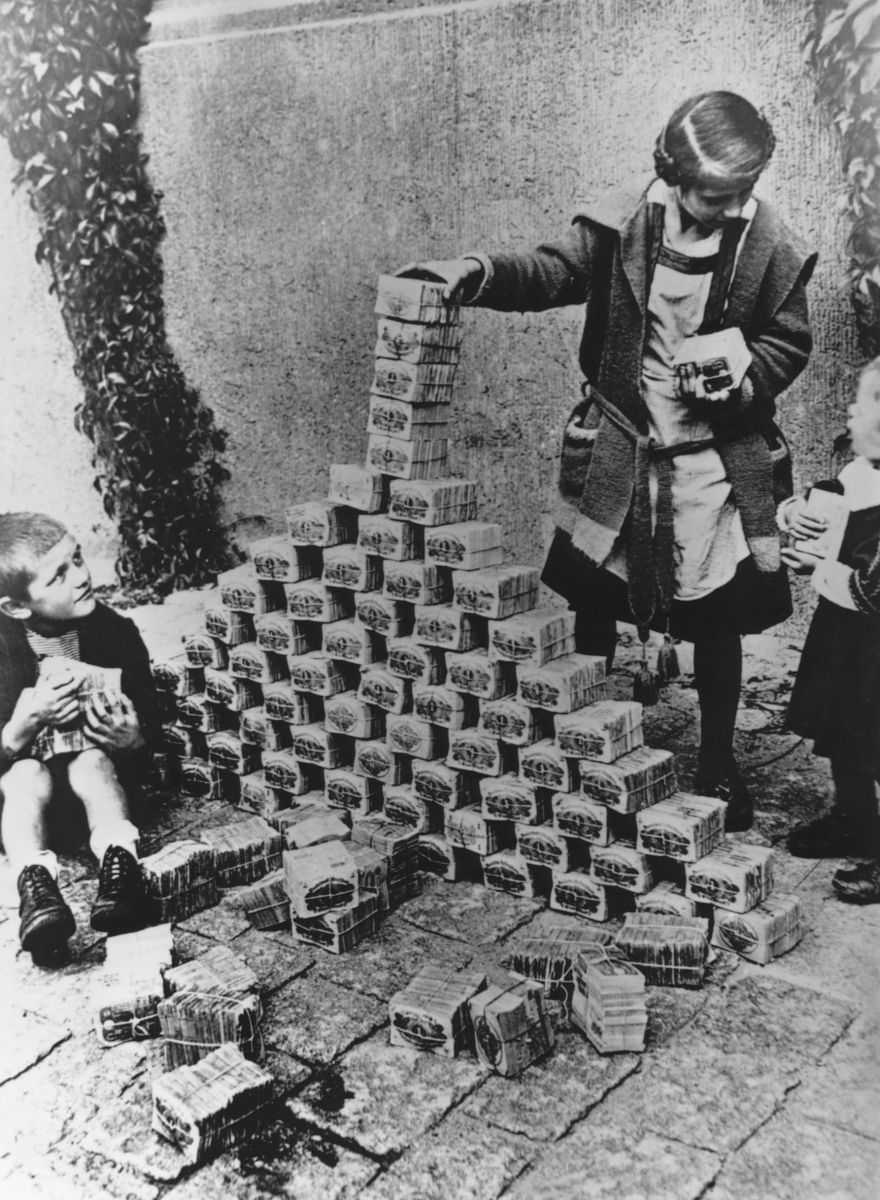
German Inflation
Hyperinflation rendered German currency so useless kids used it to have fun. 

Germany is opposed to such measures, mainly due to the hyperinflation experienced during the 1930’s. These measures had extreme effects on society and arguably contributed to the rise of the Nazi party. Ironically, the Nazi party recognized that hyperinflation may indeed lead to societal instability and began to develop the early foundations of ordoliberalism. The post Nazi German government also utilized and implemented ordoliberal policies after World War II. However, a lot of Germany’s development can be credited to generous aide offered by the USA, with little to no strings attached. Results came fast for the German economy. Between the 1950s-60 the German GDP rose roughly 8 percent every year. In comparison to other nations in the region, Germany’s growth was faster than any other nation within continental Europe. Germany’s rapid economic growth subsequently gave rise to higher living standards within that ten-year span. This initial exponential growth would set up a new powerhouse in Europe in terms of economics. And further, ordoliberalism was then acknowledged as a viable and legitimate economic alternative to the neoliberal economic framework touted by England and the US. Instead of increased debt, nations could monitor their spending and limit government fiscal intervention to achieve economic growth.


But recently ordoliberalism has come under scrutiny. This piece will attempt to answer whether German ordoliberal policies have hindered modern economic progress for the European Union. The world economy has radically transformed since the 20th century when Germany “manifested” its economic miracle via ordoliberalism. And the argument put forth will be that ordoliberal policy is slow in recognizing an economic crisis, impacting societies ability to respond in a rapid and prudent manner. Further, when an economic crisis is finally identified, the ordoliberal policies set forth are often counterproductive in terms of successfully overcoming the crisis. In contrast, a better approach would be one which attempts to address economic crisis within the context of the crisis itself. We will call that approach “economic pragmatism”.

First, we will commence by providing a bit of a literature review on the topics at hand. After the literature review section is finished we will go on to discuss the framework I’ll be relying on. Namely, the framework will be of a pragmatist nature in terms of economics. Then a case study on Germany’s response to the Eurozone crisis will be discussed. Analyzing the Greek economic crisis will enable us to analyze the implementation of ordoliberalism to a specific modern crisis. Thereafter, a comparison between other economic policies and ordoliberalism will give us insight on where ordoliberalism gets things wrong.

Ordoliberalism as economic/legal policy has its origins in Germany. Viktor Vanberg has highlighted the development of ordoliberal thought and how the ideology has been perverted from its intellectual origins. The founders of Ordoliberalism actually fully understood that the ideology wasn’t perfect, and Vanberg notes that the idea of the strong state has been grossly misinterpreted. The “strong state” phrase that comes out of ordoliberalism was originally understood as a state that is constrained by a political constitution which prevents government from becoming the target of a special interest. For example, no single interest, such as the oil industry, should have undue influence in government affairs. Nowadays the “strong state” notion is interpreted more simply. Now people understand that the strong state only creates the economic and legal dimensions of a certain nation and the state should not interfere the economy. But the nation is limited fiscally since it is not allowed to stimulate the economy “artificially” via stimulus provisions. Research conducted by Sebastian Dullien and Ulrike Guérot suggests that the ordoliberal ideology has become the de facto rule of European Union policy in terms political and economic measures. This means that ordoliberalism has become the dominant ideology in the European Union. Though there are critiques of the ideology within the EU, Dullien and Guérot note that ordoliberalism has become “mainstream” in the EU. So that means voices of critique are marginalized in the sphere of the European Union since leading government officials commonly refer to ordoliberal principals as the  “right” and only “true” ways to conduct economic policies . The de facto nature of ordoliberalism in the EU sphere can be connected to research done by Matthias Matthijs. He explains that Germany’s economic policies seem to adhere to an “ideas over interests” policy. Put simply Germany often undercuts economic stability and growth in favor of maintaining and adhering to the strict tenants of ordoliberalism. And quite often nations aren’t too keen to push back since the ideology is seen as the consensus and not only that but it is seen as the “absolute” economic truth. The domineering nature of ordoliberal thought in the EU allows readers to infer that perhaps Germany is more worried about reinforcing it’s ordoliberal rules instead of trying to ascertain the best measures to mitigate an economic crisis . That inference brings us to the theoretical framework of the paper, which will take an economic pragmatist approach to economic crises.

Pragmatism: A Better Approach?

The person often credited with innovating the pragmatic economic approach is Grzegorz Witold Kolodko. He laid out this framework in his book called Truth, Errors, and Lies: Politics and Economics in a Volatile World . The pragmatic approach will allow us to critique the current policies used by the EU. New economic pragmatism can be defined as an economic approach that attempts to solve economic crisis within the context of the crisis itself. It doesn’t rely on any specific ideology per se, but rather it attempts to compromise between economic policies at the national, international or regional economic levels. Though national, regional, and international entities may have agendas which are juxtaposed, there still exists a possibility for agreement. By mixing various elements of the juxtaposed economic policies a general consensus can be established. But what sets economic pragmatism apart is that it focuses to address three fundamental economic questions.

What’s the best route to economically sustainable growth?

What’s the best approach to insure social stability?

What’s the best approach in respects to the environmental sustainability?

Furthermore, it assumes that the recent trend of the globalized economy is irreversible and this factor must be taken into account when attempting to solve economic issues. Economic pragmatism neither endorses or disavows globalization, but quite simply globalization is categorized as a constant, a phenomena that must be accounted for when dealing with 21st century economic issues. This assumption doesn’t give way for extreme paradigm shifts. So, given that assumption, no overt disassembling of globalization will be considered within this piece. No matter how tempting revolution may be. In terms of analyzing Germany’s ordoliberal policies during the Eurozone Crisis, new pragmatic methods will be used to analyze Germany and Europe’s mistakes within the crisis. It will highlight some assumptions that were made during the crisis, and in turn discuss how and why they aren’t necessarily true via comparison to other crises. Since Germany largely relies on ordoliberalism to implement economic and political policies, the framework will display the folly of such measures. Quite simply there’s no single economic ideology that can be relied on to address any economic crisis. Strict adherents to ideological principals may in fact do more harm than good in terms of solving a crisis. But it’d be remiss to not acknowledge why such behavior exists. After all, if ordoliberalism has worked before , assuming it will work again isn’t illogical. Human’s in general are keen to use methods that they are familiar with, especially if they have worked before. But being an absolutist in terms of ideology when policies aren’t working is a cause for concern. It’s this lack of flexibility that can hamper economic development, sustainability, and innovation. The idea of inflexibility will be discussed further in the analysis of Germany’s Eurozone response. And it will be accompanied by a pragmatic study specific to the Greek crisis to describe some alternatives to the current approach taken by the Eurozone. Now that we have an understanding of economic pragmatism is coming to a close, lets shift out focus to Germany’s response to the Greek eurozone crisis.

Ordoliberalism In The Greek Economic Crisis

In order to offer a critique of Germany’s ordoliberal implementation in times of crises we must analyze the specific measures taken within a given economic crisis. The most comprehensive and recent information can be found when we investigate the German political order’s response to the Eurozone Crisis. When analyzing this response, we can find two key problem areas that have contributed to the economic downturn of certain nations, namely Greece. Firstly, German ordoliberal policy seems to vehemently deny the potential for an economic crisis, even though it’s apparent that an economic downturn will likely happen. And lastly, a strict adherence to policies that encourage austerity despite the fact that the reality of suggests that these measures are counter intuitive. These factors will be analyzed under the context of the Eurozone crisis of 2008. We will also see how these measures go against the plans of economic pragmatism which encourage economically sustainable growth, civic stability, and environmental sustainability.  Now let’s transition to how Germany’s ordoliberal hegemony was slow to act to the Greek crisis.

Delay

In light of the world financial crisis of 2008, governments were quick to act to curtail the damaging effects of the crisis. In terms of short-term responses, The Federal Reserve, Bank of England, and European Central Bank all introduced measures that increased liquidity. The Federal Reserve resorted to quantitative easing which allowed banks to purchase US government debt, essentially creating bailouts for entities that were “too big” to fail. But these measures didn’t necessarily help in the long term for the European Union. Specifically, certain nations were in desperate need of bailout assistance, but those demands were largely ignored.

By dismissing and denying claims of bailout assistance, Germany’s political guard was able to make sure it was in a position to elevate the effects of the Great Recession when it came to German economic interests. Helen Thompson notes that Angela Merkel a few years into the Great Recession remarked “I don’t believe that Greece has any acute financial needs from the European community and that’s what the Greek prime minister keeps telling me” . Despite Merkel’s beliefs and the rhetoric of the Greek Prime minister, data suggests Greece absolutely needed financial assistance. Prior to these remarks roughly 100,000 Greek companies went bankrupt, and unemployment was accelerating at a rapid rate  But due to Germany’s political and economic dominance in the Eurozone, Merkel’s sentiment meant that Greece’s crisis wouldn’t get any immediate active intervention to prevent a deeper crisis. Merkel’s regime continued to delay a Greek Bailout but eventual in May 2010 a bailout was absolutely necessary to avoid an economic catastrophe in the Eurozone. But aide would only be given if Greece accepted austerity measures. But such a delay hindered Greece’s potential for economic recovery, in an economic crisis time is literally money. Delaying a response to a crisis can be the difference from a comprehensive recovery and spiraling further into an economic disaster. Greece needed a quicker response. The response should have come much earlier, not ignored until the brink of a Eurozone disaster was evident. Research done by Christina D. Romer and David H. Romer has suggested that quick responses in the face of economic “shocks” are important. They write:

“In nearly every postwar recession, policymakers have been quick to discern the onset of recession and have responded to the downturn with rapid and significant reductions in nominal and real interest rates. Plausible estimates of the size and speed of the effects of these interest rate cuts suggest that they were crucial to the subsequent recoveries” 

In terms of economic pragmatism, identifying the issue early would be of outmost importance. That’s because the Romers’ research suggests that economic sustainability is directly impacted by the rapidity of the responsiveness. But Germany’s delay comes from an interest to uphold the tenants of ordoliberalism. Matthjs  suggests that the current German political order would much rather hold on to and uphold the dominance of their ordoliberal principals than actually attempt to solve the crisis explaining that:

“Since the German government of Christian Democrats and Free Market Liberals had quickly framed the crisis as a twin crisis of fiscal profligacy and lack of competitiveness in the southern periphery, fiscal policy would revert back to the original and rules-based consensus at Maastricht, but with substantially stronger guarantees of actual implementation of those rules” 

 Unfortunately, this trend of delay seems to be continuing into 2019. The German political order has refused to acknowledge the need for an economic stimulus in the face of slowing economy in 2019. Foreign demand for German exports has begun to shrink, bringing the country’s economy to a standstill. But yet the German government has done little to nothing to implement any measures that may countervail the economic contraction. Furthermore, in the midst of the Covid-19 pandemic ordoliberal nations, such as the Netherlands and Germany, have exhibited resentment for paying for southern Europes stimulus since it would be punishing the “savers”. Odd considering the dire circumstances. However, ECB president Christine Lagarde has emphasized the need for solidarity and fiscal stimuli to help mitigate the losses during the outbreak. This strict attachment to austerity may in fact be counter intuitive in terms of economic recovery and sustainability. The reasons why will be explained in the following section.

Austerity

As time has gone on it has become clear that ordoliberal measures imposed on Greece have done more harm than good for the Greek economy, people, and politics. Arguably, the specific measure that has done the most observable harm is the policy of austerity.  In basic terms, austerity refers to government policies that aim to reduce public sector debt and overall government spending. Though some reduction in government spending can offer marginal assistance; extreme cuts and repayment stipulations can be detrimental to an economy. This proposition has been evident throughout history. Ironically, Germany was one of the nations that was negatively affected by austerity measures. After World War I, the “victors” of the war imposed harsh repayment plans on the Germans. These measures were austere and subsequently lead to the Nazi’s coming into power. Furthermore, Joseph Stiglitz (a Nobel Prize wining economist) notes that the phenomena of austerity doesn’t necessarily result in economic recovery. He notes:

Austerity had failed repeatedly, from its early use under US President Herbert Hoover, which turned the stock-market crash into the Great Depression, to the IMF “programs” imposed on East Asia and Latin America in recent decades

Stiglitz goes on to describe how things haven’t really changed in terms of modern day austerity implementation. Greece is currently suffering, and not reaping much economic benefit. The data seems to correspond to Stiglitz’s inference. In Greece, unemployment fluctuates between 20-25%, and for young adults it’s at about 50%.  These figures have been detrimental to the Greek economy. Further, through 2009- 2019, the Greek GDP has fallen from roughly 90% to 60%, the consumption per capita has fallen from about 100% to 76 %, and all of these factors mean that the standard of living has fallen as well. This loss is largely attributable to the austerity measures the Greeks were coerced into by the EU.  In order to receive recovery aid, a considerable cut in government spending was necessary for the Greeks. A classic quid pro quo agreement. One of the specific austerity measures that was implemented was that Greece was required to restructure its pension system to aid in cutting government spending. Pension payments had absorbed 17.5 percent of GDP, higher than in any other EU country . Austerity measures required Greece to cut pensions drastically. Higher pension contribution by workers was another perquisite along with limited early retirement in order to keep pension repayment low. Limiting government spending is often a good idea for economies but only in the correct conditions.  The Greek economy wasn’t built for such a radical shift, pensions were a fundamental part of the overall Greek economy. Half of Greek households relied on pension income since one out of five Greeks were over 65 years old. We can assume that workers weren’t thrilled about paying higher contributions, and further a huge cut in retirement pensions must have aggravated retirees. Work was also drying up, so if no one was working that meant no one was contributing to pension funds. Greece was staring a looming economic depression in the face. Greek public moral took a deep dive.

Greeks Proets
Greeks Protest after austerity measures are passed.

People went to the streets to express their discontent. Civil disorder would become the norm in Greece.


Civil Unrest

Not only did the economy suffer from the ordoliberal austerity measures but civil society would be affected as well. From 2010 to 2012 a series of massive public anti-austerity movements began to demonstrate in towns across Greece. An article by Angelique Chrisafis , written in the midst of one of the Anti-Austerity demonstrations in 2011,  describes the situation as thus:

Doctors and nurses recently staged walkouts over hospital cuts. Taxi drivers have hobbled Greece with strikes in the past two weeks, protesting at government plans to open up the industry. Their tactics included blocking ports and opening the Acropolis ticket office to let tourists in free….Greece’s long-running “civil disobedience” movement, where ordinary citizens refuse to pay for anything from road tolls and bus tickets…has not fizzled out in the summer holidays. The “We Won’t Pay” offensive is championed as the purest form of “people’s power”

Chrisafis’s article articulates the social moral of the Greek people during these austerity measures. The people had lost hope in their government, and responded by not complying to societal norms. Some of the demonstrations were more violent in nature, and vandalism also occurred. When a society is actively participating in acts of civil disobedience which attempt to the undermine the political/economic order then there may be economic consequences that result. The explanation for that is that when people are protesting economic policies, refusing to pay for services, and not getting paid their wages that means that the economy isn’t running at maximum efficiency. Not only that but society itself isn’t functioning the way it normally does. But not only did the austerity measures have an effect on the economy and society but it also had repercussions to the biological environment.

                Environmental Consideration

The biological environment in Greece was also negatively affected by the economic crisis. Due to the aforementioned low wages caused by the crisis, Greeks were forced to look for cheap products in their daily life. Martha Nanou explains that this behavior had a negative effect on the environment. In her study focusing on the effects the financial crisis had on the overall air quality she explains:

“[I]ncreased heating fuel taxes that were used in order to support Greek economy, obliged people to find alternative, cheaper solutions that caused even more air pollution in large cities. More specifically, in Thessaloniki, the second largest city in Greece, the increased price of fuel oil led the citizens of the city to use the cheapest wood during winter. This increase of cheap wood products use for domestic heating, resulted in an increase of the levels of cesium (Cs) (Stoulos et al., 2014). For these reasons, Thessaloniki was characterized as one of the most air polluted cities within Europe during the past two years”

Changing to the wood alternatives may have had a negative effect on the air quality. But, if one takes a step back to analyze the situation, this also means that trees were being cut down at a much higher rate than before. Greek environmental authorities noted that illegal tree cutting had become the norm. And that the environmental ministry has issued over 3,000 lawsuits and seized over 13,000 tons of illegally chopped down trees.. This behavior outlines the underlying effects ordoliberal austerity measures can have on a nations that are not ready to cope.

  Different Models 

One of the way’s this situation could’ve been avoided is that the Greek crisis should have been addressed much sooner. But even if the crisis was caught a bit late, there could have been other measures that may have lessened the probability of a catastrophic economic crisis, societal upheaval, and environmental degradation. Namely measures which weren’t austere in nature.

Economic pragmatism would have attempted to look at a holistic solution instead of responding to the crisis via a specific economic theory. This approach would ensure that the economy wouldn’t suffer too much, society wouldn’t fall into years of civil unrest, and perhaps the environment wouldn’t be as negatively affected. Austerity wasn’t the only method available to handle the Greek Eurozone crisis. It was just the most convenient. Economic research suggests that debt restructuring doesn’t need to necessarily be strict in nature to overcome a sovereign debt crisis. Andreas Muller, Kjetil Storesletten, and Fabriziso Zillibotti are researchers who suggest austerity isn’t the only way. They provide an in depth analysis on debt restoration and reform relying on four “building blocks” , writing:

“[D]ynamic theory of sovereign debt that rests on four building blocks. The first is that sovereign debt is subject to limited enforcement, and that countries can renege on their obligations subject to real costs ….The second building block is that whenever creditors face a credible default threat, they can make a renegotiation offer to the indebted country. This approach conforms with the empirical observations that unordered defaults are rare events, and that there is great heterogeneity in the terms at which debt is renegotiated, as documented by Tomz and Wright (2007) and Sturzenegger and Zettelmeyer (2008). The third building block is the possibility for the government of the indebted country to make structural policy reforms that speed up recovery from an existing recession.1 The fourth building block is that reform effort is not contractible nor can markets commit to punish the past bad behavior of sovereign governments.”

They go on to argue that all of these measures would have an overall positive effect to a nation that’s in sovereign debt. Equilibrium isn’t achieved when austerity is implemented, but when nations are allowed to have more of a say in debt renegotiation and aren’t punished for the economic crisis then an economy can smoothly recover. This is important lesson for future economic crisis since strict adherence to economic theories may not enable a proper recovery for an economy.

Another alternative can be found by observing the US. The US avoids regional recessions by distributing risk across the states. Programs such as Social Security or unemployment insurance help support the poorer regions, and fundamentally make sure that pooer states don’t implode when they fall into recession. This idea has been propagated by several EU leaders, but due to the political clout of the Frugal Four their propositions fall through. For example, former Prime French Prime Minister Francois Hollande, has suggested that Europe move in this direction, with wealthier states funding a bigger European Investment Bank that can bankroll industrial projects in poorer countries.

Lastly, another model that can be emulated is the economic miracle which occurred in Singapore. A century ago, Singapore was an island with little to no economic clout. But after a series of pragmatic economic policies Singapore was transformed into a major manufacturing and financial center. They mixed low taxes, few capital restrictions and liberal immigration policies with policies that are often considered to be socialist such as heavy government spending on social services like housing, banking and health care. (Read more here)

In all we can see how German ordoliberlist policy may in fact make a crisis worse. However, understanding the gravity of the crisis early and responding in a manner which actively attempts to help can lessen the negative effects of a crisis. Some of those effects being economic, social, environmental. Strict adherence to austerity isn’t a necessary response to a crisis. The political dimension of this paper can be said to be of a pluralist nature. Pluralist because it doesn’t restrict itself to one economic theory but rather allows for a more flexible economic approach. But in terms of economics it takes a pragmatic approach since it attempts to take into consideration elements which attempt to solve an economic crisis by not being restricted in terms of ideology.


Sources: 

“Austerity – Overview, Examples of Austerity Policies, and Advantages.” Corporate Finance Institute, corporatefinanceinstitute.com/resources/knowledge/economics/austerity/.

Bernake, Ben s. “Financial Markets, the Economic Outlook, and Monetary Policy.” Board of Governors of the Federal Reserve System, http://www.federalreserve.gov/newsevents/speech/bernanke20080110a.htm.

Burgmann, Verity. “Conclusion.” Globalization and Labour in the Twenty-First Century, 2016, pp. 237–242., doi:10.4324/9781315624044-11.

Chrisafis, Angelique. “Greece Debt Crisis: The ‘We Won’t Pay’ Anti-Austerity Revolt.” The Guardian, Guardian News and Media, 31 July 2011, http://www.theguardian.com/world/2011/jul/31/greece-debt-crisis-anti-austerity.

Dullien, Sebastian, and Ulrike Guérot. “The Long Shadow of Ordoliberalism: Germany’s Approach to the Euro Crisis.” European Council of Foreign Affairs, 2012, doi:https://pdfs.semanticscholar.org/8da0/9ef76b1598eadd96966c9757054bfc3652f5.pdf2.

Eichengreen, Barry, and Albrecht Ritschl. “Understanding West German Economic Growth in the 1950s.” Cliometrica, vol. 3, no. 3, 2009, pp. 191–219., doi:10.1007/s11698-008-0035-7.

EUROSTAT. “First Estimates for 2018 – Wide Variation of Consumption per Capita across EU Member States – GDP per Capita Ranged from 50% to 254% of EU Average.” European Commission – PRESS RELEASES – Press Release – First Estimates for 2018 – Wide Variation of Consumption per Capita across EU Member States – GDP per Capita Ranged from 50% to 254% of EU Average, europa.eu/rapid/press-release_STAT-19-3245_en.htm.

Galofré-Vilà, Gregori, et al. “Austerity and the Rise of the Nazi Party.” 2017, doi:10.3386/w24106.

James, William. “Pragmatism: A New Name for Some Old Ways of Thinking.” 1996, doi:10.1037/10851-000.

Kolodko, Grzegorz. “The New Pragmatism, or Economics and Policy for the Future.” Acta Oeconomica, vol. 64, no. 2, 2014, pp. 139–160., doi:10.1556/aoecon.64.2014.2.1.

Kołodko, Grzegorz W. Truth, Errors, and Lies: Politics and Economics in a Volatile World. Columbia University Press, 2011.

Matthijs, Matthias. “Powerful Rules Governing the Euro: the Perverse Logic of German Ideas.” Journal of European Public Policy, vol. 23, no. 3, 2015, pp. 375–391., doi:10.1080/13501763.2015.1115535.

Muller, Andreas, et al. 11 Sept. 2016, http://www.brown.edu/academics/economics/sites/brown.edu.academics.economics/files/uploads/Fabrizio%20Zilibotti_Macro%20Seminar%20Paper_0.pdf.

Nanou, Martha. “Greek Financial Crisis and Environment. Can Crisis Be an Opportunity?” Http://Edepot.wur.nl/357781, May 2015.

Romer, Christina, and David Romer. “What Ends Recessions?” 1994, doi:10.3386/w4765.

Sindreu, Jon. “Don’t Expect a Meaningful Fiscal Push From Germany.” The Wall Street Journal, Dow Jones & Company, 20 Aug. 2019, http://www.wsj.com/articles/dont-expect-a-meaningful-fiscal-push-from-germany-11566306054.

Stiglitz, Joseph E. “A Greek Morality Tale: Why We Need a Global Debt Restructuring Framework.” The Guardian, Guardian News and Media, 4 Feb. 2015, http://www.theguardian.com/business/2015/feb/04/a-greek-morality-tale-global-debt-restructuring-framework.

Thompson, Helen. “Germany and the Euro-Zone Crisis: The European Reformation of the German Banking Crisis and the Future of the Euro.” New Political Economy, vol. 20, no. 6, 2015, pp. 851–870., doi:10.1080/13563467.2015.1041476.

Tilford, Simon. “Germany Is an Economic Masochist.” Foreign Policy, 21 Aug. 2019, foreignpolicy.com/2019/08/21/germany-is-an-economic-masochist-recession-merkel/.

Tinios, Platon. Konrad-Adenauer-Stiftung, vol. 04, 2016.

Vanberg, Viktor J. “The Freiburg School: Walter Eucken and Ordoliberalism.” Econstor, 11 Apr. 2004.


Robert Moses: The Unelected Master Planner

Robert Moses is a figure that’s relatively obscure to the general public. However his influence has had a lasting impact throughout the United States. He would be paramount in engineering how cities in the States were structured, effectively influencing how and where Americans would spend their money.

Who was Robert Moses? Well, to start, he was unelected public official who held about 12 positions in the Greater New York city area. His stints in public office span from 1924-66. The positions he held had tremendous influence over urban planning. Urban planners aren’t often thought of as being political behemoths but Robert Moses’s tenure in these positions forces us to reconsider the influence unelected politicians may have over society.

Mr. Moses was a relentless, effective, and a calculated worker. His ability to start and finish public projects is arguably unmatched within the scope of American history. Furthermore, his ability to manipulate power goes far beyond the scope of anything Machiavelli could have imagined within a democratic republic. Robert Moses wasn’t fully understood or recognized outside of New York until the publication of Rob Caro’s Pulitzer winning book The Power Broker. The book gives us a grandiose look into the Moses. Robert Caro spent years researching for his book which spans roughly 1,300 pages. His scholarship, alongside with years of historical developments since the initial publication, are what guide my analysis on Robert Moses. Through our investigation of Robert Moses we will come to understand how a lot of cities in the United States mirror each other in terms of structure and societal development. And, albeit indirectly, an analysis of Moses forces us to consider a few philosophical questions when it comes to ideal local governance in the United States. But before we attempt to get understand why these two inquires are relevant , we have to investigate the rise of Robert Moses.

 Robert Moses assent spanned various societal backgrounds. His tenure in public office spans three major historical events in the United States. Moses held positions during the economic boom of the 1920s, a crippling Depression in the 1930’s, World War II, and the subsequent post war economic boom.

The 1920’s: The Rise to Power

After finishing up his PhD at Columbia University, Moses decides to enter New York politics as a political idealist motivated to make change. A story familiar to many young professionals who aim to change the “old guard” within political systems. Moses had plenty of issues he wanted to grapple over. The society he was living in was corrupt, had little to no consumer protection, and certain industries were dominated by monopolies. He briefly worked for the Bureau of Municipal Research and with the U.S. Food Commission. But soon he realized that philosophical theories and logic, no matter how beneficial, wouldn’t take you far when it came to political advancement. His initial propositions were brushed under the rug by the seasoned veterans of government. Though his theoretical understanding of politics would come in handy from time to time, his practical education of political power would be where he was able to hone the craft of political power.

After a series of fortunate events  Moses found himself appointed as the chief of staff to a woman named Belle Moskowitz. She was the leader of a commission tasked with organizing New Yorks administrative structure. A responsibility which came with significant power. It’s worthy to note Belle Moskowitz wasn’t elected by anyone. Rather, Moskowitz was appointed by Alfred Smith the Governor of New York. Smith was of course elected. I include these details not to be redundantly informative but rather to highlight the opaque nature of local government when it comes to transparency. People who you may assume are in control are passing that responsibility to an “advisor”, meaning there are various puppeteers pulling the strings. Moses’s time with Moskowitz is where he would learn the “tricks of the trade” in terms local governance. After managing to impress Alfred Smith through the early 1920’s, Moses found himself appointed to his first positions of power. The appointments would lead him to a notorious political squabble with an eventual US president, Mr. Franklin Delano Roosevelt.

The Appointed One & The Fight with Roosevelt.

In 1924 Moses was appointed as the leader of both the Long Island State Park Commission and State Council of Parks. Moses actually drafted the legislation that created the power of these commission earlier in his career. Personally, when I read the names of these positions I didn’t immediately think POWER.  But let’s remember that Moses was calculated.  He strategically used the power that he did have to gain even more power. Being head of these political bodies allowed him unprecedented control over land-use and highway construction. Behind the scenes he usurped control over certain political entities from elected officials. Moses would lobby constituents, politicians, and special interest groups into allowing him to have independent control over land-use and highway development commissions. Overtime he began to resemble a mini dictator. However, his power wouldn’t go unchallenged.

LC645-600Border
Young Roosevelt.

Franklin Roosevelt, at the time leader of the Taconic State Parkway Commission, had a political spat with Moses. It all started when Roosevelt had a plan to build a parkway through a region of New York City called the Hudson Valley. Moses had different plans. He managed to funnel all the funds from Roosevelt’s project to his own project. Moses was able to keep the funding to Roosevelt’s project so low that it could barely even maintain operations. Roosevelt complained to the governor that Moses was “skinning” Smith’s administration alive. But nothing happened. Eventually, Roosevelt became governor and eventually his parkway project was completed. Roosevelt had another goal in mind, and that was to remove Moses from power. But the removal of Moses was almost impossible by the time Roosevelt became governor. Robert Moses had set up a powerful base of political independence by using legislation, public funding, the press, and young political reformers to support his positions. He would later spearhead a commission which aimed to consolidate 187 separate agencies into eighteen departments. In just 10 year’s Moses was able to absorb power from potential opponents and build a powerful network to get his projects done. But this was just the start there was much more to come from Robert Moses.

The Depression & Beyond

During the 1930’s the United States suffered an economic depression. During this economic catastrophe Robert Moses would blossom. Ironically, his former rival actually enabled this via New Deal legislation lead by President Roosevelt. Moses was granted even more executive and monetary incentive to solidify his power by the Federal Government. Roosevelt, not forgetting his political tenure in New York, attempted to get Moses ousted by making federal funds available only if Moses was removed from office. Moses wasn’t threatened. He told the press of Roosevelts demands. Subsequently, the Federal Government had to stop after increasing public pressure. But as World War II was being waged, Robert Moses’s influence on New York City began to take shape.  The Master Builder started to work on his vision. One unnamed federal official commented on Moses during this era saying:

“Because Robert Moses was so far ahead of anyone else in the country, he had greater influence on urban renewal in the United States – on how the program developed and on how it was received by the public – than any other single person.”

That quote gives us an insight on the magnitude of power Moses had. He was responsible for many projects ranging from the United Nations Headquarters, Shea Stadium, and the Pratt Institute. But he also led initiatives to spur more highway developments, suburban housing developments, strip malls, and other public amenities. Moses got even better at getting projects done. A common strategy involved starting projects knowing that financially they couldn’t be accomplished , but he would leverage political clout in order to manipulate political officials to complete his projects anyway. While in the depression his projects employed a largely jobless populous during the Great Depression. During this era, he held numerous public positions at the same time. None of the positions required him to be publicly elected.

WWII & The New America

The world dramatically changed after World War II. The United States emerged as an economic and political powerhouse within the International community.  Moses understood this and he wanted to further influence the new world around him. His goal for NYC was one that attempted to integrate an urban center to suburban areas which would all be interconnected via parkways. The bureaucrat’s vision would influence America for the years to come.

After World War II America’s social community began to change. Women entered the work force in droves, the nation was in better economic shape than a lot of nations in the world, and the ideal of “Americanness” began to solidify. What do I mean by Americanness? I mean white picket fences, increased home & automobile ownership, and the development of mass consumerism. After WWII plenty of soldiers came home to start anew. They were incentivized to start “nuclear” families, to buy homes, develop their market skills, and most importantly to spend money in order to expand the American economy. Robert Moses was fully aware of this societal shift. He saw the traditional layout of American cities as archaic and counter intuitive to the world’s economic demands. Small retail owners were dismissed in favor of shopping behemoths

download (1)
Robert Moses and NYC Mayor Jimmy Walker.

such as Macy’s, Sears, and the advent of the shopping mall. Local restaurants were forgotten as Dairy Queen and McDonalds slowly became staples in the American diet. Automobiles slowly eliminated the reliance on public transport, allowing people to buy suburban properties further away from NYC.  Moses preferred a sprawl model over concentrated urban communities. And he developed plenty of projects to incentivize the sprawl model. New Yorkers, such as Robert Caro, criticize Moses for destroying New York neighborhoods in favor of vast highways that connected the suburbs to the City. When developing these projects Moses displaced hundreds of thousands of people, destroyed economic centers, and arguably community identity. This led critics to surmise that Moses perhaps preferred automobiles and shopping centers over people. Furthermore, Moses played a part in depleting New York’s resources to develop his projects.  But despite that, the Moses model was in demand in post war America. Plenty of public officials from around the country demanded Robert Moses’s expertise in developing their city plans. This may explain why many American cities, especially in the Midwest, mirror each other in a plethora of ways.

In hindsight Moses’s city planning was a perfect model for a globalized economy. It was predictable; generally people would work a similar hourly schedule, consistently consume products from publicly traded corporations, and, by driving, consumers would

download
Robert Moses

support the gas, oil, and automobile industry. This model has its merits. It’s predicable, safe, and allows people to consume their preferred products. However, a community too reliant on the Moses model is more susceptible to global economic crises. This isn’t just a theoretical proposition, practical examples are evident when we look at Detroit and Las Vegas during the 2008 financial crisis. But it’d be remiss to not mention how many new and innovative developments Moses was responsible for. He was able to engineer and execute massive urban plans that did help a considerable amount of people. But at the expense of displacing many people out of their communities. But one of the most disturbing things about Robert Moses is his ability to become an immensely influential political figure without having to get elected into political office.

Moses’s story forces us to think about the type of local (& perhaps national) governments people would prefer. Do we prefer governments that can be taken over by “Mosesesque” figures in order to get long term, and perhaps beneficial, projects done? Or do we want a system that is a bit more decentralized which doesn’t allow any one sole “political will” to dominate? Whatever you prefer, each has its positive and negative implication.

Which begs a peripheral question: How much do YOU know about the unelected officials in your local government? A question to consider.

Sources:

Power Broker by Robert Caro

ROBERT MOSES AND THE RISE OF NEW YORK THE POWER BROKER IN PERSPECTIVE by KENNETH T. JACKSON

A Consumer’s Republic: The Politics of Mass Consumption in Postwar America by Lizabeth Cohen

https://www.pbs.org/wnet/need-to-know/environment/the-legacy-of-robert-moses/16018/

http://fordhampoliticalreview.org/the-legacy-of-robert-moses/

America’s Forgotten Civil War: Colorado’s Coalfield War

     The first article of the new five part Forgotten American History series! The Forgotten American History series aims to introduce readers to the less commonly known aspects of American history. The first edition takes us to Colorado! Hope you enjoy. 


Colorado’s Coalfield War is one of the most violent yet obscure events in American history. Which is a bit puzzling since The Coalfield War has all the allure of the quintessential American story. It has divisiveness, the quest for the American dream, violence, and an underdog. The Coalfield War took place after a rapid economic boom in the United States. The early 20th century saw the development of notable business magnates. Some you are most likely familiar with such as Andrew Carnegie, John D. Rockefeller, and Henry Ford. During their time they were commonly referred to as ‘industrialist”. That’s mainly due to the economic supremacy they had on industries such as fossil fuel, manufacturing, and transportation. The business strategies commonly used by these magnates were monopolistic. Common techniques used to monopolize included unilateral corporate acquisitions, price controls, and wage suppression. However, a new social development would attempt to countervail the monopolistic tendencies of these business tycoons.  The development being worker’s unions.

Laborers in the early 20th century worked in abhorrent conditions. An unnamed worker who grew up in one of Pennsylvania’s mining communities provides an account on what life was like for a miner:

Our daily life is not a pleasant one. When we put on our oil soaked suit in the morning we can’t guess all the dangers which threaten our lives. We walk sometimes miles to the place- to the man way or traveling way, or to the mouth of the shaft on top of the slope. Add then we enter the darkened chambers of the mines. On our right and on our left we see the logs that keep up the top and support the sides which may crush us into shapeless masses, as they have done to many of our comrades. We get old quickly. Powder, smoke, after-damp, bad air- all combine to bring furrows to our faces and asthma to our lungs.”

Wages were often not paid in US dollars. Rather, workers were paid with metallic strips which were redeemable in company stores. A stark contrast to how modern wage payment is facilitated. Furthermore, workers often lived at their work sites. Worker’s would often build their own dwellings which ranged from tents to shacks. This led to the development of work specific settlements.  In addition, workers often lacked representation in terms of corporate boardrooms. However, workers unions began to spring up providing an opportunity for representation. Exploited laborers could finally voice their frustration en masse.

Colorado’s Coalfield War gives us a perfect opportunity to examine the early relationship between industrialists and workers unions. The stereotypical relationship is often framed idealistically. The cliché often goes like this; workers are in discontent due to their impoverished work situation.  They then begin to band together and organize. Managers are often against organizing but after some convincing they slowly join the workers’ cause. And in one harmonious swoop the workers walk over to administrative offices and demand that the industrialist improve conditions. The industrialist, understanding the gravity of the situation, then succumbs to their demands. And after both parties reach an agreement. But realistically it was never that straightforward.  Colorado’s Coalfield War will give us a realistic glimpse of how a lot of early labor disputes panned out in the United States.

The story of Colorado’s Coalfield War begins in the coal mines of southern Colorado during the 1910’s. Colorado’s coal industry at the time was booming. So much so that roughly 10 percent of the state’s population was employed by the coal sector. At the time coal was highly profitable due to the demand of America’s expanding railroad system which needed coal to fuel their engines. One of the nation’s richest people were involved

Apr20family-298x300
One of Colorado’s mining families that was living in a tent community

in the coal industry. For example, John D. Rockefeller Jr (heir to John D. Rockefeller) recognized an opportunity to capitalize and acquired ownership of the Colorado Fuel and Iron company (CFI).

Coal mining for the CFI was physically arduous and hazardous work. CFI’s coal miners were under a considerable amount of fatal risk compared to other American coal miners. Statistically, miners in Colorado were twice as likely to die on the job compared to their peers in other states. That’s not to say that the other states were a pleasant place work. But Colorado’s coal mines were considerably risky. The fear of explosion, suffocation and collapsing mines was the reality for many coal miners . Ironically, Colorado had some of the best mining laws in the country. But Colorado’s mining laws were rarely enforced. The United States House Committee on Mines once declared:

Colorado has good mining laws and such that ought to afford protection to the miners as to safety in the mine if they were enforced, yet in this State the percentage of fatalities is larger than any other, showing there is undoubtedly something wrong in reference to the management of its coal mines

Furthermore, mining labor in Colorado was egregiously exploited. Worker’s were paid for the tonnage of coal produced. However, their “dead work” (maintenance, supply runs, and infrastructure repairs) were unpaid.

By 1913, 10,000 of Colorado’s miners had enough with their work environment and decided to strike. The strikers attempted to unionize via the United Mine Workers of America. They demanded improved work conditions, better wages, strict enforcement of Colorado’s mining laws, and union recognition. The CFI responded by rejecting all of the union’s demands.


Ludlow_Death_Car
Baldwin- Felts employees with an armored car.

There were considerable measures taken to countervail unionization. The CFI employed strikebreakers to keep the company running. The company evicted strikers from their company homes forcing the striker to build tents for their families nearby. Under Rockefellers orders, the CFI hired Baldwin- Felts Detective Agency (a private detective agency) to harass the strikers.  The agency would shine spotlight on tents, fire live ammunition at strikers’ tents, and patrolled the tent communities with an armored vehicle that had a machine gun mounted unto it. Clearly these were terror tactics. The strikers were unphased. Strikers responded to the terror tactics by taking up arms and defending their tents. Eventually, the skirmishes were acknowledged by the governor of Colorado and he responded by sending the National Guard to the tent community in Ludlow. The strikers were under the impression that the National Guard was there to protect them. But several hundred strikers were arrested by them and often beat the strikers. The National Guard would add more fuel to the fire when they discovered that a strikebreaker had been murdered. The National Guard had been financed by the CFI to cover the expenses of deployment, so they had an implicit obligation to make sure the CFI’s interests were met. One day while the tent dwellers were at funerals commemorating two infants, the National Guard began to dismantle the tent community. However, the community members rebuilt the tents and they continued the strike, persevering through the winter. However, things would come to a boiling point on April of 1914.

The Ludlow Massacre

On April 20th 1914, two national guard posts were deployed on top of a hill, encircling the Ludlow tent community. They deployed an armed post with a machine gun overlooking the strikers. No one is exactly sure what instigated the violence. Some historical records suggest that the National Guard was demanding the release of a

Masses_1914_John_Sloan
The Masses cover art depicting the Ludlow Massacre

hostage, but the strikers refused to give the hostage up. One of the sides then opened fire (it’s unclear who fired the first shot). Nevertheless, a battle would ensue which lasted the whole day. The casualties included high ranking union members such as Louis Tikas. Innocent bystanders (mainly women and children) hid in their tents to avoid the gunfire. The strikers retreated. The National guard then went to the tents, doused them with kerosene, and set them on fire. One of the tents that were set on fire housed 11 children and 2 women. The women and children all died, they were either burned or suffocated to death. These casualties were deemed a massacre by several periodicals in Colorado. The news of the National Guard’s atrocities would then spread across the nation like wild fire.

   Height of The Coalfield War

In Denver, the United Mine Workers declared “A Call to Arms”. They suggested that all union members should gather all “arms and ammunition legally available.” . Subsequently an insurgency would take place in Colorado. Three hundred armed strikers marched from all over Colorado to the Ludlow area. When they made it, the insurgents cut telephone and telegraph wires. And they prepared for battle. The New York Times described the event as such:

“With the deadliest weapons of civilization in the hands of savage-mined men, there can be no telling to what lengths the war in Colorado will go unless it is quelled by force … The President should turn his attention from Mexico long enough to take stern measures in Colorado

Furthermore, in an act of solidarity railroad workers refused to transport National Guard soldiers from Trinidad to Ludlow via railway. Up north in Colorado Springs, union

CC-X-60543
Colorado National Guardsman at an Outpost in Southern Colorado.

miners walked off their jobs and set off to Trinidad. They carried revolvers, rifles, and shotguns. Support was even shown on the East Coast. In New York City, picketers marched in front of the Rockefeller office located on 26 Broadway, New York City. However, these demonstrations were quickly quashed by local law enforcement.

When all the miners met in southern Colorado violence naturally ensued. They attacked antiunion town officials, supervisors/guards, and strikebreakers. Sporadic violence was rampant in southern Colorado as the miners carried out targeted killings, the statistical figures on fatalities vary considerably. So, a precise number can’t be drawn on how many people died. The insurgents also damaged a considerable amount of mining infrastructure.  The Associated Press estimated the financial losses at $18 million (which is about $450,239,203 in 2019).  The CFI alone lost $1.6 million. They were also able to strategically take control of an area that was roughly 50 miles long and 5 miles wide. However, this control didn’t last long. President Woodrow Wilson dispatched federal troops to Colorado, and the miners subsequently surrendered.

         Aftermath

After the Coalfield Wars, Congress held hearings with John D. Rockefeller Jr, union leaders, and several high-ranking members of the National Guard. Though atrocities were recognized by both sides during the hearing, no one was ever formally indicted for their crimes. Unfortunately, a lot of the tangible benefits the strikers were fighting didn’t materialize.  But all wasn’t lost. Rockefeller, feeling political pressure, lead an initiative so workers could have internal representation in the CFI. A measure akin to modern internal corporate arbitration. He also created an internal company union. And encouraged internal social services such as creating a YMCA for the Mining department. During this era, the YMCA played a substantial role in influencing morality and promoting athletic activity within American communities. But it’s important to remember these measures are a far cry from what the original demands the UMWA fought for. It can be argued that these measures were a bit of strategic marketing from Rockefeller. Think about internal company unions will always have corporate interest in mind. So full workers representation isn’t fulfilled. But there is a silver lining, the UMWA gained 4,000 new  members.

In all the Coalfield War gives us an interesting look into the dynamic relationship between industrialists, the government, and workers. Namely, that when disenfranchised workers sought better work conditions that undermined corporate interests, considerable measures were taken to curtail workers goals. Measures which would disgusts modern American sentiments.  Hiring private companies to terrorize workers, bringing in government officials to suppress workers, and massacring innocent bystanders would likely surprise many American households in the 21st century. We also get a key insight on what happens when “the people” get pushed too far in terms of getting their grievances acknowledged. Violent civil disobedience.


I’ll leave readers with song lyrics about the Ludlow massacre by Woody Guthrie:

It was early springtime when the strike was on,

800px-Ludlow_Monument_Cropped
Ludlow Memorial

They drove us miners out of doors,

Out from the houses that the Company owned,

We moved into tents up at old Ludlow.


I was worried bad about my children,

Soldiers guarding the railroad bridge,

Every once in a while a bullet would fly,

Kick up gravel under my feet.


We were so afraid you would kill our children,

We dug us a cave that was seven foot deep,

Carried our young ones and pregnant women

Down inside the cave to sleep.


That very night your soldiers waited,

Until all us miners were asleep,

You snuck around our little tent town,

Soaked our tents with your kerosene


Works Cited:

https://coloradoencyclopedia.org/article/ludlow-massacre

https://www.zinnedproject.org/news/tdih/ludlow-massacre/

https://www.pbs.org/wgbh/americanexperience/features/rockefellers-ludlow/

https://upcolorado.com/university-press-of-colorado/item/download/301_0c3ef02f967b1fa4d978737d608bc159

The Ludlow Massacre: Class, Warfare, and Historical Memory in Southern Colorado by Mark Walker (Historical Archaeology Vol. 37, No. 3, Remembering Landscapes of Conflict (2003), pp. 66-80)

A Miner’s Story The Independent, LIV (June 12, 1902), 1407-10. (http://www.digitalhistory.uh.edu/voices/social_history/14miner.cfm)

Thales & Heraclitus: What Russell Got Wrong.

Bertrand Russell Chiefing A Pipe.

    Often Bertrand Russell is revered in the mainstream philosophical community. And rightly so, the work he’s done in the fields of logic, linguistics, and mathematics have had a profound impact on the world. His influence has led him to be credited as the founder of analytic philosophy. But people often forget that Russell was also interested in history, so much so that he penned a lengthy history of Western Philosophy, which he called A History of Western Philosophy. This article will discuss Bertrand Russell’s account of Heraclitus and Thales. Two philosophers who came before Plato and Aristotle. The reason such a discussion is necessary is due to the fact that Russell may not be giving an accurate portrayal of either philosopher in his book. The reason being is that Russel relies on problematic sources to back his claims. This piece will attempt to outline the thoughts Russell had on these thinkers, and then we will criticize certain elements of his arguments. But in order to conduct a proper analysis we must understand the overal goal of Russel book.

    In the History of Western Philosophy  Bertrand Russell attempts to provide a coherent timeline for western philosophical thought. He claims that in order to successfully attempt such a project a specific method of analysis must be used. A method which is “philosophical”. By “philosophical” Russell means that he’ll attempt to synthesize the historical development of two different styles of inquiry, those being scientific and theological traditions (Russell Xiii). Both have different functions, but yet throughout history they’ve reinforced one another in various ways. For Russel, theology is useful because it allows us to make “speculation on matters as to which definite knowledge has, so far, been unascertainable.”(Russell Xiii). In other words, theology allows human reason to explore the unknowable. Now on the other hand, science allows human reason to explore the knowable (Russell Xiv). According to Russell, both have limitations; theology induces dogmatic belief (which he disapproves of), while science tells us what we can in fact know but “what we can know is little” (Russell xiv). Having acknowledged their flaws, Russell proceeds to argue that the development of human intellectual history has been shaped by those two methods of inquiry interacting with one another over time. Theology picks up the methodological flaw inherent in science, and vice versa. It’s this symmetric relationship which allows Russell to put various thinkers in dialogue with one another. Giving readers a coherent narrative to follow in terms of the development of western philosophical thought. But Russell’s methods have drawn scrutiny amongst critics. Frederick Copleston, a contemporary of Russel, acknowledged that “[Russell] treatment of a number of important philosophers is both inadequate and misleading.”. The inadequacy and misleading nature of Russell’s work is evident in his description of two philosophers who came before Socrates, Thales and Heraclitus.  


Bertrand’s Thales

Image result for thales
Thales the “scientist”

    In order to understand and identify the “inadequate and misleading” elements of Russel’s work we must analyze his descriptions of certain philosophers. Some of the problematic elements of his descriptions can be found when he describes Thales, a thinker who was active in the 6th century BCE. To be frank, little is known about Thales specific work, as none of his writing survived. But despite that fact, society can get a general idea about Thales by reading some second hand accounts about his teachings.  Russell provides an introduction to Thales, writing: 

“There is…ample reason to feel respect for Thales, though perhaps rather as a man of science than as a philosopher in the modern sense of the word.” (Russell 24)

This sentence should warrant our attention because we can analyze and infer a few things from Russell’s statement. One, that Bertrand holds Thales in high regard compared to the other philosopher of that particular era. And secondly, we should hold a favorable opinion on him because compared to these philosophers Thales is a “man of science”. Why does Russell feel this way? Well, it all stems from a theory attributed to Thales which professes that everything is made of water. A problematic theory to credit onto Thales in the first place, but the reason for that will be addressed in a different section in this paper. Russell explains that Thales’s theory of water shouldn’t be taken as some “foolish” hypothesis but rather as a scientific hypothesis (Russell 26). 

Now the reason he feels like Thales warrants such high praise is due to some scientific discoveries made while he wrote his book. While Russell was writing his book in the 20th century, the scientific consensus seemed to match well with Thales water theory. The consensus was largely contingent on the fact that the theoretical work done by the scientist Willaim Prout on atoms was true. Prout hypothesized that the hydrogen atom was the only fundamental element of the universe. Furthermore, he said that the atoms of other elements were actually just collection of different hydrogen atoms (Rosenfeld). This is similar to Thales’s theory since hydrogen is a pretty important component when it comes to water, but is different since Prout specifies the element hydrogen.  So this background information helps explain why Russell felt so confident in Thales. And explains assertions such as this: 

The statement that everything is made of water is to be regarded as a scientific hypothesis… Twenty years ago, the received view was that everything is made of hydrogen, which is two thirds water…. His [Thales] science and his philosophy were both crude, but they were such as to stimulate both thought and observation.” (Russell 26)

Now the last part of that sentence describes how his science and philosophy were “crude” but are acceptable since they aimed to stimulate both thought and observation. So, one can infer that theoretical frameworks which stimulate thought and observation, are ones which Russell approves of. But Russell also lets readers know what kind of frameworks he doesn’t appreciate. That leads us to Russell’s description of Heraclitus. 

Bertrand’s Heraclitus

Related image
Heraclitus the “mystic”

    The way Heraclitus is portrayed in Russell’s book plays on the theme of science and theology interacting with each other overtime. Russell generally views Heraclitus in a negative light, but acknowledges the difficulty science has had in refuting Heraclitus’s theory of perpetual flux. Additionally, Heraclitus is strangely categorized as “mystical” rather than “scientific”. Russell describes the nature of Heraclitus thought as such: 

Heraclitus, though an Ionian, was not in the scientific tradition of the Milesians. He was a mystic, but of a peculiar kind. He regarded fire as the fundamental substance, everything… is born by the death of something else “ (Russell 41)

Russell doesn’t give us a clear reason why Heraclitus shouldn’t be considered scientific, but we can imply that it’s due to his heavy reliance on intuition and speculation. Heraclitus brand of mysticism is categorized as reforming the religion of his day (Russell 42). Additionally, elements of Heraclitus doctrine are criticized by Russell. Specifically he attacks Heraclitus views on war, contempt for mankind, and his disapproval of democracy. 

Now having outlined what Russell says about these thinkers. It’s time to shift focus on what Russell may have gotten wrong when discussing these philosophers.  For instance we can use the reasoning Bertrand used to praise Thales to talk about Heraclitus as a “scientific thinker”. Additionally, we can also conceive as Thales as a “mystic”. Furthermore, we can learn to understand how Russell came to these conceptions when investigating the sources he decided to use. 


Analysis of Russell’s claims 

  Our criticism of Russell should begin with looking at what kind of information Russell based his critiques on. He’s pretty transparent in letting the readers know where he got his information from, writing: 

“According to Aristotle, he thought that water is the original substance out of which all others are formed; and he maintained that the earth rests on water”(Russell 26)

But there’s an issue with Russell’s apparent transparency. In the next paragraph he goes on to take Aristotle’s account as pure fact, and basis his entire scientific description of Thales on it. Never once does the problematic nature of Aristotle’s account of Thales get mentioned. But thankfully, recent scholarship done by Frede tells us why Aristotle’s writings on Thales aren’t to be taken as absolute fact. Frede explains that:

it is not Aristotle’s aim to provide an account of his origin of philosophy and its evolution for its own sake, to satisfy his and his readers own historical interests “(Frede 503)

Basically, Frede notes that Aristotle wasn’t entirely fair when it came down to providing accurate descriptions of certain thinkers, but rather was using their doctrines to validate his work (Frede). Now having considered that fact Thales can be seen as a mystic because not a lot of his doctrine was written down, and getting an accurate description of his work is difficult. But the school of thought he was a part of (the Milesian school) had mystical tendencies that Bertrand speaks of.  Additionally, Aryeh Finkelberg notes that: 

“Heraclitus, and other early Greek thinkers, did not set out to found philosophy and science, or pave the way for Aristotle—who has long been criticized “for reading his philosophical concerns into the early thinkers (Finkelberg, Heraclitus and Thales’ Conceptual Scheme). “So the method Bertrand uses to put them in dialogue together is problematic since none of these thinkers thought of themselves as either scientists, philosophers or mystics.

    Now having mentioned the problematic nature of the sources, I will provide  sources which allow us to think of Thales as a “mystic” and Heraclitus as a “scientist”. To begin I will refer to a source used by Russell himself- Aristotle. As noted previously Russell relies on Aristotle’s account of Thales to prove that the thinker was indeed scientific. But he conveniently leaves out an account that could hint at him being less “scientific”. In Aristotle’s work On the Soul  Thales is framed as a thinker who’s influenced by “mysticism” and attempts to explain the world via religious terms.  The account goes as such: 

“Thales too (as far as we can judge from people’s memoirs) apparently took the soul to be a principle of movement…Some say that the universe is shot through with soul, which is perhaps why Thales too though that all things were full of Gods”( Aristotle, On the Soul 405a)

There’s a lot to unpack from this phrase. Firstly, Aristotle is relying on testimonials from various people to get Thales’s account on souls. So we can infer that Thales Soul/Movement Theory was one that was known and discussed among contemporaries that were familiar with Thales. Secondly, we can see that Thales theory is based on metaphysical concepts (soul), and that these concepts have at least some effect on our material world (movement). And lastly, we can surmise that Thales’s world view largely consists of things having Gods within them. Arguably, this is a pretty “mystical” way to perceive reality. But from this phrase it’s unclear if Gods and Soul are in the same realm in terms of metaphysics. From the quote, soul is something metaphysical since it’s “principal of movement” and not movement itself. But Gods can be seen as both physical and metaphysical, since the universe being “shot with Soul” would have impact if whether things were filled with Gods or not. But it’s unclear from this reading if Gods are physical, metaphysical, or both. What we can clearly analyze is that Thales does have some mystical element in his analysis. Rendering Russell’s description as inadequate and a bit misleading. 

    Furthermore, Thales theory of water as the fundamental source of everything isn’t necessarily true. He may have never postulated that. Aristotle explains that he did indeed say that water is the fundamental source, but he also claims that he may not have seen it that way after all. Explaining that the earth and water could be reinforcing each other as elements ( Aristotle,On the Heavens, 292-294b). Thales could’ve easily believed that there didn’t need to be one principal element that’s responsible for everything. For all we know Thales could’ve theorized that several elements contributed to the forces of the world. But because Aristotle is using Thales to justify his own theories, conceptualizing him as a philosopher who believes that one fundamental source is responsible for everything is necessary in order to legitimize Aristotle’s views . 

    Let’s transition over to Heraclitus, aka the “mystical” thinker. Firstly, I’d like to mention that Russell dismissal of the claim that “everything is fire” and approval of “everything is water” is absurd. The way he justifies his reasoning, though understandable, is equally as silly. He uses Prout’s work on atoms to back up that claim but you could do the same for Heraclitus. After all everything in the universe emits heat, and if we understand fire to mean “element that emits heat”, then (considering 21st century physics) Heraclitus theory shouldn’t be taken as foolish either. Further, he can been seen as scientific due to observations such as these: 

Sea: water most pure and most tainted, drinkable and wholesome for fish, but undrinkable and poisonous for people”( Hippolytus, Refutation of All Heresies,)

&

Corpses should be disposed of more readily than dung” (Strabo, Geography).

The first quote is an empirical observation on how one element can nourish one animal but yet be dangerous to another. While the second can be interpreted as a public service announcement that corpses are as unsanitary as dung. Though not completely “scientific” in our modern use of the term, these statements are observations on the general nature of the world, and are valid. Thales allegedly made similar observations but Russell holds him in higher esteem compared to Heraclitus. 

    In all we can see that Bertrand Russell’s claims in the  History of Western Philosophy are problematic. Mainly because the notion that these thinkers were either scientific or mystical are inaccurate conceptions in the first place,since the thinkers didn’t even see themselves as such. And since we can conceptualize each thinker as both a “mystic” and “scientist” Russel’s analysis is misleading. Furthermore, the evidence used by Russell isn’t the best since the source itself, Aristotle, is biased.


Source(s):

Frede, Michael. “Aristotle’s Account of the Origins of Philosophy – Oxford Handbooks.” Oxford Handbooks – Scholarly Research Reviews, 27 Apr. 2018, http://www.oxfordhandbooks.com/view/10.1093/oxfordhb/9780195146875.001.0001/oxfordhb-9780195146875-e-20.

“Heraclitus and Thales’ Conceptual Scheme.” Heraclitus and Thales’ Conceptual Scheme | Reading Religion, 31 May 2017, readingreligion.org/books/heraclitus-and-thales-conceptual-scheme.

Rosenfeld, Louis. “William Prout: Early 19th Century Physician-Chemist.” Clinical Chemistry, Clinical Chemistry, 1 Apr. 2003, clinchem.aaccjnls.org/content/49/4/699.

Russell, Bertrand. History of Western Philosophy. Routledge, 2015.


Aristotle: On the Soul and On the Heavens


Hippolytus: Refutation of All Heresies,


Strabo: Geography


Frege’s Challenging Questions

  1. Gottlob Frege was a German logician, mathematician, and philosopher who played a crucial role in the emergence of modern logic and analytic philosophy. His work has influenced computer programming and mathematical set theory. He had some interesting things to say about language, and noticed some inconsistencies in way people thought about language and logic.

In Ueber Sinn Und Bedeututng Frege makes this assertion:

  “Equality gives rise to challenging questions which are not altogether easy to answer.”

In order to understand what he means by this phrase we must flesh out two things. Firstly, we must understand what he means by “equality”, and secondly investigate the kinds of challenging questions which are not easy to answer.

When Frege uses the term “equality” the reader must understand that he is referring to certain ways people use language. Specifically, “equality” refers to the relationship that different words have in reference to the same object. For example, Frege brings up two different phrases which refer to the same object. He points out that the phrases “morning star” and “evening star” are two separate phrases that refer to the same object in the sky commonly called Venus. And in terms of equality they share a relationship since “morning star and “evening star” both equal the object Venus. It’s understandable how one can infer that “morning star and “evening star” share a relationship of equality since they both point to the same object. After all since they point to the same object, logically one would think that the phrases are identical (or to use Frege’s term equal). But Frege notices a complication in this reasoning.

Frege makes a keen observation in terms of people equating two separate phrases to one another. They aren’t necessarily saying that these phrases are actually the same. To use Frege’s Venus example, “the morning star” and “the evening star” do refer to the same object. But the phrases themselves are different when considering humanities relationship to the object and other contextual factors. In order to flesh this idea out further I will use an example of my own to convey the complication Frege is addressing.

Let’s say two people are looking at a person with a hat. One person is to the left and another person is on the right of the hat wearer. Now let’s say that this hat has two colors on it (red and blue ). The person on the left can only see the blue and the person on the right only sees the red.  When these two people attempt to refer to the hat they could say something to the effect of  “look at the “red” or “blue” hat”. If they were to go back to people who’d never seen the hat they’d use the colors they saw as ways to refer to the hat. So if one was given the description “blue” and they saw the red side of the hat they wouldn’t realize that the hat was the object being referred to. The only way the person would realize that is if they knew that the hat was BOTH red and blue. But the person is given a particular phrase to describe the object so we can’t fault them for not realizing that “blue hat” and “red hat” are equal in terms of referring to the hat. After all “blue hat” and “red hat” without the context of the duality of the hat wearer are to be understood differently. Complications like this are what Frege intends to point out.

Now the aforementioned example may seem highly unlikely. But you’d be surprised in the ways this complication pops up in the real world. Let’s take a case from the 21st century. On February 26th 2015 a picture began to circulate on the internet creating quite a stir on social media. The photo in question is known commonly as “the dress”, and it drew strong reactions. The reason being is that the object in question (the dress) appeared to convey two separate colors to observers. One set of individuals claimed it was “yellow” and another set said it was “blue”. But how could this be? To be

“The Dress”

frank, there is no large consensus in terms of an explanation. But logically the object in question possess 2 color impressions at the same time. That would mean you could see both the blue and the yellow, but human cognition only allows for one. So logically it’s either yellow,  blue, or neither. But despite the logical inconsistency people could talk and point to the dress while at the same time holding their own interpretation of “the dress”. So in this weird case “yellow dress” and “blue dress” mean the same thing when referring to “the dress”. But when they are alone and not referring to anything they absolutely can’t mean the same thing.  Frege recognized this phenomena over a hundred years ago, and perhaps forces us to investigate human cognition itself when it comes to conundrums such as this.

A Brief Critique of Locke: Deconstruction and Reconstruction

words in their primary or immediate signification stand for nothing but the ideas in the mind of him that uses them (p. 146).”

The quote above is taken out of the work called An Essay Concerning Human Understanding by John Locke. Specifically, the quote is from Book III which talks about how humans come to understand words and communicate ideas to one another. From the quote above the reader can get a general idea of John Locke’s theory on words. We can reason that Locke thinks words are equal to ideas when he says “Words in the their primary…. signification stand for nothing BUT ideas in the mind…”. Additionally, he goes on to explain that humans are endowed with various thoughts that are supposed to benefit other people. But there’s a catch, these thoughts are all locked up within the individual. Despite this dilemma, words allow these ideas to become unlocked from the individual. According to Locke the unlocking process is what allows society to flourish (Chapter ii sec1. Pg 146 Locke). From that readers are compelled to conceptualize language as a phenomenon which instructs and provides knowledge in order for society to flourish. Furthermore, sharing ideas would be living in accordance with human nature, since he also believes that humans are inherently designed to be sociable (Chap I sec 1 pg 145). Since for Locke ideas are used to be sociable, that means words have utility as well. He argues there are two use values when it comes to recording words: 1. it aids memory 2. It brings ideas out in the open where others can see them (Chapter ii sec 2 pg 146). But words would become too idiosyncratic if people conceived of their own “markings” to translate their ideas. So words that flourish are a “mark” which are universally recognized. Locke explains this notion by saying:

nobody can apply a word, as a mark, immediately to anything else. For that would involve making the word be a sign of his own conceptions, …applying the word as a mark of a thing involves applying it intending it to stand for that thing, which means applying it with an accompanying thought about the word’s significance.”

So if you want an idea to universally stand for a certain mark that means one must find a mark within the world which can generally signify the idea you are trying to convey. This process is what facilitates proper communication with others. So, for example,  if “x” signified the idea “car” in a certain society, then another mark such as “y” (y= not car) would be inappropriate to use for car since “y” isn’t generally understood to mean car. Though Locke has interesting reasons to justify his views on words and ideas, that doesn’t exempt his arguments from criticism.

One objection to Locke’s reasoning would be one that challenges the claim that recording words aid personal memory. While yes, generally this may seem true, readers should analyze the full extent of this claim. Let’s consider a brief example. Imagine an individual who has trouble with long term memory but is proficient at remembering locations. Now let’s say this person is attending a speech and wants to remember the way the orator was talking, and so writes down “Remember the address”. Later on in the week the person finds the paper and reads what he had written. According to Locke the words written down on the paper should aid our forgetful person in remembering the infliction of the orator. But problems arise considering the fact the person is proficient at remembering locations. So he reads it and thinks “Right, it was 5th street”. On the surface this seems like it aided his memory but his initial intention was to remember the infliction of the orators voice, and not the location. After all the person is already good at remembering locations and didn’t necessarily need the words to remind him where the speech was. This could be mitigated by recording his voice (since address (location) and address (speech style) can have different pronunciations). But this would be problematic if the person voice recorded words like “councilor/counselor” or “bank”. Because these words sound the same, the forgetful individual might still find trouble in remembering what they meant.

Another detail we must pay attention to in Locke’s reasoning is the concept that when we write symbols to denote ideas we are doing this to share ideas with others. This once again is generally true. And we get a qualifier on why sometimes it may not be true, since popular symbols must be used to signify ideas (“x”= car example above). So Locke successfully explains why sometimes people don’t understand words that explain ideas. The symbols are too idiosyncratic. But he fails to go deeper on what makes these symbols generally understood in the first place. It’s not as if when human’s with linguistic capacity look at objects they immediately have word impressions of that object. Quite plainly, when you look at a dog in the real world, the brains initial impression doesn’t initially stimulate the cognitive impression of “dog!”. And if you were to pan over to a chair your brain doesn’t exclaim “chair!”. It just understands these objects as such. The word and the object here don’t seem to be directly linked to one another in terms of recognizing objects in our consciousness. But nonetheless these names exist and we have formulated them, so in that sense Locke is correct in saying words are ideas. But it’s wrong to say the inverse, that ideas are words. Mainly because objects in themselves don’t contain the property “word”. But rather, this cognitive property assignment comes from humans. He acknowledges the arbitrary nature of word denotation but still believes that the impressions of objects warrant an automatic denotation. But this isn’t an accurate conceptions of human cognitive thinking. We don’t get impressions from objects in the world and immediately think “this object is that”, rather the brain seems to conduct a process of pattern recognition. The brain’s process seems to fall under reasoning like this “this object is this object, which generally falls under this set of symbols/sound in the world”. This distinction, though small, opens up the scope of Locke’s inquiry into the human mind. Here, we can begin to understand the creatures we are. We aren’t creatures who cognitively just process objects and translate them to ideas, but rather we do that and then inquire about its relationship in the world. This process happens quickly, and most humans master this skill by around the age of 3. That’s how we are able to come closer to understanding each others intentions. Animals are generally good at understanding intentions. Humans obviously fall in that category too, but we are different in that we are able to connect patterns with certain sounds and symbols. Let’s imagine, I invite you over for dinner but I don’t speak your language. Now, I could be standing at a table with some spaghetti on a plate and I can point to it and say “fleeblah” and then have another family member come to it and say “fleeblah”, and a person who has never even heard “fleeblah” uttered can reason the sound “fleeblah” has something to do with that spaghetti. Now if I go even further and open up my phone and google many pictures of spaghetti. And then point and say “fleeblah” that person is inclined to understand that when I utter “fleeblah” I am intending to put the idea spaghetti into their head. This recognition of intention should warrant our attention when we speak about human cognition and language. It seems as if when humans utter/ write words we are intending to put ideas into other people’s cognition. This turns Locke’s assertion that words are used to bring ideas out in the social world, into a question of “what do humans intend with words when they try to bring ideas out in the social world?”. A question which may be tackled in a future post.

Singapore’s Economic Rise: A Synthesis of Economic Principals

Full Disclosure: I am not advocating Marxism, Neoliberal capitalism, or Communism. I disagree with Marxist ideology but it has been influential on the political scene. 
My understanding of Marxism was influenced by lectures taken by me at Rutgers by Professor Sam Carter, an analytic philosopher with  degrees from Oxford &Edinburgh. His research at Rutgers is conducted in linguistics and higher order logic. His work can be found here: https://www.samjbcarter.com/

This article will discuss how one of the founding fathers of Singapore, Lee Kuan Yew, was influenced by Marxist notions of the relations of production have helped Singapore’s economy since the 1950’s. Pioneering leaders, such as Lee Kuan Yew have pushed towards reform specifically targeting the relations of production in order to create economic prosperity in the nation. Arguably, it’s Yew’s Marxist influence which allowed him to actualize a form of state capitalism never before seen in Singapore.

Yew was not an ardent communist as leader of Singapore but may have been influenced by his early encounters with the ideology as a youth.  Lee was influenced by a Marxist organization called the Fabian Society in his youth. He asserted that “cooperation and competition between people” which he believed was a compromise between communism which relied too much on collectivism, and capitalism which he considered to rely too much on competition. This lead his focus on the plights of poor people in Singapore, allowing him to create favorably economic conditions for his constituents. This form of capitalism has allowed Singapore to outperform the USA in terms of  Neoliberal economics used and popularized by the USA. This is the case because it’s clear that Singapore’s economic rise can be directly correlated to the enfranchisement of its working class and the use of various financial instruments popularized by Wall Street. And that was only possible via reforms that looked to reorganize certain relations of production. Specifically, reorganization was possible via the establishment of the Central Provident Fund. The reason why the Central Provident Fund was so important in changing the relations of production was that it enfranchised Singapore’s citizens in terms of healthcare, housing, and other financial means- enabling Singapore’s economy to grow at an exponential rate.  But this enfranchisement didn’t come in the form of a “hand out”, rather it incentivized productivity and entrepreneurship.

IMG_0998.jpg
This graph shows Singapore’s economic rise in terms of GDP over time compared to Cuba & The USA. Worthy to note Singapore achieved this growth with a lot less debt than the USA.

In order to understand Singapore’s exponential economic rise under a Marxist framework, a few Marxist terms Lee was likely familiar with must defined. These definitions will act as reference points which allow for a clear understanding on how Lee’s early exposure to Marxist ideology may have played a role in Singapore’s state capitalism. One of the fundamental Marxist notions that needs to be analyzed is the phrase “subsistence needs”. Arguably, it is nearly impossible to understand Karl Marx’s writings without defining this core phrase. Mainly, because Marx believes that without understanding that phrase, accurately conceptualizing how humans organize their material lives would be difficult. Marx emphasizes this point by saying that humans:

 “…begin to distinguish themselves from animals as soon as they begin to produce their means of subsistence, a step which is conditioned by their physical organization. By producing their means of subsistence men are indirectly producing their actual material life.” (Marx German Ideology sec: A. Idealism and Materialism).

So clearly it’s an important definition because defining what a societies subsistence needs exactly are  will give valuable insight on the physical organization of that society. Naturally, the next question ought to be: what are human subsistence needs? One could reason that human subsistence needs are reflective of natural human impulses. And it’s these impulses which drive humans to organize themselves the way they do. Furthermore, Marx seems to give insight on what these “human impulses” are, claiming that humans meet their subsistence needs via biological means (eating, drinking, delaying death etc) and cultivating individual gifts, and that is all done because humans have a natural tendency to do things for the community ( Marx German Ideology sec: D. Proletarians and Communism). This is important to the discussion regarding Singapore’s economic development because the way Singapore’s government institutions decided to improve their society was to make sure certain subsistence’s needs were facilitated and guaranteed to their citizenry. Under a Marxist framework, one can observe how Singapore addressed these subsistence needs of its populous by observing the societies relations of production.

The second and final term that needs to be properly analyzed is the phrase relations of production. For Marx, the relations of production seemed to serve as an important part of analysis in terms of understanding a particular society. The reason he thought this can be best explained by Marx:

“The totality of these relations of production constitutes the economic structure of society, the real foundation, on which arises a legal and political superstructure and to which correspond definite forms of social consciousness.” (Marx A Contribution to the Critique of Political Economy sec Preface).

So in essence the relations of productions for Marx are a reflection of a number of things such as: the economy, law, and political climate. The reason that Marx thinks the relation of production can provide an adequate description of society is due to the fact that it describes individuals’ relationship with productive forces. Mainly, he seems to pay close attention to who exactly owns these productive forces, because for Marx that determines how a particular society is organized. A brief excerpt from Marx’s magnus opus, Das Kapital allows for a more thorough explanation on the topic of relations of production:

The latter is as much a production process of material conditions of human life as a process taking place under specific historical and economic production relations, producing and reproducing these production relations themselves, and thereby also the bearers of this process, their material conditions of existence and their mutual relations…their particular socio-economic form. For the aggregate of these relations, in which the agents of this production stand with respect to Nature and to one another, and in which they produce, is precisely society…”

The prose used by Marx gives insight on the importance of the relations of production if one is to fully grasp society via a Marxist framework. So, in order to understand Singapore’s economic rise under Marxist terms, we need to look at Singapore’s relations of production. But in order to do that a brief history of Singapore’s economic development must be discussed.

 Singapore: A Brief Economic History.

sagostreet3.jpg
Sago Street in the 1960’s

Though Singapore has a rich history stretching back to antiquity, this work will focus on modern developments. Specifically, the scope will be limited to Singapore’s development from the mid-20th century to our present day. The two main reasons for that are: the data from this period is extensive, and this is the period Singapore’s contemporary national identity comes to fruition. Singapore’s story beings in 1965, after Malaysia expelled them from their political union via parliamentary resolution, due to growing racial tension that was perceived as directly undermining the Malaysian economy. (US Library of Congress). After this forced independence, Singapore immediately found itself in a fiscally disadvantaged situation. The situation for the citizenry was dismal. Over 70 percent of households lived in overcrowded communities, a third squatted in shanty towns outside of the urban center, and over half the population was illiterate. (World Bank). Additionally, Singapore faced a heavy influx of immigration before they were kicked out of the Malay political union, further exacerbating the situation. This wave contributed to a high level of unemployment (roughly 15-20%) (World Bank). A visitor living in Singapore during this tumultuous time provides a firsthand account on what this society looked like to him:

“The undercover walkways are usually taken over by hawker stalls and junk. Laundry hangs from poles thrust out of windows above—just like in old Shanghai. This is Singapore, in the early 1970s. We were all devastated at the time—we who didn’t live here. From 1871 to 1931 the city’s Chinese population rose from 100,000 to 500,000. By 1960 it is estimated that more than 500,000 Chinese were living in slum-like conditions—indoors. Equipped with only one kitchen and one bathroom, the shophouses were designed for two extended families at most. After extensive partitioning many of them housed up to 50 individuals.” (Yeo)

It’s worthy to note this person wasn’t in the outskirts where the shanty towns were prevalent. But rather close to the Urban center highlighting the destitute situation a majority of Singaporeans faced. Now this was all going on in the 1960’s-70’s. But now let’s fast forward 50 years, and look at the state of Singapore now.

Contemporary Singapore is far removed from its impoverished past. Their progress is reminiscent and analogous to the Rocky Balboa series. Once a land where

sago-street.jpg
Sago Street in the 21st century

over half the population was illiterate, Singapore now boasts a literacy rate of 96.8% (Knoema). Furthermore, Singapore can take pride in being number one worldwide in terms of educational prowess in math, science and reading (OECD.)Additionally, the unemployment rate has drastically fallen to a staggering 2%. Now comapare that to the world average which falls roughly around 6% (World Bank). And not only that, but roughly 90.7 % of Singaporeans are home owners (Singapore State Government). Comparatively the USA, which is perceived to have a reputable standard in terms of homeownership, has about a 64% rate (US Census). How has the populous of Singapore improved so exponentially? A lot of credit should be given to the population itself.  The large majority of the people who immigrated to Singapore in the early days were impoverished and looked to work hard in order to change their circumstances. However, it would be remiss not to mention the contribution of an individual who started at the grassroots level and would end up at the highest office in Singapore’s government, Lee Kuan Yew.

Lee Kuan Yew

It would be disingenuous to talk about Singapore’s meteoric rise without mentioning the contributions of its first prime minister Lee Kuan Yew.  He grew up during the Japanese colonial occupation of Singapore which would influence his politics in the coming future. But a specific event would have profound effect on Yew. On his way home from work Yew was randomly ordered by a Japanese guard to join a group of Chinese people who were being round up for a “routine” inspection. Luckily for Yew, he spoke Japanese and was able to convince an Imperial soldier to let him go get a better pair of cloths from home. That “routine” inspection group ended up being the victims of the Sook Ching Massacre, a Japanese atrocity that would cause the deaths of roughly 50,000- 100,000 ethnic Chinese. Yew’s close encounter with Japanese oppression inspired him to say “My colleagues and I are of that generation of young men who went through… the Japanese Occupation and emerged determined that no one…had the right to push and kick us around”(Yeo 87). That sentiment inspired him to enter politics, joining the Communist Party of Malaya, where one can assume he was exposed to terms such as the relations of production and subsistence needs. After a complicated series of events Yew would find himself at the helm of Singapore’s newly independent state, inheriting an economic and humanitarian crisis few would ever want to deal with. But his early Marxist influence may have given him an idea on where to start. That can be argued by analyzing some of the reforms he introduced which set up a solid economic base for Singapore’s population to prosper in the future. But it is worthy to note that Singapore is NOT a Marxist state but rather a state influenced by Marxism.

The Central Provident Fund

In order to tackle the economic crisis that plagued Singapore in the 1960’s sweeping reforms that addressed these economic woes needed to be established. Luckily for Yew he inherited the Central Provident Fund which was created under the old Malay regime in 1955. The CPF was the social security system used by the previous regime as a retirement plan, which was funded via taxes. This fund is owned and controlled by individuals but it allows for a bit more autonomy in terms of where the money from the fund is spent, in comparison to other social security systems. Essentially, it creates a bank account for all of it’s citizens. But at the same time allows citizens to use private banks in conjunction with the CPF. Additionally, the CPF can be seen as a government voucher which allows users to save or spend the capital within it whenever they want. Another difference in social security lies in who is qualified for social security services. That’s because all that’s needed to be eligible for the CPF is Singaporean citizenship (CPF).But when Yew came to power the CPF’s power was limited in scope. However, he must’ve realized the potential of the social security system because his regime greatly expanded it over the years, and in hindsight it paid dividends. That’s because the CPF covers 3 layers of subsistence needs which arguably allow Singapore’s population to focus on other things such as: self-fulfillment, community engagement, or social leisure. The 3 layers that allow that are: Shelter, Health, and Education. Each of these would be addressed via the CPF, but the first expansion of the CPF occurred in 1968 and it aimed to address one of the biggest problems challenging Singapore’s prosperity.

Public Housing Scheme

            In 1968 Lee Kuan Yews government was tasked with handling an economic crisis, and one of the first things they decided to address was the housing problem. They did this by expanding the CPF social security apparatus in order to foster viable living conditions, the government also mass produced housing units, which eased the burden felt by the populous during this tumultuous time. (CPF History of CPF). In addition to this, the government made it it’s priority to insure that citizen’s private wages didn’t go into buying houses but rather housing was paid via the CPF (CPF History of CPF). Having said that, this isn’t traditional public housing where the state owns the houses, but rather it insures citizens with an opportunity to become homeowners. That’s possible because the CPF essentially was expanded to act as a state sponsored investment account and as a social security system. When taxes are taken out the funds, they are immediately redistributed to everyone’s CPF account. In addition to that, individuals can choose to contribute more funds to this account via private wages, and if that’s done the private employer is expected to match that amount, similar to 401k schemes in the USA except more full in scope. Moreover, citizens have the option to use their CPF funds as resources to invest in global markets, individuals can invest in low risk accounts or high risk accounts at their discretion. All of these benefits of the CPF enfranchise individuals to become homeowners. These developments explain the aforementioned high percentage of homeowners in Singapore.

Under Marxist terms we can argue that the productive forces in terms of housing were aimed to eventually belong to the people of Singapore. Because when the development first started the government owned the productive forces since they built everything, but over time that debt was paid and individuals owned their houses. Furthermore, they could later sell them to other individuals. In essence, ownership of a house is predicated mainly on citizenship and partly on labor power. The reason it’s partly labor power is because individuals can contribute their private wages to the fund, increasing its value compared to someone who didn’t want to. Reducing the anxiety of shelter must’ve been a much needed relief for the citizenry, allowing them to focus on their own personal endeavors. But that’s not all, the healthcare sector would also be targeted by the CPF leading to further reform in their society.

Medisave

After an economic expansion in the face of the recessions of the early 1980’s, Singapore was able to further improve upon the CPF, guaranteeing yet another subsistence need. They addressed one of the essential parts of subsistence- healthcare. In 1984, the Singaporean government passed legislation which would expand the CPF’s role in its citizens lives. The expansion would be called Medisave. The financial mechanisms used by the CPF to guarantee housing are also used to finance the healthcare sector. At first the funds could only be used for public hospitals but after ample amounts of private economic expansion Medisave was combined with a new model Medishield which allowed CPF funds to be used at private hospitals. Arguably, this new expansion further diminished the worries of the populous. That’s because once subsistence needs are taken care of, people can free up their resources towards other societal endeavors. And certain societal endeavors taken by individuals can also have tremendous effect on the overall economy. More minds can focus on developments in medicine rather than survival. Singapore’s government seems like it incentivizes these private endeavors, and the data can back it up. It ranks number 2 in the index of economic freedom which measure what countries best protect the liberty of individuals to pursue their own economic interests allowing for greater prosperity for  society at large (Heritage Foundation). Compare that to the USA, often perceived as the ideal in terms individual economic freedom, who currently ranks 18th . So in Marxist terms it seems as if the government of Singapore wants workers to make and own the productive forces in Singapore. In nontechnical language they want to develop as many entrepreneurs as possible.

In the end,  Singapore’s development was exponential. Arguably, one could reason this was influenced by addressing Marxist concepts to improve their economy. Specifically, by addressing subsistence needs Singapore could improve the nations relations of production, effecting greater economic society. They were able to do that with a government financial instrument called the Central Provident Fund, which enabled and incentivized home ownership, entrepreneurship, and other personal endeavors. Though not a communist state, Singapore seems to have tried to help their citizens realize their potential. Capitalism and Marxist techniques have been used hand in hand to increase efficiency in a Neoliberal capitalist system.


Works used:

“Adult Literacy Rate by Countries, 2017.” Knoema, Knoema, knoema.com/atlas/topics/Education/Literacy/Adult-literacy-rate?baseRegion=SG.

“Country Rankings.” The Heritage Foundation, http://www.heritage.org/index/ranking.

“Households – Latest Data.” Singapore Department of Statistics (DOS), http://www.singstat.gov.sg/find-data/search-by-theme/households/households/latest-data.

Huff, W.g. “The Developmental State, Government, and Singapore’s Economic Development since 1960.” World Development, vol. 23, no. 8, 1995, pp. 1421–1438., doi:10.1016/0305-750x(95)00043-c.

“OECD Data.” The OECD, data.oecd.org/.

Yeo, Kim Wah. Political Development in Singapore, 1945-1955. U.P., 1973.

“Das Kapital” “A Contribution to the Critique of Political Economy” & German Ideology” by Karl Marx


Sago images:  Lam Chun See http://goodmorningyesterday.blogspot.com/2005/11/my-memories-of-chinatown-part-1-chu.html

http://www.focussingapore.com/photo-gallery/streets-malls/sago-street/


The Development of Cyber Law: Past and Future

The Development of Cyber Law: Past and Future

Cyber law is often seen as a developing field in terms of international law. And rightly so, considering that the internet is a relatively new development in human history. However, that’s not to say that there isn’t development within the field of cyber law. The field encompasses a broad range of topics such as Intellectual property, data privacy, censorship etc, and some laws regarding cyber law are clearly defined. But despite that, this paper will narrow the scope in terms of where cyber law is the least developed, arguably that is within the context of data privacy and unauthorized access. These laws are often the least developed because they used to be enforced by legislation that covered traditional communication networks, such as mail and phone networks. But since data and unauthorized access is  the least developed that means they are often the most abused by agents committing cybercrimes. Feasibly, this is mainly due to the fact that these sectors lack enforcement and detection methods. However, in regions where cyber law is most enforceable have decided to back enforcement and detection mechanisms that allow their  cyber law to be practically enforced. But in order to understand how that’s possible a bit of background information on cybercrime and cyber law is necessary.


Background

Cybercrime has existed since the 1970’s in the form of network attacks on phone companies. Hackers would infiltrate telephone networks enabling them to create connection, reroute calls, and use payphones for free (The History of Phone Phreaking).  This early era of hacking was a problem due to the lack of legislation that could act as a guide for law enforcement to accurately charge criminals. Arguably, it was the lack of legislation on hacking which allowed computer hackers to hone their techniques of network infiltration and data theft. The reason why that’s so can be observed in the late 1980s, where the intensity of large system attacks became more abundant and destructive. One of these major system hacks was perpetuated by a group known as 414. It may come as a surprise that this group wasn’t a group of hardened criminals, but rather 6 teenagers from Milwaukee, Wisconsin. These teenagers managed to hack high profile systems ranging from a nuclear power to banks (Stor). The intentions of the hackers didn’t seem maligned, since they didn’t steal any info from these systems. But the 414 hacks weren’t harmless either since they cost a research company $1,500 after the hackers deleted some billing records. But other major hacks weren’t as harmless. The notorious Morris worm is a prime example of the harmful effects of unwarranted network infiltration. The reason that’s the case is that it the Morris Worm was one of the first hacks that was distributed to the public internet (Sack). The worm was created by Robert Morris a Graduate student at Cornell in order to showcase the security problems of the internet, the worm would go on to cause in-between $100,000- $10,000,000 in damage by infiltrating networks and causing them to become non-operational (Newman). Clifford Stoll, one of the people responsible for purging the worm, described the Morris worm as such:

“I surveyed the network, and found that two thousand computers were infected within fifteen hours. These machines were dead in the water—useless until disinfected. And removing the virus often took two days.” (Sack)

Additionally, one of Stoll’s colleagues says that 6,000 computers were infected, which may not seem like much but only 60,000 computers were connected  to the internet at that time. Meaning 10% of the internet was infected (Sack). Such attacks would force legislators to address the problems of cybercrime, specifically network infiltration. One of the first pieces of comprehensive cyber law to address these issues was the Computer Fraud and Abuse Act enacted by the United States congress.

Computer Fraud and Abuse Act

After a lieu of cyber-attacks plagued the world, the U.S Congress decided to specifically address cybercrime. Prior to the Computer Fraud and Abuse Act (CFAA) cybercrime was prosecuted under mail and fraud, however that proved uncomprehensive. The CFAA’s framework defined what cybercrime entailed. One of the pioneering things the legislation did was define what kinds of computers were off limits to data infiltration. According United States code, In Title 18, Section 1030 of CFAA a computer is unlawful to hack if that computer is:

“(A) exclusively for the use of a financial institution or the United States Government, or, in the case of a computer not exclusively for such use, used by or for a financial institution or the United States Government and the conduct constituting the offense affects that use by or for the financial institution or the Government; or

(B) which is used in interstate or foreign commerce or communication, including a computer located outside the United States that is used in a manner that affects interstate or foreign commerce or communication of the United States.” -18 U.S. Code § 1030 – Fraud and related activity in connection with computers (Cornell)

Basically, stealing information from a computer that effects the United States via interstate or foreign commerce/communication is forbidden. These specifications were enough to convict various individuals who committed cybercrimes in the late 1980s. Interestingly enough, Robert Morris was the first person to be convicted for violating the Computer Fraud and Abuse Act. Specifically, because he intended to infiltrate several computers without authorization which negatively affected economics and communication within the US (Newman). Arguably, the enforcement power of the CPAA may have been the essential precedent needed for the international community in terms of creating sufficient cyber laws.

Budapest Convention on Cybercrime

In November 2001, the first international convention on cybercrime took place. The scope of the Budapest Convention on Cyber Crime (BCC), unlike the CPA, had a wide range because it addressed: IP law, fraud, and child pornography. However, the convention also found it important to address what unlawful access to a computer constituted, defining it as:

“..A Party may require that the offence be committed by infringing security measures, with the intent of obtaining computer data or other dishonest intent, or in relation to a computer system that is connected to another computer system.” -Article 2 of BCC (Council Of Europe)

Here, arguably, the BCC is more specific then the CPAA in terms of defining unlawful access. The reason being is that it ignores the economic/ social effects and directly addresses what unlawful access is which would be:

“..the intent of obtaining computer data or other dishonest intent…to a computer system that is connected to another computer system”.

The BCC ignores the economic/ social effects because some hacks may not influence the economy or society, by keeping the CPAA definition, the scope of data infiltration would’ve been limited to social and economic consequences on specific nations.  Furthermore, the BCC’s unlawful access clause has been a topic of discussion for legal entities and private corporations.

Modern Developments

     EU v Facebook

The precedent set by the BCC on data infiltration remains relevant in contemporary times. Especially when considering the role private corporations have in data security.  This is evident when taking Facebook’s recent big data breach into consideration. In order to understand why Facebook could potentially be an important catalyst to cybercrime we need to understand Facebook’s role on the internet. Simply put, Facebook is a social media website which connects private users via a public platform, but despite it being a public platform users’ can share data privately.  However, controversy emerged after users’ data was allegedly being misdirected and sold to third parties without user’s complete consent(Guzenko). This is a clear violation of the BCC’s definition of unlawful system infiltration. The reason that could be so is that since Facebook is in charge of maintaining data security for their users, that would mean Facebook selling data without user’s consent would constitute unlawful data infiltration according to article 2 of the BCC. Additionally, Facebook was hacked by a third party and millions of users’ data was exposed without user consent. After this particular hack the European Union decided to step in and reprimand Facebook via a 1 billion euro fine (Schnechner). The EU argues Facebook didn’t do enough to protect users’ data from infiltration, but such accusations do little for cyberlaw. The reason for that is that the EU could always argue that an entity “didn’t do enough” to protect user data, and supplement that reasoning with a fine. Rather, since cyberlaw is a relatively new field, legal entities ought to cooperate with influential players within the cyber world in order to create viable solutions to cybercrimes. The EU accusations assume that Facebook is the entity which allows 3rd parties to access user’s data, but actually it’s the users themselves who allow it. Restricting one’s data is an option if a user changes their privacy settings. Additionally, It’s unrealistic to expect Facebook to curtail the behavior of its one billion users, some users may be more susceptible to data hackers due to their ignorance on data security. The reasoning the EU expels on to Facebook would be similar to this: If an EU citizen were to steal property from another citizen then the EU itself would be held accountable for allowing that to occur, and thus deserves to be fined. This is so because Facebook is similar to the EU, in that it’s a microcosm of different sets of people behaving in ways they can’t totally predict. So instead of focusing on how specific internet services operate, focus should be shifted to network self-enforcement. A prime example of that shift of focus would be China’s comprehensive self-regulating internet network.

China’s Internet Network

Modern cybercrime has evolved in terms of the magnitude of attacks. However, in the 21st century cyber attacks, particularly on infrastructure, are not only possible but prevalent (Schmitt). An example of such an attack is explained by Tomas Ball, a contributor to the Computer Business Review

in December 2015 a massive power outage hit the Ukraine, and it was found to be the result of a supervisory control and data acquisition (SCADA) cyber-attack. This instance left around 230,000 people in the West of the country without power for hours…chaos was sewn using spear phishing emails, a low tech approach to launch such an attack; this trend is relevant today, with phishing still being used against critical infrastructure.” (Ball).

That’s only one case, but hacks on critical infrastructure can range from manipulating data which changes the chemical composition of drugs being manufactured, or to infiltrating a dam and redirecting electricity (Schmitt). Countries have implemented measures to mitigate and respond to this risk on critical infrastructure. A notable response to this problem has been from the Chinese government. China has been able to mitigate the risk of data infiltration by regulating its domestic network via legislation and technology. This may seem like a normal approach, but China is unique in the sense that it’s network is reinforced by technology which actively implements its cyber legislation. It’s difficult to understand the full scope of how China is able to do this (since the government isn’t transparent on how the network fully operates) but there are things that are clearly observable in terms of how data transfer is controlled. Firstly, data transfer in China is purposefully slowed. This is important because it allows the Chinese network to detect potential disturbances before they fully manifest, so infiltration could be detected much easier (Chew). Secondly, as mentioned before, the system self regulates. The Chinese government implements its own filters by creating comprehensive state tech that enforces Chinese law. However, China also puts heavy pressure on Chinese firms to self-regulate content, meaning that a firm that deals within the cyber world must follow the cyber laws or face a shutdown of business or a hefty fine. This is similar to how the EU went about dealing with Facebook, the only key difference being that the EU lacks its own data enforcement technology (Chew).   And lastly, China’s network will respond to infringements of their cyber law by quickly “poisoning” unlawful data connections. An example of this would be if a hacker wanted to infiltrate some data network the connection would immediately be detected as a “poisonous connection” and thereby the hacker would be cut off from that connection (Chew). Arguably this is what sets China’s cyber network apart from everyone else, the ability to actively regulate data under their legal framework. Though it’s worthy to note that China’s network indeed does well in terms of enforcing its cyber law by regulating data, but that doesn’t mean the network is exempt from criticism.

China’s cyber network is rather effective in terms of enforcing its cyber law, however it has been used to disenfranchise its own civilian population. Qiang Xiao an internet researcher at UC Berkeley describes China’s internet network as such

…it has consistently and tirelessly worked to improve and expand its ability to control online speech and to silence voices that are considered too provocative or challenging to the status quo.”(Xiao). But such things, unfortunately, should be expected. After all it makes sense for illiberal governments to manifest illiberal computer networks. But such realities shouldn’t deter liberal government from trying to conceptualize and develop internet networks which enforce cyber law. This is a lot easier said than done because it’s easier to enforce authoritarian cyber law than more liberal law (Schmitt).”

Mainly, due to the fact that the amount of computing power needed to create a liberal network would be immense. In conjunction with it being so massive, economic factors come into play when determining how effective cyber law is enforced in a region, leaving poorer liberal nations behind. Despite that, developments in quantum computing can allow for massive amounts of data to be processed and it’s getting cheaper as it develops (IBM). Not only that but quantum computing opens up the door for the network to self-learn, enabling better self-enforcement (IBM). Such features may intrigue governments who want to enforce a Common Law internet network since it can self-learn off of old legal precedents. So in the future enforceable cyber for liberal governments is definitely a possibility, and perhaps a necessity if strong cyber law is to be properly enforced.

In conclusion, since there are problems with enforcement and efficiency of cyber law, internet networks which actively enforce cyber law using the internet network itself are necessary to achieve practical cyber data enforcement. Different legal jurisdictions would naturally have different laws concerning their respective internet networks, therefore various network legal structures would need to exist to facilitate their cyber laws. Developments in quantum computing may pave the way for networks to regulate themselves.

Works Cited

“18 U.S. Code § 1030 – Fraud and Related Activity in Connection with Computers.” LII / Legal Information Institute, Legal Information Institute, http://www.law.cornell.edu/uscode/text/18/1030.

Ball, Tom. “Top 5 Critical Infrastructure Cyber Attacks.” Computer Business Review, Computer Business Review, 18 Jan. 2018, http://www.cbronline.com/cybersecurity/top-5-infrastructure-hacks/.

“Budapest Convention on Cybercrime.” Council of Europe, Council of Europe, http://www.coe.int/en/web/conventions/full-list/-/conventions/rms/0900001680081561.

Chew, Wei Chun. “How It Works: Great Firewall of China – Wei Chun Chew – Medium.” Medium.com, Medium, 1 May 2018, medium.com/@chewweichun/how-it-works-great-firewall-of-china-c0ef16454475.

Guzenko, Ivan. “The Third-Party Data Crisis: How the Facebook Data Breach Affects the Ad Tech.” MarTechSeries, 5 July 2018, martechseries.com/mts-insights/guest-authors/the-third-party-data-crisis-how-the-facebook-data-breach-affects-the-ad-tech/.

“The History Of Phone Phreaking.” The History of Phone Phreaking — FAQ, http://www.historyofphonephreaking.org/faq.php.

Newman, Jon O. “UNITED STATES of America, Appellee, v. Robert Tappan MORRIS, Defendant–Appellant.” Stanford Law, stanford.edu/~jmayer/law696/week1/Unites%20States%20v.%20Morris.pdf.

Sack, Harald. “The Story of the Morris Worm – First Malware Hits the Internet.” SciHi Blog, 3 Nov. 2018, scihi.org/internet-morris-worm/.

Schechner, Sam. “Facebook Faces Potential $1.63 Billion Fine in Europe Over Data Breach.” The Wall Street Journal, Dow Jones & Company, 30 Sept. 2018, http://www.wsj.com/articles/facebook-faces-potential-1-63-billion-fine-in-europe-over-data-breach-1538330906.

Schmitt , Michael N. “Cyberspace and International Law: The Penumbral Mist of Uncertainty.” Harvard Law Review, harvardlawreview.org/2013/04/cyberspace-and-international-law-the-penumbral-mist-of-uncertainty/.

Stor, Will. “The Kid Hackers Who Starred in a Real-Life WarGames.” The Telegraph, Telegraph Media Group, 16 Sept. 2015, http://www.telegraph.co.uk/film/the-414s/hackers-wargames-true-story/.

“What Is Quantum Computing?” What Is Quantum Computing? , IBM, http://www.research.ibm.com/ibm-q/learn/what-is-quantum-computing/.

Xiao, Qiang. “Recent Mechanisms of State Control over the Chinese Internet – Xiao Qiang.” China Digital Times CDT, chinadigitaltimes.net/2007/07/recent-mechanisms-of-state-control-over-the-chinese-internet-xiao-qiang/.