
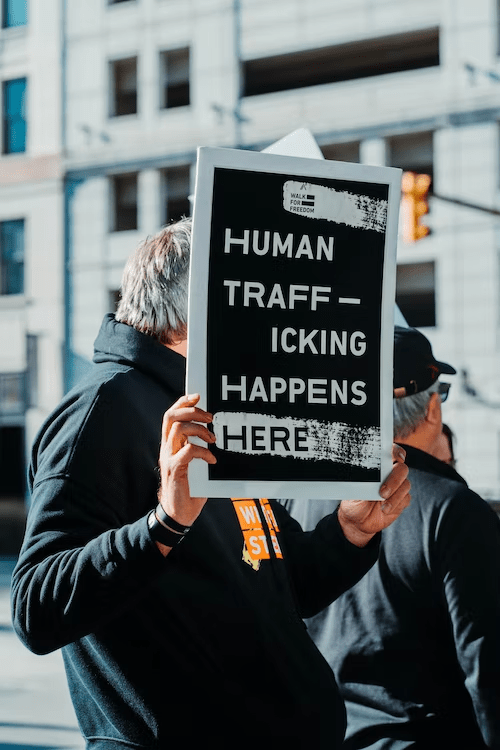
It’s no secret that human trafficking is an issue that must be dealt with. Human trafficking involves the use of force, fraud or coercion to transport persons across international borders or within countries to exploit them for labor or sex.[1] The International Labour Organization estimates that 40.3 million people are victims of human trafficking.[2] These statistics mean that on any given day over 40 million people are being trafficked for the purposes of either forced labor or sexual exploitation. Sex trafficking has dominated headlines in the 21st century, and rightly so, since UN reports stipulate that 50 percent of detected human trafficking victims were sex trafficked. [3]Additionally, over 38 percent of detected victims were trafficked for forced labor purposes.[4] These alarming
figures are a wakeup call for the international community, leading to the 2030 Sustainable Development Goals (SDGs) which are committed to ending modern slavery and human trafficking by the year 2030.[5] There have also been several initiatives to combat human trafficking such as the Palermo Protocols and the 2014 protocol to the Forced Labour Convention (1930).[6] The Palermo Protocols are more focused on combating human trafficking with two of the three protocols being focused on trafficking, while the 2014 Forced Labor Protocol is focused on combating forced labor trafficking and “slavery-like practices”. [7] [8]
It is worth noting that trafficking crimes are actionable under customary international law, even when asserted against private actors.[9] Since they are actionable crimes, the United Nations Office on Drugs and Crime has the right to enact measures against these crimes. However, despite these ambitious goals and protocols, there have been notable lapses in enforcing the crime on the international scale. Behavior from states following these protocols suggests that they usually attempt to address trafficking from either an immigration perspective or from a solely criminal perspective, which is limiting.[10] This is a cause for concern since, with a multifaceted issue such as human trafficking, the implementation of all possible international initiatives to combat trafficking is a priority. One legal instrument that could help facilitate the enforcement of international human trafficking would be a human rights-based approach to help tackle the issue via the establishment of ad hoc tribunals. The main argument put forth by this piece will be to suggest that human trafficking is a crime against humanity, and that the creation of an ad hoc tribunal operating under the Forced Labour Convention (1930) would likely have a positive immediate impact on efforts to enforce the law on human trafficking.
Methodology
This piece will discuss this issue in three parts. The first part will use three places as case studies to describe the large scale nature of the human rights atrocities that are occurring which are also facilitating human trafficking, making the issue of persecuting human trafficking a human rights concern. The second part will argue that human trafficking should be a crime against humanity and can likely be brought forth to the ICC. However realistically this may not happen considering the nature of the ICC. The third part will discuss the importance of creating ad hoc tribunals under the framework of the Forced Labor Convention of 1930 to combat human trafficking. Arguably this will help set further precedent to make sure it is a crime against humanity under Article 7 of the Rome Statute and therefore actionable by the ICC.
I. Modern Trafficking Issues
The reason it is important to discuss modern trafficking is show that human trafficking is a pressing issue. Framing both human rights abuses and human trafficking in context with one another will allow us to investigate the relationship between the two. This will allow us to see strong correlations between human rights atrocities and human trafficking, setting up the discussion as to how human trafficking is essentially a crime against humanity. In order to further this discussion several modern human rights abuses will be examined to show how they have facilitated the rise of human trafficking on an international scale. The first example will be the Rohingya genocide perpetuated by Myanmar; the second example will describe the human trafficking occurring to fund Boko Harams terrorism; thirdly we will describe the rise of human trafficking in Libya after the Libyan Revolutionary War. These examples will further the argument that human trafficking should be seen as a crime against humanity due to the endemic rise of various atrocities occurring in the world. It’s important to note that these are not the only instances of large scale international human trafficking. There are plenty of examples across the world that could help further the discussion.[11] [12] [13] These particular nations were selected due to the lack of enforcement found within their jurisdictions.
A. The Ethnic Cleansing of The Rohingya in Myanmar
The Southeast Asian nation of Myanmar has recently ramped up its campaign of discrimination and violent persecution of the Rohingya peoples.[14] The Rohingya are an ethnic minority in Myanmar and differ from the majority in several ways.[15] The main difference is that the Rohingya commonly practice Islam while the majority practice Buddhism.[16] Additionally, the Rohingya have a different physical racial makeup then the majority. [17] The first major instances of state sponsored persecution of the Rohingya can be traced back to
the Nationality Law of Myanmar.[18] [19] This piece of legislation was enacted in October 15th, 1982 and basically rendered the Rohingya stateless, making them eligible for state prosecution since they did not fall under the 135 “national races”. [20] [21] That meant they had no rights in the eyes of the Myanmar Government. Over time there was systematic persecution of the Rohingya, cumulating into the eventual 2012 pogroms against the ethnic minority.[22] The state of Myanmar has also been accused of requiring the Rohingyas to perform forced labor.[23] According to the Special Rapporteur on the Situation of Human Rights in Myanmar, the military has been making use of forced labor, since they have been lacking in labor resources.[24] Additionally, the government has been involved in the enslavement and trafficking of the Rohingya in Myanmar, with the Rohingya being forced to participate in the construction of various government projects.[25] Men and boys are arbitrarily picked up and are forced to immediately follow the authorities to the construction sites.[26] Rejecting these forced labor demands often results in killings, torture and rape of other family members unless the person concerned pays financial compensation to the authorities.[27]

The atrocities in Myanmar have forced residents to flee the area to avoid prosecution.[28] Unfortunately, this has led human traffickers to prey on the vulnerability of Rohingyan refugees. For example, families have been selling their children to labor and sex traffickers to raise money.[29] So far in Bangladeshi refugee camps at least more than 1,000 individuals have been identified as victims of human trafficking.[30] Further, there is evidence to suggest that officials in Thailand and Malaysia have actively participated in the trafficking of the Rohingya when they attempt to seek asylum.[31] This has resulted in countless numbers of Rohingya being trafficked for the purposes of forced labor and prostitution. According to victim’s stories, several hundred Rohingya have been deprived of their liberty by traffickers and tortured while extorted for money.[32] The Rohingya case shows us how intertwined human rights atrocities such as genocide can incentivize human trafficking of the persecuted group. Not only will the oppressors attempt to traffic the vulnerable population, but other nefarious actors will attempt to capitalize on the situation.[33]
B. Boko Haram: Funding Terrorism Through Human Trafficking
Boko Haram is a terrorist organization founded in Nigeria in the 20th century.[34] Boko Haram’s terroristic operations have been mostly focused within northeastern Nigeria and other contiguous countries such as Chad, Niger, and Cameroon. Its ideology has been centered around the teachings of Mohamed Marwa who expressed the abandonment of all western ideology, declaring that the Quran is the only book that should be read.[35] Overtime the group has become notorious for trafficking women and children for the purposes of forced marriages, forced labor, military conscription and selling victims to the highest bidder in order to finance their ideological goals.[36] Boko Haram has begun operating “baby farms.” A baby farm is where women who are trafficked have babies, and those babies are then sold to people for a profit.[37] Philip Obaji reports that “women and girls are held captive to deliver babies who are then sold illegally to adoptive parents, forced into child labor, trafficked into prostitution or, as several reports suggest, ritually killed”.[38] Prosecuting Boko Haram’s human trafficking activity has proved difficult, despite Nigerian anti-trafficking laws.[39] This can largely be attributed to enforcement issues such as the lack of funding, corruption, and inappropriate application of trafficking law by the judiciary.[40] If Nigeria cannot properly prosecute Boko Haram for their human trafficking operations, perhaps an international tribunal especially dedicated to handle these matters would prove beneficial.[41]
C. The Horrific Effects of the Libyan Revolution
Libya has gone through major institutional reforms since the fall of Muammar Gaddafi. [42] Though the revolution was supposed to liberalize Libya, the opposite seems to have occurred. After the revolution there has been a lack of institutional capacity and enforcement of human trafficking laws.[43] The current administration that is in power has failed to facilitate a fully functioning judicial system and enforcement agencies. [44] This has resulted in extrajudicial proceedings maintained and enforced by armed bans of militants.[45] These “enforcers” have committed a plethora of human rights abuses ranging from unlawful killing, forcible military recruitment, forced labor, and human trafficking.[46] Trafficking victims have included both adults and children who are vulnerable to the instability and violence that is occurring within Libya.[47] Furthermore, refugees from Sub-Saharan Africa looking to enter Europe through Libya have been subject to human trafficking, in some instances these venerable refugees are trafficked for forced labor or into prostitution.[48] These atrocities were made infamous after a couple of videos showing chained people being sold in an auction reminiscent of the times of the Trans-Atlantic slave trade were widely publicized in mainstream media outlets in the western world[49]. To this day the government of Libya has not provided any reports on prosecuting or convicting any individuals on the grounds of human trafficking.[50] Additionally, the government has no programs that encourage victims to participate in investigations and prosecutions against their traffickers.[51] This is problematic since Libya is a signatory of the Convention Concerning Forced or Compulsory Labour (1930).[52] This begs the question of what institutions will hold these people accountable for committing these atrocities when the domestic instutions fail to fulfill their obligations on international human trafficking and forced labor agreements?
II. Human Trafficking: A Crime Against Humanity Under Article 7 of The Rome Statute?
Because human trafficking has proven to be a persistent problem for the international community, it should be recognized as a crime against humanity. There has been a fair amount of scholarship advocating for human trafficking to be a crime against humanity.[53] For example scholar Tomoya Obokata has noted that “trafficking… is not an ordinary crime with transnational dimensions. It has increasingly been recognized that trafficking can rank among the ‚most serious crimes of concern to the international community as a whole‘or delict juris gentium.” [54] Furthermore, he notes that in the context of human trafficking , subsequent exploitation can be regarded as slavery which would mean that trafficking would be a crime against humanity under Article 7 of the Rome Statute. [55] This is significant since the Rome Statute established the jurisdictional parameters of the International Criminal Court.[56] Further state actors are not the only people that can be prosecuted under the ICC. Courts have noted that criminal gangs and other organized groups can also be prosecuted.[57] Furthermore, the opinion in Prosecutor v.Kunarac, decided by the International Criminal Tribunal for the Former Yugoslavia, held that “ the duration of the suspected exercise of powers attaching to the right of ownership is another factor that may be considered when determining whether someone was enslaved’”.[58] On its face the durational acknowledgement by the court seems to insinuate human trafficking is a crime against humanity under the umbrella of “enslavement” under article 7 of the Rome Statute since human traffickers exercise control over a victim to perform forced labor or sex acts.[59] But the court notes that the buying, selling, or trading in humans, although an important factor to be taken into consideration, is in itself insufficient in determining whether or not that enslavement has been committed.[60] This is a problematic narrowing by the court. In order for human trafficking to become a crime against humanity under Article 7 of the Rome Statute, human trafficking would need to fall under the definition of enslavement which requires a higher level of scrutiny since “buying, selling, and trading of humans” is insufficient to prove that a crime was enslavement, according to the Kunarac court.[61] Therefore, it is paramount that human trafficking be enumerated within the Article 7 of the Rome Statute as a crime against humanity itself. The United Nations defines human trafficking as the recruitment, transportation, transfer, harboring, or receipt of persons by improper means (such as force, abduction, fraud, or coercion) for an improper purpose including forced labor or sexual exploitation, this exact definition would render the “buying, selling, and trading” of humans as crime against humanity itself had human trafficking been enumerated within Article 7 of the Rome Statute. [62] However, despite the validity of these arguments it would take a significant lobbying effort to get such a measure passed.[63]
Though all of the above may be true it is unlikely that the Rome Statute would be amended to include human trafficking within Article 7 anytime soon. Further, there are large number of nations who are not signatories of the Rome Statute, so even if human trafficking were to become a crime against humanity 43 of nations would not fall under the jurisdiction of the ICC.[64] Hypothetically these nations could become safe harbors for human traffickers. However, if a tribunal was created under an amendment of the Forced Labor Convention 2014 Protocol then arguably proper judicial remedies would be available for human trafficking atrocities that are occurring around the world. Additionally, this tribunal operating under the FLC 2014 protocol could facilitate adjudication for the ICC by setting the appropriate precedent for the ICC. History has proven that past tribunals have been instrumental in how the ICC has proceeded in its present case load. For example, the first case tried by the ICTY was Prosecutor v. Tadic. In that case the main argument Tadic had was that the court lacked jurisdiction since neither he nor Serbia ever consented to the jurisdiction of the court.[65] Proponents for the ineffectiveness of this international tribunal likely found tremendous merit in Tadic’s argument. Thankfully the court was able to assert its jurisdiction by citing prior tribunal precedent, namely the Nuremburg trials and other customary international law; the court was able to carefully dismantle the jurisdictional argument made by Tadic.[66] The court laid the criteria for establishing an International Tribunal which includes the establishment in accordance with proper international standards, the provision of guarantees of fairness, justice, and even-handedness that have been full conformity with internationally recognized human rights instruments.[67] This meant that tribunals like those created in the Tadic case are often endowed with primacy over national courts when enforcement cannot properly occur within a nation’s jurisdiction. The Tadic case provided the precedent for future adjudication for the ICTY, International Criminal Tribunal for Rwanda, and ICC, consistently being cited as the prima facie case that asserts the legitimacy of international courts when dealing with human rights atrocities. Further, since the precedent set in Tadic over 200 war criminals have been fully prosecuted under the law in international courts. Though more could always be done in regards to adjudication of international crimes in international tribunals, there has been considerable progress in regards to adjudication of crimes on the international scale. Let’s remember international courts are relatively young and need more time to fully develop their potential. After all national courts often go through a similar “infancy” stage. For example, it took the US judiciary years after its inception to develop judicial review and the idea of substantive due process.[68] [69] In light of the effectiveness of international tribunals that I have outlined, another tribunal focused on combating human trafficking would likely be effective and would not be hindered by challenges to its jurisdiction.
III. Ad Hoc Tribunals That Enforce the Forced Labor Convention Would Be An Effective Way to Counter Human Trafficking When National Courts Lack the Capacity to Enforce Anti Trafficking Laws
A. The Case for an Additional Amendment to the FLC 2014
The FLC 2014 protocol puts an obligation on states to “provide protection and appropriate remedies, including compensation, to victims of forced labour and to sanction the perpetrators of forced labour.[70] It also obligates states parties to develop “a national policy and plan of action for the effective and sustained suppression of forced or compulsory labour”. [71] Considering the aforementioned case studies this has not significantly deterred human trafficking in areas where enforcement is minimal to say the least. The protocol could be further amended to include a provision which makes the failure to uphold the FLC 2014 protocol a trigger for an investigation and if ineffective implementation is found then an ad hoc tribunal would be created to make sure that the protocol is enforced via adjudication. Furthermore, a provision could be included to allow voluntary investigations, allowing nations that do not have the enforcement/ adjudicatory capacity to call upon an ad hoc tribunal to deal with a matter a national court may no be equipped to handle. The option for voluntary investigations is important considering the fact that a large amount of the ICC’s cases have come from self-referrals. [72] Often people criticize the ICC for selective enforcement, particularly in Africa. However, most of the ICC’s jurisdiction in Africa comes from self-referrals.[73] These provisions would be necessary in order to create a court that could handle human trafficking crimes on the on international scale. The main reason the FLC would be the proper vehicle to facilitate adjudication of international human trafficking is because of its broad mission to “suppress the use of forced labour in all its forms irrespective of the nature of the work or the sector of activity in which it may be performed”.[74] This would include both forced labor and sex trafficking. Additionally, all but fifteen nations have ratified the 1930 FLC convention, which makes it a powerful legal instrument on the international scale. Additionally, the 2014 protocol was approved with 437 votes in favor and 8 against (each member state has 3 votes).
B. Consistent Enforcement
If an ad hoc tribunal provision were to be promulgated under the FLC of 1930 then we could expect consistent enforcement of norms against human trafficking, especially in nations that have had issues with the rule of law. For example, the Democratic Republic of Congo and Mali have had trouble prosecuting war criminals and invited the ICC via self-referral to ensure that crimes against humanity are being punished in a consistent fashion. [75] [76]. Scholars have noted that consistency of enforcing international human rights principles is one of the primary factors for establishing the rule of law within a region. [77] Establishing an ad hoc tribunal in places where human trafficking enforcement has been substandard, for example in Libya and Nigeria, would be a proper step forward in combating human trafficking.
C. General Deterrence
Furthermore, the ad hoc tribunal could serve as a symbolic deterrent since, if there is an active tribunal prosecuting human trafficking cases, potential perpetrators would be deterred for fear of prosecution. Though the deterrent effect of international tribunals is a contentious topic within international legal scholarship, there is evidence to suggest that the ICC does have a deterrent effect.[78] For example, in the Democratic Republic of the Congo, there is evidence that ICC prosecutions are having at least some impact on the militaristic behavior of troop commanders. Media reports from the region have highlighted that a significant number of ex-combatants have noticed a modification in the behavior of rebel commanders which have been designed to avoid the possibility of ICC prosecution. This phenomena has been noted in the region of Ituri, which has been the focus of the ICC’s investigative and prosecutorial activities.[79] Furthermore, after the ICC expressed interest in investigating Colombia for crime against humanity, the government subsequently took measures to promulgate laws that made sure their officers were not committing war crimes and crimes against humanity. Investigations by the Crisis Group have noted that:
“The threat of ICC prosecution appears to not only have influenced the calculations of the Colombian government – including former President Pastrana who, according to cables published by Wikileaks, expressed (unwarranted) concern that he may be prosecuted by the ICC for his actions while in power from 1998-2002 – but also by key rebels. And at least one of the leading paramilitary leaders, Vincente Castrano (AUC), was apparently sharply aware and fearful of the possibility of ICC prosecution, a fear that reportedly directly contributed to his demobilisation.”[80]
Though opponents of the ICC’s deterrent effect are plenty, the main argument against the ICC is for “specific deterrence” which is not the kind of deterrence this paper is discussing. [81] Rather this paper is concerned with “general deterance”. General deterrence focuses more on educating the general public on the legal ramifications of illegal behavior, rather than just the individual being charged with a crime.[82] The idea is that, if an individual is punished for a crime that was not enforced, the public will be aware of the punishment and be dissuaded from engaging in the same or similar activity.[83] Specific deterrence is variable and can mainly be studied on case by case basis, since specific deterrence emphasizes the deterrent effect on specific individuals charged with crimes. [84]
D. Crystallization of Legal Precedent
Creating an ad hoc tribunal via the FLC of 1930 would also allow for the crystallization of legal precedent on the international scale. Much like how Tadic solidified the jurisdiction of international tribunals, a tribunal specializing on human trafficking issues would be setting the appropriate legal precedent for human trafficking internationally. The merit of that would be that the establishment of legal norms in regard to human trafficking. Nations could use the judgments of the ad hoc tribunal as guides for court rulings, establishment of legislation, and enforcement.[85] There has been a trend for domestic courts to rely on international law and cases as guiding principless that influence court rulings, most notably in Asian nations.[86] Furthermore, if this ad hoc tribunal were allowed to function it could facilitate the ICC when the ICC is dealing with human trafficking issues. By having systemic pieces of legal precedent solidifying the norms for adjudicating human trafficking on the international scale this could facilitate the crime of human trafficking becoming a crime against humanity under Article 7 of the Rome Statute.
Conclusion
In conclusion, this piece highlighted various human rights abuses around the world that have helped facilitate human trafficking, showing us that the two offences are intertwined. If war crimes or crimes against humanity are occurring then there is the strong likelihood that human trafficking is also occurring. Additionally, the case studies in Myanmar, Nigeria, and Libya have shown us that the issue of human trafficking is a problem that must be dealt with on an international scale due to the failures of enforcement within various regions in the world. Those case studies are not the only instances of large-scale human trafficking operations but are only a few cases across a wide spectrum of human trafficking. The argument that human trafficking should be enumerated as a crime against humanity within the Article 7 of the Rome Statute has merit and should be considered. However, lobbying for such a cause would likely take a considerable amount of time. Having recognized these difficulties, this paper discussed the merits of creating an ad hoc tribunal under the FLC of 1930. Specifically amending the 2014 Protocol under the FLC of 1930 would be the best route to create the necessary triggering mechanisms to create a tribunal that can investigate human trafficking. The benefits of this ad hoc tribunal would be centered around consistent enforcement, deterrence, and the establishment of legal precedent for the prosecution of human trafficking. Though more research needs to be done to analyze the potential negatives of such a measure, the creation of ad hoc tribunals to combat human trafficking would be the right step forward in mitigating the severity of the issue.
[1] “Human Trafficking.” United Nations : Office on Drugs and Crime, https://www.unodc.org/unodc/en/human-trafficking/human-trafficking.html.
[2] Global Estimates of Modern Slavery . International Labour Organization, https://www.ilo.org/wcmsp5/groups/public/—dgreports/—dcomm/documents/publication/wcms_575479.pdf.
[3] “Covid-19 Seen Worsening Overall Trend in Human Trafficking.” United Nations: Office on Drugs and Crime, https://www.unodc.org/unodc/frontpage/2021/February/share-of-children-among-trafficking-victimsincreases–boys-five-times-covid-19-seen-worsening-overall-trend-in-human-trafficking–says-unodc-report.html.
[4] Id.
[5] Id.
[6] Id.
[7] “Protocol to Prevent, Suppress and Punish Trafficking in Persons Especially Women and Children, Supplementing the United Nations Convention against Transnational Organized Crime.” OHCHR, https://www.ohchr.org/en/instruments-mechanisms/instruments/protocol-prevent-suppress-and-punish-trafficking-persons.
[8] “Forced Labour Convention, 1930 (No. 29).” Convention C029 – Forced Labour Convention, 1930 (No. 29), https://www.ilo.org/dyn/normlex/en/f?p=NORMLEXPUB%3A12100%3A0%3A%3ANO%3A%3AP12100_ILO_CODE%3AC029.
[9] See Doe v. Nestle USA, Inc., 766 F.3d 1013, 1022 (9th Cir. 2014); Abdullahi v. Pfizer, Inc., 562 F.3d 163, 206, 64 A.L.R. Fed. 2d 685 (2d Cir. 2009)
[10]“International Instruments Concerning Trafficking in Persons.” United Nations Human Rights Office of The High Commissioner , Aug. 2014, https://www.ohchr.org/sites/default/files/Documents/Issues/Women/WRGS/OnePagers/Maternal_mortality_morbidity.pdf.
[11] https://borgenproject.org/human-trafficking-in-peru/ Peruvian Trafficking
[12] https://www.state.gov/reports/2021-trafficking-in-persons-report/liberia/ The Government of Liberia does not fully meet the minimum standards for the elimination of trafficking but is making significant efforts to do so. These efforts included opening a new shelter for child trafficking victims, initiating an investigation into a high-profile labor trafficking case in cooperation with foreign governments, and allocating funding to NGOs to conduct awareness raising campaigns.
[13] https://www.state.gov/reports/2020-trafficking-in-persons-report/ukraine/ noting that traffickers kidnap women and girls from conflict-affected areas for sex and labor trafficking in Ukraine and Russia. Traffickers targeted internally displaced persons and subjected some Ukrainians to forced labor on territory not under government control, often via kidnapping, torture, and extortion.
[14] Rohingya. Human Rights Watch, 7 June 2021, https://www.hrw.org/tag/rohingya.
[15] Id.
[16] Id.
[17] Id.
[19] See Burma Citizenship Law , 15 October 1982, https://www.refworld.org/docid/3ae6b4f71b.html
[20] “Burma Citizenship Act.” Religion and Public Life at Harvard Divinity School, https://rpl.hds.harvard.edu/faq/burma-citizenship-act.
[21] See Burma Citizenship Law , 15 October 1982, https://www.refworld.org/docid/3ae6b4f71b.html
[22] “Burma’s Path to Genocide.” United States Holocaust Memorial , https://exhibitions.ushmm.org/burmas-path-to-genocide/timeline.
[23] “Myanmar: Ongoing Human Rights Violations Against Rohingya.” Fortify Rights, 5 Nov. 2020, https://www.fortifyrights.org/mya-inv-2019-12-07/.
[24] “Special Rapporteur on the Situation of Human Rights in Myanmar.” OHCHR, 21 Mar. 2022, https://www.ohchr.org/en/special-procedures/sr-myanmar.
[25] Id.
[26] Haraldsen, Janne. Human Trafficking as a Crime Against Humanity . University of Osolo, https://www.duo.uio.no/bitstream/handle/10852/40117/LLM-PIL-THESIS-MAY-2014.pdf?sequence=1.
[27] Id.
[28] Id.
[29] Ferrie, Jared. “U.N. Says Rohingya Refugee Girls Sold Into Forced Labor in Bangladesh.” Reuters, Thomson Reuters, 17 Oct. 2018, https://www.reuters.com/article/us-bangladesh-refugees-trafficking/u-n-says-rohingya-refugee-girls-sold-into-forced-labor-in-bangladesh-idUSKCN1MR15Z.
[31] Belford, Aubrey. “Rohingya Refugees Say Traffickers in Malaysia Abuse and Kill.” Reuters, Thomson Reuters, 28 Jan. 2015, https://www.reuters.com/article/myanmar-malaysia-rohingya/rohingya-refugees-say-traffickers-in-malaysia-abuse-and-kill-idINKBN0L12MF20150128
[33] Shishir, Nazmun Naher. “Human Traffickers Prey on Rohingya Refugees.” The Third Pole, 12 Jan. 2022, https://www.thethirdpole.net/en/livelihoods/human-traffickers-prey-on-rohingya-refugees/.
[34] Nctc. “National Counterterrorism Center: Groups.” National Counterterrorism Center | Groups, https://www.dni.gov/nctc/groups/boko_haram.html.
[35] Id.
[36] “Nigeria: Tier 2 Watch List.” U.S. Department of State, U.S. Department of State, 1 Dec. 2020, https://www.state.gov/reports/2020-trafficking-in-persons-report/nigeria/.
[37] Philip Obaji Jr. “Survivors of Nigeria’s ‘Baby Factories’ Share Their Stories.” Human Trafficking | Al Jazeera, Al Jazeera, 3 May 2020, https://www.aljazeera.com/features/2020/5/3/survivors-of-nigerias-baby-factories-share-their-stories.
[39] “NIGERIA: Tier 2 Watch List.” U.S. Department of State, U.S. Department of State, 1 Dec. 2020, https://www.state.gov/reports/2020-trafficking-in-persons-report/nigeria/.
[40] Id.
[41] Id.
[42]Vanessa A. Arslanian, Beyond Revolution: Ending Lawlessness and Impunity During Revolutionary Periods, 36 B.C. Int’l & Comp. L. Rev. 121, 125 (2013) noting that “leaders seek a return to pre-Gaddafi federalism, and demand their own legislature, courts, and police. Such increased demand for regional autonomy threatens the NTC’s plan to form a constituent assembly
[43] “2021 Trafficking in Persons Report: Libya.” U.S. Department of State, U.S. Department of State, 5 Aug. 2021, https://www.state.gov/reports/2021-trafficking-in-persons-report/libya/.
[44] Id.
[45] Id.
[46] Id.
[47] Id.
[48] Id.
[49] https://www.bbc.com/news/world-africa-42038451
[50] “2021 Trafficking in Persons Report: Libya.” U.S. Department of State, U.S. Department of State, 5 Aug. 2021, https://www.state.gov/reports/2021-trafficking-in-persons-report/libya/.
[51] “2019 Trafficking in Persons Report – Libya.” U.S. Embassy in Libya, 20 June 2019, https://ly.usembassy.gov/2019-trafficking-in-persons-report-libya/.
[52] “ILO Ratifications for Libya.” Ratifications of ILO Conventions: Ratifications for Libya, https://www.ilo.org/dyn/normlex/en/f?p=NORMLEXPUB%3A11200%3A0%3A%3ANO%3A%3AP11200_COUNTRY_ID%3A103130.
[53] Haraldsen, Janne. Human Trafficking as a Crime Against Humanity . University of Osolo, https://www.duo.uio.no/bitstream/handle/10852/40117/LLM-PIL-THESIS-MAY-2014.pdf?sequence=1.
[54] Tom Obokata, Trafficking of Human Beings as a Crime against Humanity: Some Implications for the International Legal System, 2005, vol. 54, no. 2, pp. 445–457.
[55] Id.
[56] See Rome Statute
[57] See 53rd International Law Commission ‘Opinion of the International Law Commission work of its 43rd Session’ 1991 ILC Report 266. which stipulates that a crime again committed ‘in a systematic manner or on a large scale and instigated or directed by or by any organization or group.’the ILC states on direction of a Government or any organization or group, which may or may not be afflicted with a Government, can be a crime against humanity.
[58] Prosecutor v. Kunarac, Nos. IT–96–23 ¶ 58 (Int’l Crim. Trib. for the Former Yugoslavia June 12, 2002)
[59] Traffickers target victims using tailored methods of recruitment and control they find to be effective in compelling that individual into forced labor or commercial sex.
[60] See Prosecutor v. Kunarac, Nos. IT–96–23 ¶ 58 (Int’l Crim. Trib. for the Former Yugoslavia June 12, 2002) the court noting that: “The Prosecutor also submitted that the mere ability to buy, sell, trade or inherit a person or his or her labours or services could be a relevant factor. The Trial Chamber considers that the mere ability to do so is insufficient, such actions actually occurring could be a relevant factor”
[61] Id.
[62] “Human Trafficking.” United Nations : Office on Drugs and Crime, https://www.unodc.org/unodc/en/human-trafficking/human-trafficking.html.
[63] See Articles 121(3), (4), and (6) of the Rome Statute of the International Criminal Court. Amending Rome Statute would necessity a two thirds majority of the 123 signatories. The process of inclusion into the Rome Statute has 4 stages: proposal, admissibility, amendment, ratification. Further after a year it is amended another seven eighths must ratify for it to come into force for all state parties.
[64] “The States Parties to the Rome Statute.” International Criminal Court, https://asp.icc-cpi.int/states-parties.
[65] See Prosecutor v. Tadić, Case No. IT–94–1 (App. Chambers Oct. 2, 1995)
[66] Id.
[67] Id.
[68] See Marbury v. Madison, 5 U.S. 137, 137, 2 L. Ed. 60 (1803) which developed the standard of Judicial Review h
[69]See Lochner v. New York, 198 U.S. 45, 25 S. Ct. 539, 49 L. Ed. 937 (1905), overruled in part by Day-Brite Lighting Inc. v. State of Mo., 342 U.S. 421, 72 S. Ct. 405, 96 L. Ed. 469 (1952), and overruled in part by Ferguson v. Skrupa, 372 U.S. 726, 83 S. Ct. 1028, 10 L. Ed. 2d 93 (1963), and abrogated by W. Coast Hotel Co. v. Parrish, 300 U.S. 379, 57 S. Ct. 578, 81 L. Ed. 703 (1937); Adair v. United States, 208 U.S. 161, 167, 28 S. Ct. 277, 277, 52 L. Ed. 436 (1908), overruled in part by Phelps Dodge Corp. v. N.L.R.B., 313 U.S. 177, 61 S. Ct. 845, 85 L. Ed. 1271 (1941) which helped refine the notions of substantive due process
[70]See Ratifications of P029 – Protocol of 2014 to the Forced Labour Convention, 1930
https://www.ilo.org/dyn/normlex/en/f?p=NORMLEXPUB:11300:0::NO::P11300_INSTRUMENT_ID:3174672
[71] Id.
[72] Lorien Giles. “The Future of Self-Referrals to the ICC: A Path to Greater Legitimacy with State Parties and the International Community.” The International Criminal Court Forum, https://iccforum.com/forum/permalink/113/31219.
[73] Patricia Hobbs “The Catalysing Effect of the Rome Statute in Africa: Positive Complementarity and Self-Referrals.” Springer Netherlands, 2 June 2020, https://link.springer.com/article/10.1007/s10609-020-09398-7.
[74] See Article 2 of Forced Labor Convention of 1932
[75] Democratic Republic of Congo. Coalition for the International Criminal Court, 11 Apr. 2002, https://www.coalitionfortheicc.org/country/democratic-republic-congo#:~:text=Unable%20to%20bring%20the%20perpetrators,to%20the%20ICC%20in%202004.&text=In%20April%202004%2C%20DRC%20invited,armed%20conflict%20in%20its%20territory.
[76] 2012 Mali Self Referral. ABA Center for Human Rights, 3 Aug. 2017, https://how-the-icc-works.aba-icc.org/cases/2012-mali-referral/.
[77] Overview – Rule of Law. Overview – Rule of Law, https://www.uscourts.gov/educational-resources/educational-activities/overview-rule-law.
[78] Nick Grono & Anna de Courcy Wheeler. “The Deterrent Effect of the ICC on The Commission of International Crimes by Government Leaders.” Crisis Group, 28 Dec. 2016, https://www.crisisgroup.org/global/deterrent-effect-icc-commission-international-crimes-government-leaders.
[80] Id
[81] John Dietrich. The Limited Prospects of Deterrence by the International Criminal Court: Lessons from Domestic Experience. International Social Science Review, https://www.jstor.org/stable/intesociscierevi.88.3.03.
[82] Stafford , Mark, and Mark Warr. Reconceptualization of General and Specific Deterrence. Journal of Research in Crime and Delinquency, https://www.ojp.gov/ncjrs/virtual-library/abstracts/reconceptualization-general-and-specific-deterrence.
[84] Id.
[85] Sloss, David, and Michael Van Alstine. International Law in Domestic Courts . Santa Clara Law Digital Commons, https://digitalcommons.law.scu.edu/cgi/viewcontent.cgi?article=1891&context=facpubs.
[86] Venkatachala Hegde. “International Law in the Courts of India.” Asian Yearbook of International Law, Volume 19 (2013), 2018, pp. 63–87., https://doi.org/10.1163/9789004379756_003.
 Sermo Civilis