
Full Disclosure: I am not advocating Marxism, Neoliberal capitalism, or Communism. I disagree with Marxist ideology but it has been influential on the political scene.
My understanding of Marxism was influenced by lectures taken by me at Rutgers by Professor Sam Carter, an analytic philosopher with degrees from Oxford &Edinburgh. His research at Rutgers is conducted in linguistics and higher order logic. His work can be found here: https://www.samjbcarter.com/
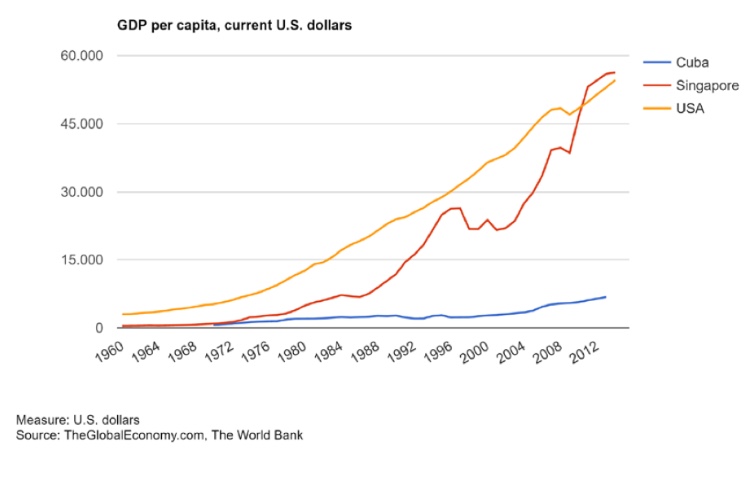
This article will discuss how one of the founding fathers of Singapore, Lee Kuan Yew, was influenced by Marxist notions of the relations of production have helped Singapore’s economy since the 1950’s. Pioneering leaders, such as Lee Kuan Yew have pushed towards reform specifically targeting the relations of production in order to create economic prosperity in the nation. Arguably, it’s Yew’s Marxist influence which allowed him to actualize a form of state capitalism never before seen in Singapore.
Yew was not an ardent communist as leader of Singapore but may have been influenced by his early encounters with the ideology as a youth. Lee was influenced by a Marxist organization called the Fabian Society in his youth. He asserted that “cooperation and competition between people” which he believed was a compromise between communism which relied too much on collectivism, and capitalism which he considered to rely too much on competition. This lead his focus on the plights of poor people in Singapore, allowing him to create favorably economic conditions for his constituents. This form of capitalism has allowed Singapore to outperform the USA in terms of Neoliberal economics used and popularized by the USA. This is the case because it’s clear that Singapore’s economic rise can be directly correlated to the enfranchisement of its working class and the use of various financial instruments popularized by Wall Street. And that was only possible via reforms that looked to reorganize certain relations of production. Specifically, reorganization was possible via the establishment of the Central Provident Fund. The reason why the Central Provident Fund was so important in changing the relations of production was that it enfranchised Singapore’s citizens in terms of healthcare, housing, and other financial means- enabling Singapore’s economy to grow at an exponential rate. But this enfranchisement didn’t come in the form of a “hand out”, rather it incentivized productivity and entrepreneurship.

In order to understand Singapore’s exponential economic rise under a Marxist framework, a few Marxist terms Lee was likely familiar with must defined. These definitions will act as reference points which allow for a clear understanding on how Lee’s early exposure to Marxist ideology may have played a role in Singapore’s state capitalism. One of the fundamental Marxist notions that needs to be analyzed is the phrase “subsistence needs”. Arguably, it is nearly impossible to understand Karl Marx’s writings without defining this core phrase. Mainly, because Marx believes that without understanding that phrase, accurately conceptualizing how humans organize their material lives would be difficult. Marx emphasizes this point by saying that humans:
“…begin to distinguish themselves from animals as soon as they begin to produce their means of subsistence, a step which is conditioned by their physical organization. By producing their means of subsistence men are indirectly producing their actual material life.” (Marx German Ideology sec: A. Idealism and Materialism).
So clearly it’s an important definition because defining what a societies subsistence needs exactly are will give valuable insight on the physical organization of that society. Naturally, the next question ought to be: what are human subsistence needs? One could reason that human subsistence needs are reflective of natural human impulses. And it’s these impulses which drive humans to organize themselves the way they do. Furthermore, Marx seems to give insight on what these “human impulses” are, claiming that humans meet their subsistence needs via biological means (eating, drinking, delaying death etc) and cultivating individual gifts, and that is all done because humans have a natural tendency to do things for the community ( Marx German Ideology sec: D. Proletarians and Communism). This is important to the discussion regarding Singapore’s economic development because the way Singapore’s government institutions decided to improve their society was to make sure certain subsistence’s needs were facilitated and guaranteed to their citizenry. Under a Marxist framework, one can observe how Singapore addressed these subsistence needs of its populous by observing the societies relations of production.
The second and final term that needs to be properly analyzed is the phrase relations of production. For Marx, the relations of production seemed to serve as an important part of analysis in terms of understanding a particular society. The reason he thought this can be best explained by Marx:
“The totality of these relations of production constitutes the economic structure of society, the real foundation, on which arises a legal and political superstructure and to which correspond definite forms of social consciousness.” (Marx A Contribution to the Critique of Political Economy sec Preface).
So in essence the relations of productions for Marx are a reflection of a number of things such as: the economy, law, and political climate. The reason that Marx thinks the relation of production can provide an adequate description of society is due to the fact that it describes individuals’ relationship with productive forces. Mainly, he seems to pay close attention to who exactly owns these productive forces, because for Marx that determines how a particular society is organized. A brief excerpt from Marx’s magnus opus, Das Kapital allows for a more thorough explanation on the topic of relations of production:
“The latter is as much a production process of material conditions of human life as a process taking place under specific historical and economic production relations, producing and reproducing these production relations themselves, and thereby also the bearers of this process, their material conditions of existence and their mutual relations…their particular socio-economic form. For the aggregate of these relations, in which the agents of this production stand with respect to Nature and to one another, and in which they produce, is precisely society…”
The prose used by Marx gives insight on the importance of the relations of production if one is to fully grasp society via a Marxist framework. So, in order to understand Singapore’s economic rise under Marxist terms, we need to look at Singapore’s relations of production. But in order to do that a brief history of Singapore’s economic development must be discussed.
Singapore: A Brief Economic History.
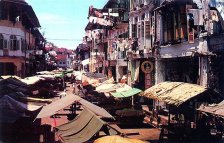
Though Singapore has a rich history stretching back to antiquity, this work will focus on modern developments. Specifically, the scope will be limited to Singapore’s development from the mid-20th century to our present day. The two main reasons for that are: the data from this period is extensive, and this is the period Singapore’s contemporary national identity comes to fruition. Singapore’s story beings in 1965, after Malaysia expelled them from their political union via parliamentary resolution, due to growing racial tension that was perceived as directly undermining the Malaysian economy. (US Library of Congress). After this forced independence, Singapore immediately found itself in a fiscally disadvantaged situation. The situation for the citizenry was dismal. Over 70 percent of households lived in overcrowded communities, a third squatted in shanty towns outside of the urban center, and over half the population was illiterate. (World Bank). Additionally, Singapore faced a heavy influx of immigration before they were kicked out of the Malay political union, further exacerbating the situation. This wave contributed to a high level of unemployment (roughly 15-20%) (World Bank). A visitor living in Singapore during this tumultuous time provides a firsthand account on what this society looked like to him:
“The undercover walkways are usually taken over by hawker stalls and junk. Laundry hangs from poles thrust out of windows above—just like in old Shanghai. This is Singapore, in the early 1970s. We were all devastated at the time—we who didn’t live here. From 1871 to 1931 the city’s Chinese population rose from 100,000 to 500,000. By 1960 it is estimated that more than 500,000 Chinese were living in slum-like conditions—indoors. Equipped with only one kitchen and one bathroom, the shophouses were designed for two extended families at most. After extensive partitioning many of them housed up to 50 individuals.” (Yeo)
It’s worthy to note this person wasn’t in the outskirts where the shanty towns were prevalent. But rather close to the Urban center highlighting the destitute situation a majority of Singaporeans faced. Now this was all going on in the 1960’s-70’s. But now let’s fast forward 50 years, and look at the state of Singapore now.
Contemporary Singapore is far removed from its impoverished past. Their progress is reminiscent and analogous to the Rocky Balboa series. Once a land where
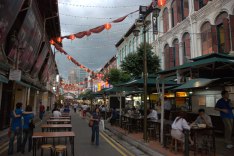
over half the population was illiterate, Singapore now boasts a literacy rate of 96.8% (Knoema). Furthermore, Singapore can take pride in being number one worldwide in terms of educational prowess in math, science and reading (OECD.)Additionally, the unemployment rate has drastically fallen to a staggering 2%. Now comapare that to the world average which falls roughly around 6% (World Bank). And not only that, but roughly 90.7 % of Singaporeans are home owners (Singapore State Government). Comparatively the USA, which is perceived to have a reputable standard in terms of homeownership, has about a 64% rate (US Census). How has the populous of Singapore improved so exponentially? A lot of credit should be given to the population itself. The large majority of the people who immigrated to Singapore in the early days were impoverished and looked to work hard in order to change their circumstances. However, it would be remiss not to mention the contribution of an individual who started at the grassroots level and would end up at the highest office in Singapore’s government, Lee Kuan Yew.
Lee Kuan Yew
It would be disingenuous to talk about Singapore’s meteoric rise without mentioning the contributions of its first prime minister Lee Kuan Yew. He grew up during the Japanese colonial occupation of Singapore which would influence his politics in the coming future. But a specific event would have profound effect on Yew. On his way home from work Yew was randomly ordered by a Japanese guard to join a group of Chinese people who were being round up for a “routine” inspection. Luckily for Yew, he spoke Japanese and was able to convince an Imperial soldier to let him go get a better pair of cloths from home. That “routine” inspection group ended up being the victims of the Sook Ching Massacre, a Japanese atrocity that would cause the deaths of roughly 50,000- 100,000 ethnic Chinese. Yew’s close encounter with Japanese oppression inspired him to say “My colleagues and I are of that generation of young men who went through… the Japanese Occupation and emerged determined that no one…had the right to push and kick us around”(Yeo 87). That sentiment inspired him to enter politics, joining the Communist Party of Malaya, where one can assume he was exposed to terms such as the relations of production and subsistence needs. After a complicated series of events Yew would find himself at the helm of Singapore’s newly independent state, inheriting an economic and humanitarian crisis few would ever want to deal with. But his early Marxist influence may have given him an idea on where to start. That can be argued by analyzing some of the reforms he introduced which set up a solid economic base for Singapore’s population to prosper in the future. But it is worthy to note that Singapore is NOT a Marxist state but rather a state influenced by Marxism.
The Central Provident Fund
In order to tackle the economic crisis that plagued Singapore in the 1960’s sweeping reforms that addressed these economic woes needed to be established. Luckily for Yew he inherited the Central Provident Fund which was created under the old Malay regime in 1955. The CPF was the social security system used by the previous regime as a retirement plan, which was funded via taxes. This fund is owned and controlled by individuals but it allows for a bit more autonomy in terms of where the money from the fund is spent, in comparison to other social security systems. Essentially, it creates a bank account for all of it’s citizens. But at the same time allows citizens to use private banks in conjunction with the CPF. Additionally, the CPF can be seen as a government voucher which allows users to save or spend the capital within it whenever they want. Another difference in social security lies in who is qualified for social security services. That’s because all that’s needed to be eligible for the CPF is Singaporean citizenship (CPF).But when Yew came to power the CPF’s power was limited in scope. However, he must’ve realized the potential of the social security system because his regime greatly expanded it over the years, and in hindsight it paid dividends. That’s because the CPF covers 3 layers of subsistence needs which arguably allow Singapore’s population to focus on other things such as: self-fulfillment, community engagement, or social leisure. The 3 layers that allow that are: Shelter, Health, and Education. Each of these would be addressed via the CPF, but the first expansion of the CPF occurred in 1968 and it aimed to address one of the biggest problems challenging Singapore’s prosperity.
Public Housing Scheme
In 1968 Lee Kuan Yews government was tasked with handling an economic crisis, and one of the first things they decided to address was the housing problem. They did this by expanding the CPF social security apparatus in order to foster viable living conditions, the government also mass produced housing units, which eased the burden felt by the populous during this tumultuous time. (CPF History of CPF). In addition to this, the government made it it’s priority to insure that citizen’s private wages didn’t go into buying houses but rather housing was paid via the CPF (CPF History of CPF). Having said that, this isn’t traditional public housing where the state owns the houses, but rather it insures citizens with an opportunity to become homeowners. That’s possible because the CPF essentially was expanded to act as a state sponsored investment account and as a social security system. When taxes are taken out the funds, they are immediately redistributed to everyone’s CPF account. In addition to that, individuals can choose to contribute more funds to this account via private wages, and if that’s done the private employer is expected to match that amount, similar to 401k schemes in the USA except more full in scope. Moreover, citizens have the option to use their CPF funds as resources to invest in global markets, individuals can invest in low risk accounts or high risk accounts at their discretion. All of these benefits of the CPF enfranchise individuals to become homeowners. These developments explain the aforementioned high percentage of homeowners in Singapore.
Under Marxist terms we can argue that the productive forces in terms of housing were aimed to eventually belong to the people of Singapore. Because when the development first started the government owned the productive forces since they built everything, but over time that debt was paid and individuals owned their houses. Furthermore, they could later sell them to other individuals. In essence, ownership of a house is predicated mainly on citizenship and partly on labor power. The reason it’s partly labor power is because individuals can contribute their private wages to the fund, increasing its value compared to someone who didn’t want to. Reducing the anxiety of shelter must’ve been a much needed relief for the citizenry, allowing them to focus on their own personal endeavors. But that’s not all, the healthcare sector would also be targeted by the CPF leading to further reform in their society.
Medisave
After an economic expansion in the face of the recessions of the early 1980’s, Singapore was able to further improve upon the CPF, guaranteeing yet another subsistence need. They addressed one of the essential parts of subsistence- healthcare. In 1984, the Singaporean government passed legislation which would expand the CPF’s role in its citizens lives. The expansion would be called Medisave. The financial mechanisms used by the CPF to guarantee housing are also used to finance the healthcare sector. At first the funds could only be used for public hospitals but after ample amounts of private economic expansion Medisave was combined with a new model Medishield which allowed CPF funds to be used at private hospitals. Arguably, this new expansion further diminished the worries of the populous. That’s because once subsistence needs are taken care of, people can free up their resources towards other societal endeavors. And certain societal endeavors taken by individuals can also have tremendous effect on the overall economy. More minds can focus on developments in medicine rather than survival. Singapore’s government seems like it incentivizes these private endeavors, and the data can back it up. It ranks number 2 in the index of economic freedom which measure what countries best protect the liberty of individuals to pursue their own economic interests allowing for greater prosperity for society at large (Heritage Foundation). Compare that to the USA, often perceived as the ideal in terms individual economic freedom, who currently ranks 18th . So in Marxist terms it seems as if the government of Singapore wants workers to make and own the productive forces in Singapore. In nontechnical language they want to develop as many entrepreneurs as possible.
In the end, Singapore’s development was exponential. Arguably, one could reason this was influenced by addressing Marxist concepts to improve their economy. Specifically, by addressing subsistence needs Singapore could improve the nations relations of production, effecting greater economic society. They were able to do that with a government financial instrument called the Central Provident Fund, which enabled and incentivized home ownership, entrepreneurship, and other personal endeavors. Though not a communist state, Singapore seems to have tried to help their citizens realize their potential. Capitalism and Marxist techniques have been used hand in hand to increase efficiency in a Neoliberal capitalist system.
Works used:
“Adult Literacy Rate by Countries, 2017.” Knoema, Knoema, knoema.com/atlas/topics/Education/Literacy/Adult-literacy-rate?baseRegion=SG.
“Country Rankings.” The Heritage Foundation, http://www.heritage.org/index/ranking.
“Households – Latest Data.” Singapore Department of Statistics (DOS), http://www.singstat.gov.sg/find-data/search-by-theme/households/households/latest-data.
Huff, W.g. “The Developmental State, Government, and Singapore’s Economic Development since 1960.” World Development, vol. 23, no. 8, 1995, pp. 1421–1438., doi:10.1016/0305-750x(95)00043-c.
“OECD Data.” The OECD, data.oecd.org/.
Yeo, Kim Wah. Political Development in Singapore, 1945-1955. U.P., 1973.
“Das Kapital” “A Contribution to the Critique of Political Economy” & “German Ideology” by Karl Marx
Sago images: Lam Chun See http://goodmorningyesterday.blogspot.com/2005/11/my-memories-of-chinatown-part-1-chu.html
http://www.focussingapore.com/photo-gallery/streets-malls/sago-street/
 Sermo Civilis
One thought on “Singapore’s Economic Rise: A Synthesis of Economic Principals”